The Slow Flowers Podcast is the award-winning show known as the “Voice of the Slow Flowers Movement.” Launched in 2013 as the original flower podcast, we’ve devoted more than 10 years to covering the business of flower farming, floral design, and the Slow Flowers sustainability ethos. Listen to a new episode each Wednesday, available for free download here at slowflowerspodcast.com or on iTunes, Spotify, and other podcast platforms.
Leslie Bennett believes that gardens are for all. In Garden Wonderland, this celebrated landscape designer treats us to an accessible garden-making approach to create our own plant-based spaces, spaces that provide sustenance, beauty, and wonder. Her new book will inspire your own garden journey as you gain more than a pretty landscape and redefine your relationship with nature.
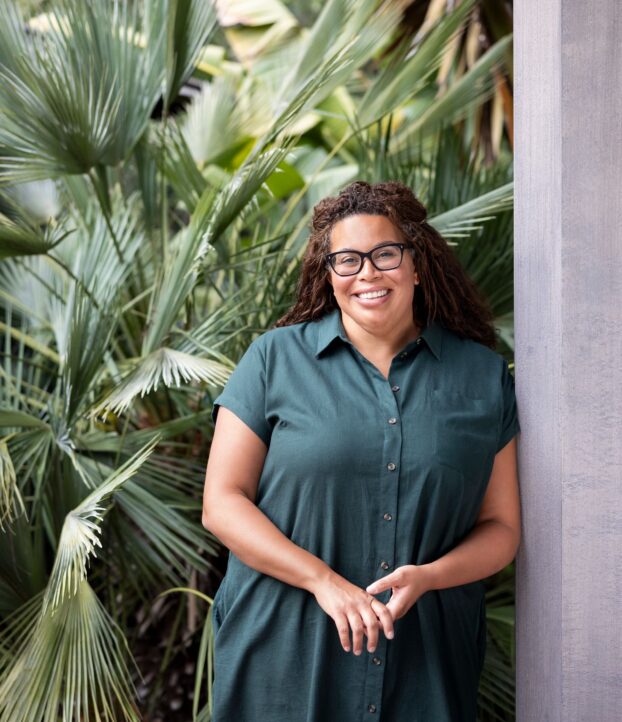
Leslie Bennett of Pine House Edible Gardens (c) Rachel Weill
It is with much personal joy that I welcome back Leslie Bennett to the Slow Flowers Podcast today. As a past guest of the podcast and a speaker at the first Slow Flowers Summit in 2017, many of you already know about this gifted human.
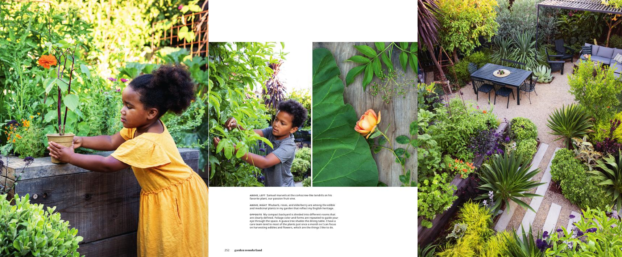
Inside the pages of Garden Wonderland, by Leslie Bennett & Julie Chai (c) Rachel Weill
You probably have read about Pine House Edible Gardens and Leslie’s soulful and soul-fulfilling gardens in top design publications, but now, with her brand new book, Garden Wonderland we can read about Leslie’s garden-making philosophy and principles in her own words. Garden Wonderland is co-authored with Julie Chai and features photography by Rachel Weill.
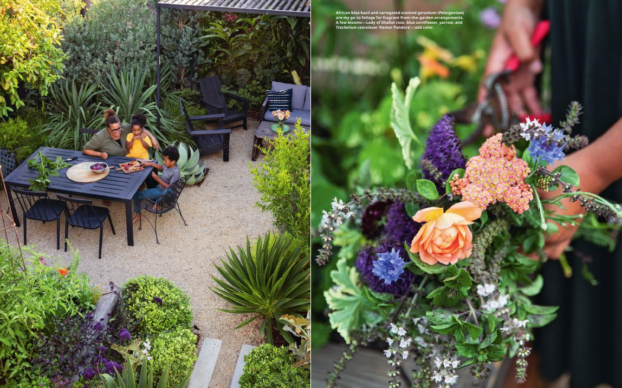
More inside pages from Garden Wonderland (c) Rachel Weill
Leslie joined me last week to talk about her approach to garden design as we paged through the book together. Leslie most recently appeared on this podcast in 2020 to talk about her very personal initiative Black Sanctuary Gardens. And what a treat to have her share Rachel’s photography and the stories Leslie and Julie wrote about two of those garden projects during today’s conversation.
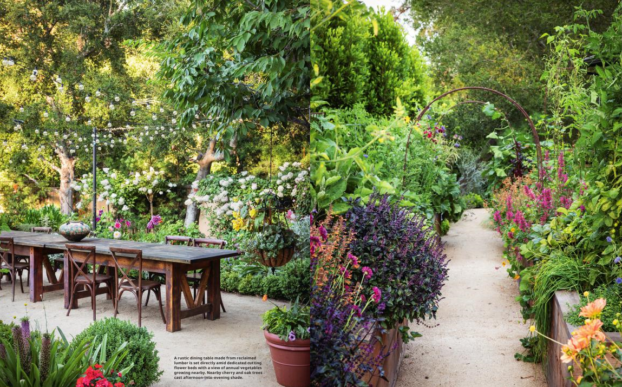
Lush and verdant Garden Wonderland projects by Pine House Edible Gardens (c) Rachel Weill
Please join me as we dive into the wonderland of gardens, formed through the vision, heart, and soul of Leslie Bennett. Along the way, you’ll learn how Leslie integrates her personal leadership style into running a dynamic design/build/maintain landscape design business, a decidedly female-centric approach that I find truly inspiring.
This show is brought to you by Slowflowers.com, the free, online directory to more than 750 florists, shops, and studios who design with local, seasonal and sustainable flowers and to the farms that grow those blooms. It’s the conscious choice for buying and sending flowers.
Thank you to Longfield Gardens, which provides home gardeners with high quality flower bulbs and perennials. Their online store offers plants for every region and every season, from tulips and daffodils to dahlias, caladiums and amaryllis. Check out the full catalog at Longfield Gardens at longfield-gardens.com.
Thank you to Rooted Farmers. Rooted Farmers works exclusively with local growers to put the highest-quality specialty cut flowers in floral customers’ hands. When you partner with Rooted Farmers, you are investing in your community, and you can expect a commitment to excellence in return. Learn more at RootedFarmers.com.
And thank you to Johnny’s Selected Seeds, an employee-owned company that provides our industry the best flower, herb and vegetable seeds — supplied to farms large and small and even backyard cutting gardens like mine. Find the full catalog of flower seeds and bulbs at johnnyseeds.com.
I’m so glad you joined us today! The Slow Flowers Podcast is a member-supported endeavor, downloaded more than one million times by listeners like you. Thank you for listening, commenting and sharing – it means so much. As our movement gains more supporters and more passionate participants who believe in the importance of our domestic cut flower industry, the momentum is contagious. I know you feel it, too. If you’re new to our weekly Show and our long-running Podcast, check out all of our resources at SlowFlowersSociety.com
Thank you for listening! Sending love, from my cutting garden to you! (c) Missy Palacol Photography
I’m Debra Prinzing, host and producer of the Slow Flowers Show & Podcast. The Slow Flowers Podcast is engineered and edited by Andrew Brenlan. The content and opinions expressed here are either mine alone or those of my guests alone, independent of any podcast sponsor or other person, company or organization. Next week, you’re invited to join me in putting more Slow Flowers on the table, one stem, one vase at a time. Thanks so much for joining us today and I’ll see you next week!
On Slowflowers.com there are several search categories to help visitors find flower farms, florists, suppliers and other floral businesses, and one of those – business consulting and development services — was originally inspired by my conversations with Sahid Nahim of New Bloom Solutions, today’s guest. Join us as we discuss branding, social media, and other ways you can market your floral enterprise.
With an emphasis on helping floral business with B2B marketing, New Bloom Solutions is a media consultancy that provides a full menu of services, including website design, SEO management, content creation through videography and photography, plus brand promotion, recruitment, networking opportunities and more.
Today we’ll meet Sahid Nahim of New Bloom Solutions as we discuss how to expand your network and increase your sales.
Sahid is co-president of sister companies, ‘Above All Flowers‘ and ‘New Bloom Solutions’. With two decades of floral industry experience, Sahid started his career with major international brands and has since collaborated with global leaders like Fleurmetz, Chrysal, and Cal Flowers. His passion drives innovation and strengthens connections in the floral world.
You can watch Sahid behind the microphone on ‘The Bloom Show,’ a live YouTube platform where he highlights industry pioneers. The show has been filmed at major global conventions, including in the U.S., Holland, Ecuador, and Colombia.
FLORIEXPO The code for free entry: Bloom2 The Boot Camp: 25% off is NewBloom
Thank You to Our Sponsors
This show is brought to you by Slowflowers.com, the free, online directory to more than 750 florists, shops, and studios who design with local, seasonal and sustainable flowers and to the farms that grow those blooms. It’s the conscious choice for buying and sending flowers.
And thank you to Store It Cold, creators of the revolutionary CoolBot, a popular solution for flower farmers, studio florists and farmer-florists. Save $1000s when you build your own walk-in cooler with the CoolBot and an air conditioner. Don’t have time to build your own? They also have turnkey units available. Learn more at storeitcold.com
Thank you goes to Red Twig Farms. Based in New Albany, Ohio, Red Twig Farms is a family-owned farm specializing in peonies, daffodils, tulips and branches, a popular peony-bouquet-by-mail program and their bouquet-giveaway program that allows customers to buy a 10-stem tulip bouquet for others in their community. Learn more at redtwigfarms.com.
And thank you to Seattle Wholesale Growers Market, a farmer-owned cooperative committed to providing the very best the Pacific Northwest has to offer in cut flowers, foliage and plants. The Growers Market’s mission is to foster a vibrant marketplace that sustains local flower farms and provides top-quality products and service to the local floral industry. Visit them at seattlewholesalegrowersmarket.com.
I’m so glad you joined us today! The Slow Flowers Podcast is a member-supported endeavor, downloaded more than one million times by listeners like you. Thank you for listening, commenting and sharing – it means so much. As our movement gains more supporters and more passionate participants who believe in the importance of our domestic cut flower industry, the momentum is contagious. I know you feel it, too. If you’re new to our weekly Show and our long-running Podcast, check out all of our resources at SlowFlowersSociety.com
Thank you for listening! Sending love, from my cutting garden to you! (c) Missy Palacol Photography
I’m Debra Prinzing, host and producer of the Slow Flowers Show & Podcast. The Slow Flowers Podcast is engineered and edited by Andrew Brenlan. The content and opinions expressed here are either mine alone or those of my guests alone, independent of any podcast sponsor or other person, company or organization. Next week, you’re invited to join me in putting more Slow Flowers on the table, one stem, one vase at a time. Thanks so much for joining us today and I’ll see you next week!
We believe in community here at the Slow Flowers Society and today’s guest does too, as she has a mission to support florists and the floral Industry within the Pacific Northwest Region. Meet Slow Flowers member Michelle Kenny, founder of the new Pacific Northwest Florist Association based in Portland, Oregon.
Many state florist associations are thriving, but as changes occur in the floral marketplace, others have ceased operations. Today, you’ll learn from Michelle Kenny, co-founder and executive director of the new Pacific Northwest Florist Association, a community to support and promote florists in Oregon and Washington.
Michelle Kenny, executive director of the PNW Florist Association
Membership in the Pacific Northwest Florist Association is open to any individual in the florist industry in the region. The association provides networking, support, education and an opportunity to showcase and promote the talented florists in Oregon and Washington. People working in the horticultural and allied industries are also invited to join and I know we have many Slow Flowers, including our society, that are part of this effort to support the growth of the floral marketplace here in the PNW.
Michelle and I first met in 2017 at the Bouquets of the Heart auction in Portland, which was held to raise funds for The Bloom Project. Michelle was one of several guest florists who took inspiration from a featured artwork to create an arrangement. It was a fabulous event and I was there to act as emcee to introduce the florists and the pieces they created.
Michelle is the owner of Goose Hollow Flowers, a Portland-based full-service florist, and we were so happy she joined Slow Flowers as a member. It made sense because of her close relationships with many of the growers at the Oregon Flower Growers Association, where local flowers are available at the Portland Flower Market.
Fast-forward and a few years ago, and having survived/endured the COVID challenges, Michelle decided to act on a long-held dream of starting an association for florists. With seed funding from the Portland Flower Market, Michelle formed a board, passed articles and bylaws, and launched PNW Florist Association last fall. They recently received approval for their 501 c 3 nonprofit status as an association.
Here’s a bit more about Michelle:
After spending a decade working for Marriott hotels in 1996, and with a lifelong passion for floral design, gardening, and events, Michelle took the plunge and bought Goose Hollow Gardens in 2007 all while on maternity leave.
The first year as an owner, Michelle trained extensively with her mentor, Jeanie Gray, a florist and artist. Michelle brought her past experience in hospitality as an event planner, wedding coordinator and convention sales manager to her new venture and in 2013, re-brand her shop to Goose Hollow Flowers, named after one of downtown Portland’s neighborhoods.
As a small floral shop owner, Michelle saw the need to bring back a new and improved floral association to help support, benefit and showcase the local floral talent in the area. Most importantly, she is excited to connect like-minded professionals to be part of a rich and vibrant community and founded the Pacific Northwest Florist Association.
Upcoming PNW Florist Association Events
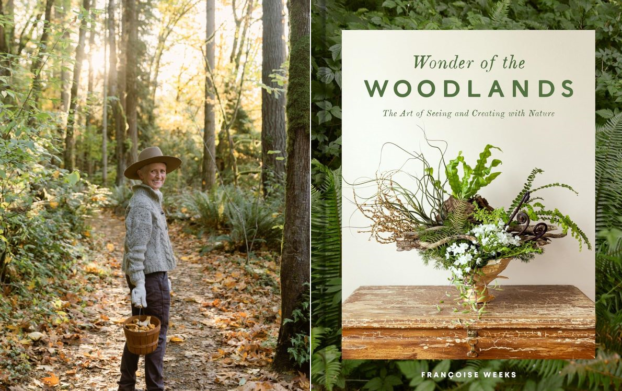
Wonder of the Woodlands book by Francoise Weeks
As we discussed, PNW Florist Association has a sustainability initiative that will be the focus of a weekend of Earth Day programming on April 20-21. On Saturday, April 20th they are hosting an all-day workshop with Francoise Weeks, at the incredible price of $265 including lunch (PNW members receive a discounted registration rate). The morning will include woodland centerpieces and the afternoon includes wearables, and the class rate includes lunch and a copy of Francoise’s new book “Wonder of Woodlands.” Find the registration link here.
The following date, on Sunday, April 21st, is an all day Sustainability Workshop, which includes demonstrations, hands-on design activities and other speakers, including me. Lunch is included and the session is $75 for nonmembers, $45 for members of the PNW Florist Association. Both events will be held at The Creative Space at the Portland Flower Market, a studio and gathering space in North Portland. I hope to see you there! Find the registration link here.
News of the Week
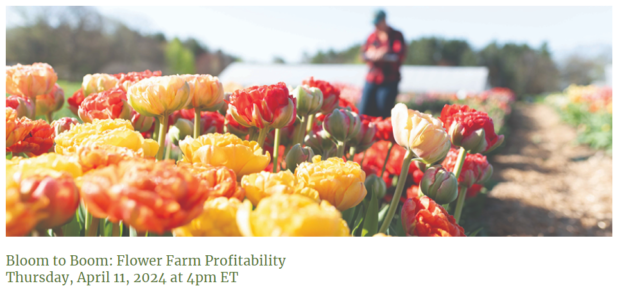
If you missed it in our newsletter, I want to remind you about tomorrow’s free webinar that Slow Flowers is co-presenting with Johnny’s Selected Seeds, Thursday, April 11th at 1 pm PT/4 pm ET featuring two of our farmer-florist members as experts on the topic of profitability. You’ll hear from Lennie Larkin of B-Side Farm and Niki Irving of Flourish Flower Farm, both past guests of this podcast, who will discuss their operations and share their approaches to increasing profitability, including tracking labor costs, inputs, markups, and sales channels. Johnny’s Flower Product Manager Hillary Alger will moderate the Q&A session that follows my roundtable discussion with Lennie and Niki. Find the pre-registration here. The session will be recorded for replay!
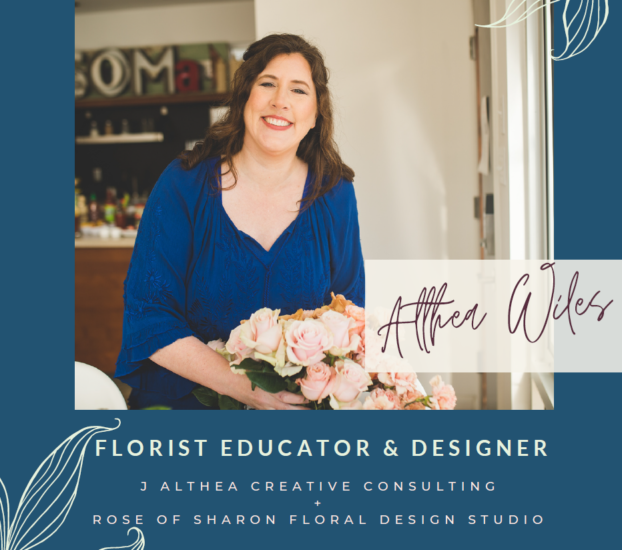
And don’t forget this Friday’s April Slow Flowers (virtual) Member Meet-Up, scheduled for April 12th at 9 am PT/Noon ET on Zoom. The topic: Spring Tune-Up for Florists, Studios, and Shops, and our special guest is longtime member Althea Wiles owner of Rose of Sharon Floral Design Studio and J Althea Creative, based in Springdale, Arkansas. Bring your questions and get ready for a jolt of inspiration for tuning up your floral enterprise. The meet-up is free, but preregistration is required. You can find the link in today’s show notes or in the Linktr.ee menu at @slowflowerssocity on IG.
This show is brought to you by Slowflowers.com, the free, online directory to more than 750 florists, shops, and studios who design with local, seasonal and sustainable flowers and to the farms that grow those blooms. It’s the conscious choice for buying and sending flowers.
Thank you to Johnny’s Selected Seeds, an employee-owned company that provides our industry the best flower, herb and vegetable seeds — supplied to farms large and small and even backyard cutting gardens like mine. Find the full catalog of flower seeds and bulbs atjohnnyseeds.com.
Our next sponsor thank you goes to Mayesh Wholesale Florist. Family-owned since 1978, Mayesh is the premier wedding and event supplier in the U.S. and we’re thrilled to partner with Mayesh to promote local and domestic flowers, which they source from farms large and small around the U.S. Learn more at mayesh.com.
Our next sponsor thank you goes to The Gardener’s Workshop, which offers a full curriculum of online education for flower farmers and farmer-florists. Online education is more important than ever, and you’ll want to check out the course offerings at thegardenersworkshop.com.
I’m so glad you joined us today! The Slow Flowers Podcast is a member-supported endeavor, downloaded more than one million times by listeners like you. Thank you for listening, commenting and sharing – it means so much. As our movement gains more supporters and more passionate participants who believe in the importance of our domestic cut flower industry, the momentum is contagious. I know you feel it, too. If you’re new to our weekly Show and our long-running Podcast, check out all of our resources at SlowFlowersSociety.com
Thank you for listening! Sending love, from my cutting garden to you! (c) Missy Palacol Photography
I’m Debra Prinzing, host and producer of the Slow Flowers Show & Podcast. The Slow Flowers Podcast is engineered and edited by Andrew Brenlan. The content and opinions expressed here are either mine alone or those of my guests alone, independent of any podcast sponsor or other person, company or organization. Next week, you’re invited to join me in putting more Slow Flowers on the table, one stem, one vase at a time. Thanks so much for joining us today and I’ll see you next week!
Music Credits:
Drone Pine; Gaena; Turning on the Lights; Over the Fence by Blue Dot Sessions http://www.sessions.blue
There’s HGTV and there’s the Food Network, but have you checked out the Bloom TV Network? Today, we’ll meet Monica Michelle, creator of the floral-centric streaming platform and Slow Flowers member Katie Lila, host and producer of the new series “Follow the Blooms,” which begins at the flower farm and ends with a beautiful installation for the public to enjoy.
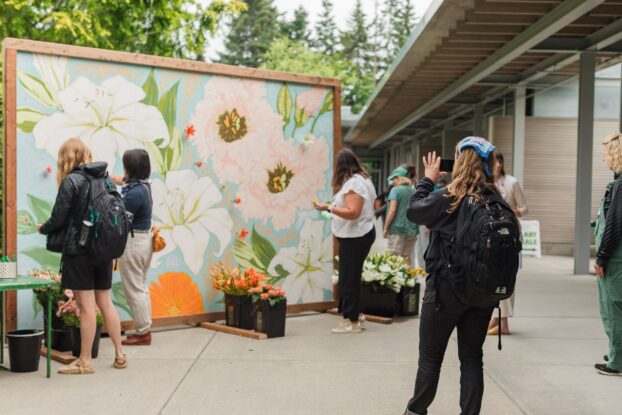
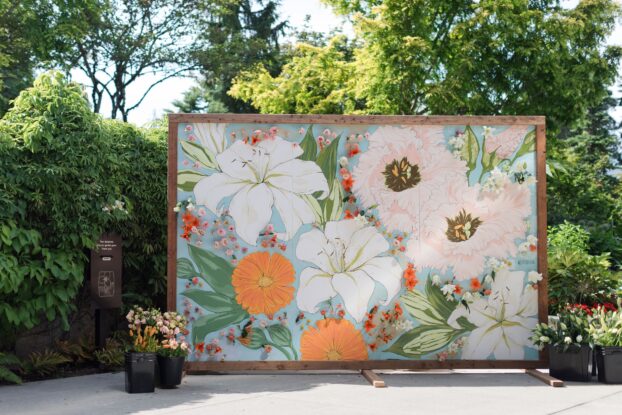
Follow the Blooms installation at the Slow Flowers Summit in progress, featuring mural by Toby Keogh
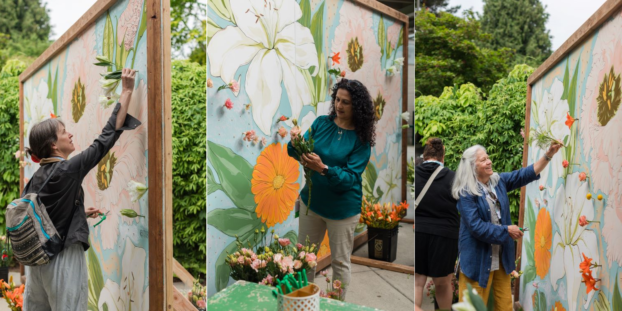
Slow Flowers Summit attendees at Bellevue Botanic Garden, adding flowers to the mural. From left: Anne Bradfield (Analog Floral), Mayuri Parikh (True Client Pro), and Lisa Schwarz (Coastal Blooms).
Today, we’re getting a peek behind the scenes of Bloom TV Network’s exciting series called “Follow the Blooms,” which debuted on March 7th with new episodes dropping every Thursday through April 25th.
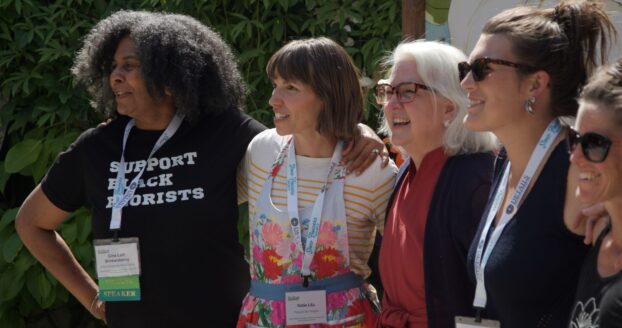
Slow Flowers Summit 2024 with Katie Lila of Follow the Blooms. From left: Gina Lett-Shrewsberry, Katie Lila, Debra Prinzing, Olivia Yates O’Donnell and Sarah Wagstaff
The host is Slow Flowers member Katie Lila, owner of Flowers for People in Spokane, Washington. A few years ago, after a career doing everything in the floral space, Katie started collaborating with creative teams to produce pop-up artistic floral installations in a Spokane gallery environment, inviting photographers and the public to be part of the experience.
And then she learned that Bloom TV network, the new online streaming platform for all things floral, had announced a call for creatives to submit their pilot concepts to be considered for the network’s programming lineup.
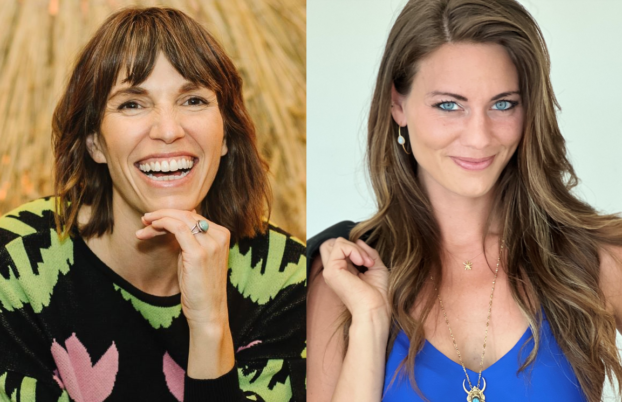
Katie Lila (left) and Monica Michelle (right)
Katie saw the potential opportunity to turn her public floral installations into a show – and she teamed up with DittoFilm Media in her community to film three pilots that they submitted to Bloom TV. Like a fast-paced floral party with a race to the finish, Katie brings the viewer along for the ride as she comes up with a venue, brainstorms the design concept, seeks out flower farmers whose seasonal blooms will bring the concept to life, and then with a design team, a floral installation is brought to life. And the viewer “follows” the blooms from field to floral art piece.
Fast-forward to June 2023 and Follow the Blooms was launched as a bonafide series in production for Bloom TV. Katie and her crew asked if they could film one of their eight episodes at the Slow Flowers Summit, which we held at Bellevue Botanic Garden. Of course, we said yes, and it was a whirlwind moment during the busy Summit – I’m glad we documented the experience because it was a bit of a blur. We’ve been anxiously awaiting the series release ever since.
Follow the Blooms Mural at Slow Flowers Summit 2023
The Summit episode includes a large, interactive “paint by flower” mural, the creation of which invited our attendees to participate. The film crew also visited the Seattle Wholesale Growers Market and JARN Co. Flowers, a member flower farm owned by Tracy Yang and Nick Songsangcharntara – we “followed” the blooms from both spots to the Summit where Katie’s installation became a reality.
When you see a sneak peek of the series, you’ll be swept up in Katie’s joyful approach to life. She’s determined to get everyone involved in her big schemes, including friends, family members, and strangers, and it all ends up in an explosion of blooms.
We’ll also learn more from Monica Michelle, CEO and founder of Bloom TV Network, and I’m delighted that she was able to join Katie for our conversation today.
Monica Michelle has an extensive background in marketing and entrepreneurship, and has spent her career implementing new ideas, and building online communities across multiple industries including the medical industry, food industry and now in the world of media. In 2021 she developed a new niche media model meant to elevate creators, serving as a launchpad for individuals interested in expanding their brands through the power of streaming TV. In January of 2022 she launched her first streaming tv network, building from the model to create “BloomTV,” where an array of floral focused content was housed for streaming, as well as broadcast to over 615k homes in the state of Colorado.
In 2023, Monica co-founded a sister network based on the same model called “Made TV” that is designed specifically for makers and artists of all kinds, with the mission of helping them to share their creations and crafts with a wider audience. She believes that connection is key, and that through innovative ideas that combine technology with education, people can all experience life in full bloom.
Monica will share her story of how the seed of an idea blossomed in to a digital platform for video content. Through her goal of “restoring Eden,” Monica’s mission is to help spark inspiration and beauty, connecting people to each other and to the planet through nature’s most beautiful creation – the Flower.
A few program notes, Bloom TV is a subscription-based platform with packages that start at $12 per month or $99 per year. However, right, now, you can sign up for a 30-day free trial and watch Follow the Blooms, along with countless hours of other great floral content, so check it out.
I was so happy to catch one of our Slow Flowers members, Spokane area farmer-florist Loreen McFaul of Daisies in May, featured in one of the episodes. Congratulations on being featured, Loreen! Loved seeing your blooms in that special episode about the Spokane Lilac Festival Parade.
And in another episode, Katie uses dried flowers grown by Beth Mort of Snapdragon Flower Farm – Beth is a past guest of this podcast, so it’s great to see her flowers play a role on Follow the Blooms!
On Wednesday, April 10th, you’ll want to log onto Flowers for People on IG, to join a live conversation about the Slow Flowers Summit episode. Then on Thursday, April 11th our episode will air! Can’t wait to see the full story of the Slow Flowers Summit on Follow the Blooms!
You also heard Monica mention a new call for creators who wish to participate in their upcoming Bloom TV Network Earth Day programming. The Earth Day campaign invites floral creatives to submit a video tutorial showcasing sustainable practices within the floral world. Submitted videos will enjoy a prominent spot on the Bloom TV platform from April 22nd through May. Submission deadline is April 18th or sooner – and you can find the details here. Who knows? You could become the next Katie Lila!
Thank you to our Sponsors
This show is brought to you by Slowflowers.com, the free, online directory to more than 750 florists, shops, and studios who design with local, seasonal and sustainable flowers and to the farms that grow those blooms. It’s the conscious choice for buying and sending flowers.
Thank you to the Seattle Wholesale Growers Market, a farmer-owned cooperative committed to providing the very best the Pacific Northwest has to offer in cut flowers, foliage and plants. The Growers Market’s mission is to foster a vibrant marketplace that sustains local flower farms and provides top-quality products and service to the local floral industry. Visit them at seattlewholesalegrowersmarket.com.
Thank you to Longfield Gardens, which provides home gardeners with high quality flower bulbs and perennials. Their online store offers plants for every region and every season, from tulips and daffodils to dahlias, caladiums and amaryllis. Check out the full catalog at Longfield Gardens at longfield-gardens.com.
Thank you to Rooted Farmers. Rooted Farmers works exclusively with local growers to put the highest-quality specialty cut flowers in floral customers’ hands. When you partner with Rooted Farmers, you are investing in your community, and you can expect a commitment to excellence in return. Learn more at RootedFarmers.com.
I’m so glad you joined us today! The Slow Flowers Podcast is a member-supported endeavor, downloaded more than one million times by listeners like you. Thank you for listening, commenting and sharing – it means so much. As our movement gains more supporters and more passionate participants who believe in the importance of our domestic cut flower industry, the momentum is contagious. I know you feel it, too. If you’re new to our weekly Show and our long-running Podcast, check out all of our resources at SlowFlowersSociety.com
Thank you for listening! Sending love, from my cutting garden to you! (c) Missy Palacol Photography
I’m Debra Prinzing, host and producer of the Slow Flowers Show & Podcast. The Slow Flowers Podcast is engineered and edited by Andrew Brenlan. The content and opinions expressed here are either mine alone or those of my guests alone, independent of any podcast sponsor or other person, company or organization. Next week, you’re invited to join me in putting more Slow Flowers on the table, one stem, one vase at a time. Thanks so much for joining us today and I’ll see you next week!
Françoise Weeks brings home the charm of the wild woods with her creative botanical arrangements that are so much more than bouquets of blooms. Our conversation about Wonder of the Woodlands, Françoise’s new book, includes an exclusive visit to her Portland garden and design studio.
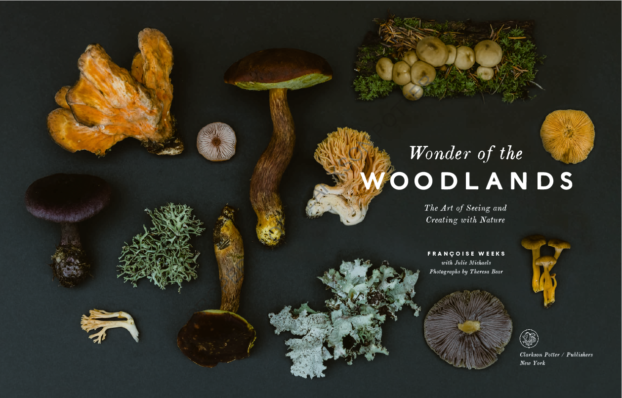
Wonder of the Woodlands book by Françoise Weeks
Françoise Weeks is a good friend to the Slow Flowers Movement and she is a longtime member of our society. Regular podcast listeners will have met Francoise on a few earlier occasions, including on her first appearance on Episode 217 in the fall of 2015, during Lisa Waud’s Flower House Detroit – Françoise collaborated with Susan McLeary to design a fantstical vintage kitchen filled with flowers and root vegetables, plants, and foliages – it was a delight.
The book will be published on April 2nd so you’re the first to hear all about it and if you check out the video interview on which today’s podcast is based, you’ll enjoy a peek into Françoise’s Portland, Oregon Studio, where we recorded our conversation.
Wonder of the Woodlands
Here’s a bit more about the new book:
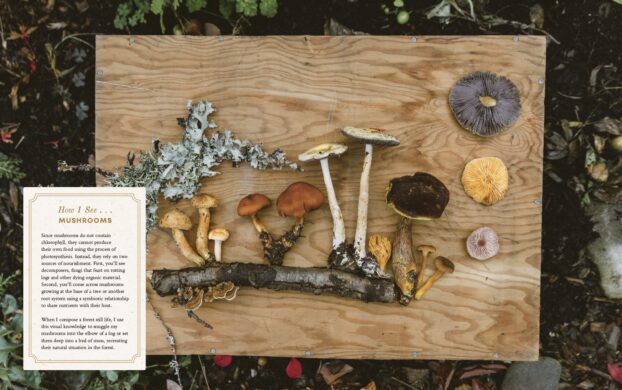
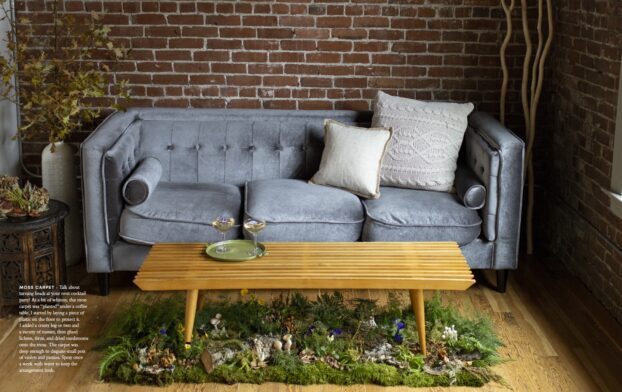
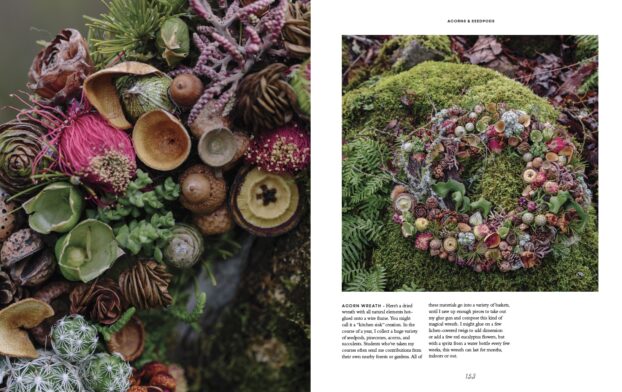
Containers lined with bark to replace ordinary glass vases. A bed of moss to cushion a vibrant spring arrangement. Ever-changing wreaths to showcase acorns, branches, lichen, twining vines, and delicate ferns throughout the year. A cloche holding an arrangement of dried mushrooms that might have come out of a fairytale.
In this gorgeous celebration of the woodlands, renowned floral designer Françoise Weeks offers all the ways, from simple to complex, that you can bring the wildness and wonder of the forest to your indoor arrangements. Each chapter of Wonder of the Woodlands features the materials Françoise uses most—barks and logs; acorns and seeds; ferns, branches, moss, and lichen—and showcases how she builds her unique, beautiful arrangements, which last far longer than a vase of cut flowers.
Inside are also Françoise’s insights on seeking out the most unique natural materials for arrangements, and how to responsibly forage or source them in a shop. And you’ll find her tips on how to reuse materials so you can enjoy lots of different arrangements without increasing your environmental impact.
Bursting with images of nature and suggestions for weaving that magic into your interiors, Wonder of the Woodlands is a celebration of arrangements that are inspired by a walk through the trees. With stunning photography of wild and wonderful wreaths, table arrangements, wall décor, and more, you can re-create the peaceful majesty of spending time in the forest in your own home.
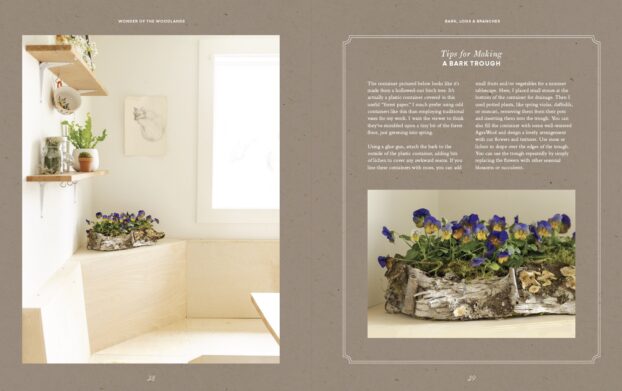
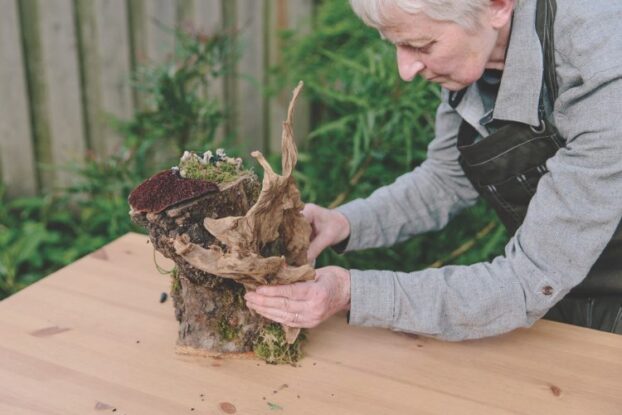
A Planted Bark Trough
How I see Mushrooms
A Moss Carpet
In this gorgeous celebration of the woodlands, renowned floral designer Françoise Weeks offers all the ways, from simple to complex, that you can bring the wildness and wonder of the forest to your indoor arrangements. Each chapter of Wonder of the Woodlands features the materials Françoise uses most—barks and logs; acorns and seeds; ferns, branches, moss, and lichen—and showcases how she builds her unique, beautiful arrangements, which last far longer than a vase of cut flowers.
Inside are also Françoise’s insights on seeking out the most unique natural materials for arrangements, and how to responsibly forage or source them in a shop. And you’ll find her tips on how to reuse materials so you can enjoy lots of different arrangements without increasing your environmental impact.
Bursting with images of nature and suggestions for weaving that magic into your interiors, Wonder of the Woodlands is a celebration of arrangements that are inspired by a walk through the trees. With stunning photography of wild and wonderful wreaths, table arrangements, wall decor, and more, you can re-create the peaceful majesty of spending time in the forest in your own home.
An Acorn Wreath
Françoise Weeks
Françoise was born in Belgium and started her business in 1996. She has infused her work with a quintessential European reverence for flowers and nature. Combined with creativity and mechanical ingenuity, she has crystalized her singular style of Textural Woodlands and Botanical Haute Couture pieces, garnering a global following.
Her innovation and love of teaching have brought her to many cities in the US in studios, at wholesalers, at garden clubs, Art in Bloom events and conferences, including at AIFD Symposium. She also taught in Mexico, Canada, England, Sweden, Iceland, France, China and Australia.
Her dynamic work has been published in national and international publications such as Fusion Flowers, Modern Wedding Flowers, Huffington Post, Flutter and Millieu.
Françoise’s studio is located in Portland, OR where she teaches and offers online courses, including Zoom workshops.
She created “The Herbal Recipe Keeper,” a blank journal featuring her artwork, published by Timber Press in 2018.
Debra Prinzing, Françoise Weeks, and Julie Beeler
Before we start the interview, I want to mention that you’ll occasionally hear the voice of botanical artist Julie Beeler of Bloom & Dye, a Slow Flowers member who lives in Trout Lake, Washington, outside of Portland; Julie joined me on my visit to Françoise’s studio last week and then the three of us had lunch together. I had wanted these two women to meet and I’m so delighted that it worked out. Julie and Françoise share a mutual love of mushrooms and Julie has a forthcoming book – out this fall – called The Mushroom Color Atlas, A Guide to Dyes and Pigments Made from Fungi, so keep an ear out for her appearance on this podcast.
This show is brought to you by Slowflowers.com, the free, online directory to more than 750 florists, shops, and studios who design with local, seasonal and sustainable flowers and to the farms that grow those blooms. It’s the conscious choice for buying and sending flowers.
Thank you to The Gardener’s Workshop, which offers a full curriculum of online education for flower farmers and farmer-florists. Online education is more important than ever, and you’ll want to check out the course offerings at thegardenersworkshop.com.
Thank you to Store It Cold, creators of the revolutionary CoolBot, a popular solution for flower farmers, studio florists and farmer-florists. Save $1000s when you build your own walk-in cooler with the CoolBot and an air conditioner. Don’t have time to build your own? They also have turnkey units available. Learn more at storeitcold.com.
Thank you to Red Twig Farms. Based in Johnstown, Ohio, Red Twig Farms is a family-owned farm specializing in peonies, daffodils, tulips and branches, a popular peony-bouquet-by-mail program. Learn more at redtwigfarms.com.
I’m so glad you joined us today! The Slow Flowers Podcast is a member-supported endeavor, downloaded more than one million times by listeners like you. Thank you for listening, commenting and sharing – it means so much. As our movement gains more supporters and more passionate participants who believe in the importance of our domestic cut flower industry, the momentum is contagious. I know you feel it, too. If you’re new to our weekly Show and our long-running Podcast, check out all of our resources at SlowFlowersSociety.com
Thank you for listening! Sending love, from my cutting garden to you! (c) Missy Palacol Photography
I’m Debra Prinzing, host and producer of the Slow Flowers Show & Podcast. The Slow Flowers Podcast is engineered and edited by Andrew Brenlan. The content and opinions expressed here are either mine alone or those of my guests alone, independent of any podcast sponsor or other person, company or organization. Next week, you’re invited to join me in putting more Slow Flowers on the table, one stem, one vase at a time. Thanks so much for joining us today and I’ll see you next week!
More Slow Flowers members are exploring native plants as potential floral design elements – both on their farms and in their studios. In fact, in our recent survey, 87 percent of members say they grow native plant species as part of their crop mix! Today, you’ll hear the inspiring Native Flora conversation recorded during our March Slow Flowers member meet-up, as three creatives share their insights and advice for adding more native plants to your floral business.
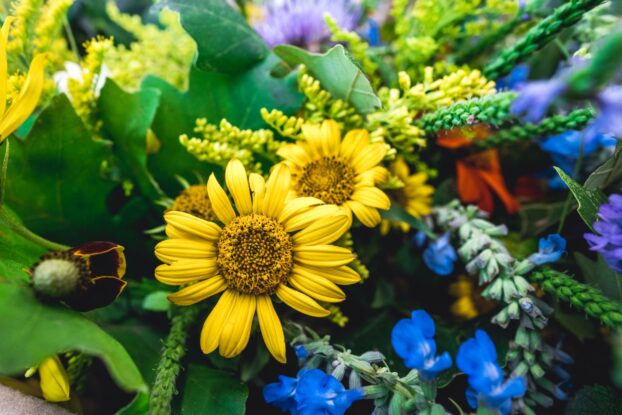
Floral design by District 2 Floral Studio (c) Mike Machian Photography
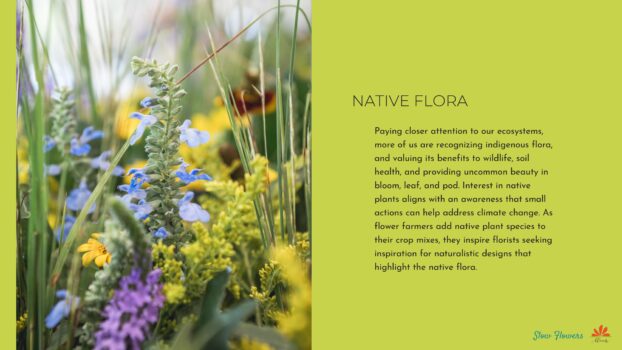
There’s an emerging a mindset that individual actions, while small, can be part of our cumulative efforts to address climate change. While the horticulture and landscape professions in North America have long been tuned into the importance of preserving native plant species, that awareness has not been present in flower farming and floral design circles until recently.
Native Flora from Slow Flowers Floral Insights 2024
We’ve been tracking the embrace of native flora for some time here at the Slow Flowers Movement. In the 2023 Slow Flowers Floral Insights & Industry Forecast, we noted the work of flower farmer Alexandra Cacciari of Ann Arbor-based Seeley Farm to evaluate native perennials as cut flowers and later hosted Alex on Episode 598 to discuss her research exploring native plants as potential floral design elements.
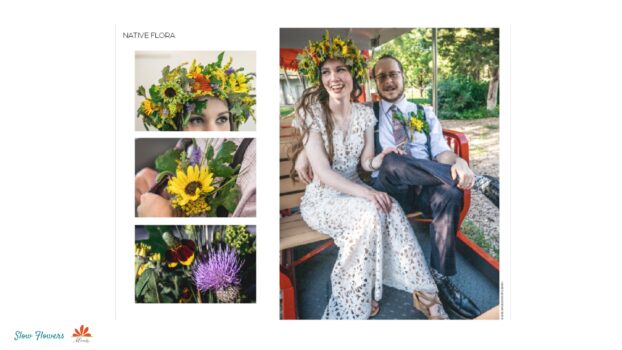
Native Flora for a Nebraska Wedding (c) Mike Machian Photography Design: District 2 Floral Studio
In our 2024 Slow Flowers Floral Insights & Industry Forecast, we devoted the first insight to ‘Native Flora,’ with contributions from Holly and Deborah. There are long-term benefits of championing native plants, and that conversation continued during the March 8th virtual member meet-up, the recording of which you’ll hear today. I’m delighted to share this episode with you and many thanks to our three panelists, Native Flora for Farmers and Florists with Holly Lukasiewicz of District 2 Floral Studio; Deborah Majerus of Iron Butterfly Farm and Lodging; and Kate Watters of Wild Heart Farm.
Here’s a bit more about our guests:
Holly has a background in design, creative projects and community art and through her Omaha-based District 2 Floral Studio she serves Nebraska and Iowa with floral design rooted in sustainability and Slow Flowering practices, offering event work, installations, workshops, daily deliveries, New Moon monthly flower subscriptions, Celebration of Life pieces, custom flower preservation, along with home & corporate account design services.
Deborah is the owner of Iron Butterfly Farm and Lodging in Rochester, Minnesota, an urban flower farm that uses sustainable and regenerative practices, grows a permaculture mini food forest, peonies, woody ornamental shrubs, early spring bulbs, and annuals.
Kate Watters joined the panel to share her unique perspective from Rimrock, Arizona, where she owns Wild Heart Farm. Here creative mission is to share the detail and diversity that exists in moments from a place through the seasons – through writing, floristry, gardening, and art. She grows and designs with flowers, bringing 20 years’ experience from botany and conservation.
Thanks so much for joining me today! We are fully behind the goal of increasing the propagation and planting of native plants and increasing awareness among florists and consumers around supporting native habitat!
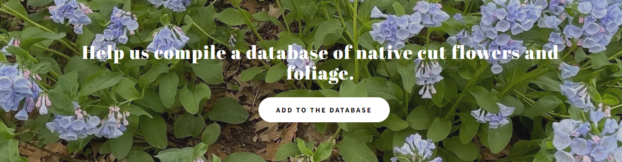
To that end, inspired by this conversation, Deb Majerus has created the start of a database for native cut flowers and plants – and you are invited to contribute your recommendations. This is an ongoing project that we hope to expand and share with the broader Slow Flowers Community – and I salute Deb for getting it started. Kate and Holly will add their suggestions by specific region, and I hope you will do the same. The Native Flowers and Foliage for cuts database is a place to compile our collective knowledge so members are not duplicating efforts – and can make the growing of native flora more accessible to farmers, growers, gardeners, florists, and the public.
Get Ready for the Slow Flowers Summit – Ticket Promotion this Week!
If you’re listening during the first week of Spring – I’ve great news to share. We’re celebrating the Spring Equinox with a special ticket promotion for the Slow Flower Summit registration, March 19-25th. Use the coupon code SPRINGISHERE to receive $50 off any Slow Flowers Summit registration – and put that $50 in your pocket (or fund your seed or plant purchases) as our gift to you! The Summit is about 100 days away – and native plants are on the program this year! We’re excited to feature Latifa Pelletier-Ahmed of ALCLA Native Plants, based in Calgary, Alberta. She will help us understand what defines a plant or flower as “native,” and how to use natives to boost the diversity of your own growing areas. Hope to see you at the Banff Centre for Arts & Creativity in Alberta, Canada!
This show is brought to you by Slowflowers.com, the free, online directory to more than 750 florists, shops, and studios who design with local, seasonal and sustainable flowers and to the farms that grow those blooms. It’s the conscious choice for buying and sending flowers.
Thank you to Rooted Farmers. Rooted Farmers works exclusively with local growers to put the highest-quality specialty cut flowers in floral customers’ hands. When you partner with Rooted Farmers, you are investing in your community, and you can expect a commitment to excellence in return. Learn more at RootedFarmers.com.
Thank you to Johnny’s Selected Seeds, an employee-owned company that provides our industry the best flower, herb and vegetable seeds — supplied to farms large and small and even backyard cutting gardens like mine. Find the full catalog of flower seeds and bulbs at johnnyseeds.com.
And thank you to Mayesh Wholesale Florist. Family-owned since 1978, Mayesh is the premier wedding and event supplier in the U.S. and we’re thrilled to partner with Mayesh to promote local and domestic flowers, which they source from farms large and small around the U.S. Learn more at mayesh.com.
I’m so glad you joined us today! The Slow Flowers Podcast is a member-supported endeavor, downloaded more than one million times by listeners like you. Thank you for listening, commenting and sharing – it means so much. As our movement gains more supporters and more passionate participants who believe in the importance of our domestic cut flower industry, the momentum is contagious. I know you feel it, too. If you’re new to our weekly Show and our long-running Podcast, check out all of our resources at SlowFlowersSociety.com
Thank you for listening! Sending love, from my cutting garden to you! (c) Missy Palacol Photography
I’m Debra Prinzing, host and producer of the Slow Flowers Show & Podcast. The Slow Flowers Podcast is engineered and edited by Andrew Brenlan. The content and opinions expressed here are either mine alone or those of my guests alone, independent of any podcast sponsor or other person, company or organization. Next week, you’re invited to join me in putting more Slow Flowers on the table, one stem, one vase at a time. Thanks so much for joining us today and I’ll see you next week!
Music Credits:
Drone Pine; Gaena; Turning on the Lights; A Burst of Light by Blue Dot Sessions http://www.sessions.blue