Do search

Archive for the ‘Architecture’ Category

New Garden Products for 2011 – Part Two

Tuesday, November 30th, 2010

Preserve the Harvest with Burgon & Ball's charming jam, marmalade, pickles and chutney jars.

Trend-spotters are reading the horticultural tea leaves these days.

It’s an annual practice that I remember so well from my newsroom career when, without fail, we reporters were asked to compile the obligatory “forecast” story. I covered retail, and you could imagine how loathe Seattle’s major retail CEOs were to tell me anything about the coming year when it was just days after Christmas and they hadn’t tallied up the current year’s performance.

But, alas, we all want a glimpse into the future. And that’s what going to industry trade shows can help reveal. A peek into the products, plants, tools and design items you may be seeing in 2011′s backyards.

This post continues with even more interesting offerings. Or the ones that caught my interest anyway. I welcome your reaction. Are these items you can see yourself purchasing for your garden? Do you even NEED more products? (That’s a long conversation, isn’t it?).

Here is the "sun" bracket from M Brace - simply brilliant!

I really enjoyed meeting Jill Plumb, a school teacher who came up with a brilliantly simple method of building raised beds.

Her product is called M Brace. It is a decorative steel corner bracket that holds lumber at a 45-degree angle WITHOUT HARDWARE (note: this is a big selling point for anyone who has dragged the electric drill and 100-foot-long orange extension cord out to the backyard to try and wrestle together a box for the tomatoes).

Here's Jill demonstrating the nifty packaging for a pair of brackets.

Jill told me that she got this “big idea” one day while re-loading paper napkins into a “slot” style napkin holder.

Something clicked and she saw in her mind’s eye how easy it would be to have a bracket that emulated that napkin holder. Just larger, more durable and also pretty. Several prototypes later, including the support of her students who she involved in the design process, packaging development and marketing, Jill’s M Brace is looking very professional and has already hit garden center shelves in some markets.

Made from recycled steel (natural or powder-coated), with decorative cut-outs including a squiggle, sun, carrot or bamboo fronds, the set of 4 brackets has a $165/set recommended retail price. Jill continues to offer new product ideas such as “edging” made from the leftover swirl pieces or plant stakes from the leftover carrot cutouts. Brilliant!

The Feeney 3-in-1 trellis, shown in a fan pattern

I spotted another clever system to corral plants – especially in this case, vines – in the Feeney Architectural Products booth.

A detail of the Somerset II Trellis

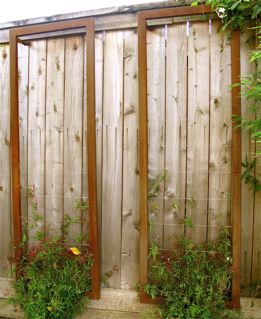
We see so much over-designed crap in the marketplace, which is one reason why I appreciated Feeney’s simple use of stainless steel cables to create a trellis for climbing plants. Feeney’s 3-in-1 Trellisis an easy-to-assemble wall-mount trellis kit with 1/8-inch diameter rods and special mounting components that can be configured into a Fan, Grid or Diamond design. This is a lightweight solution that does require measuring and drilling skills to install, but can turn a blah wall or fence into something quite beautiful. Just add a vine of your choice and voila! Something quite pretty. Suggested retail: $199.

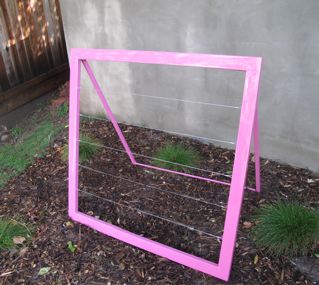
Feeney also uses stainless steel cables in its inexpensive “It’s a Cinch” plant hanger and in a freestanding trellis panel kit. The Greenway Trellis has a frame of aluminum tubing and a square-grid pattern for the vines. The frame legs can be set in compacted gravel or concrete footings, or they can be base-mounted on a deck or patio. That square-grid pattern also shows up in the Somerset II Trellis, which has top and bottom powder-coated aluminum brackets. It is also a wall-mount system but a little larger than the 3-in-1. (more…)

A tour of the Chartreuse House garden

Saturday, November 20th, 2010

You can't miss the Chartreuse House, seen through the similarly-colored plant palette.

Today’s Los Angeles Times’ HOME section features my architecture/interiors story about Lisa Little and Phil Brennan’s makeover of a pair of tiny cottages in Venice, Calif.

The Venice-based architect and her special effects wizard husband painted the exterior an acid-chartreuse color and trimmed the house in charcoal gray.

Click on over to the story and you’ll see a fabulous web gallery of images shot by photographer Katie Falkenberg.

I also included a sidebar on Stephanie Bartron’s amazing work in the postage stamp-sized front yard, which faces a Venice walk street, which appears in LA at Home, the Home section’s daily design blog.

But you really can’t see much of the garden in the Times’ web gallery.

I promise you – it’s something to behold, featuring a dazzling palette of plants that enliven the small entry garden and play beautifully with the rugged materials Stephanie selected.

So I will share those photos here, along with the sidebar text:

A Chartreuse garden

As a color-packed accent to the renovated 1905 Craftsman bungalow, the Chartreuse House’s front yard is a example of how much great design can occur in a tiny patch of soil.

Yet before choosing a zesty palette of drought- and salt-tolerant plantings, designer Stephanie Bartron, of SB Garden Design, had to address some of the less visible challenges of the property’s postage stamp-sized entry. Prior owners had piled layers of topsoil over the sandy native soil, which created a drainage mess.

A wave-like pattern gives lots more interest to the raised bed.

“I needed to lower the grade of the front yard in order to move water away from the house,” Bartron says. “We calculated the volume of soil to excavate and used that amount to fill two raised planters. That way we didn’t have to haul away any material.”

Divided by a permeable walkway of concrete tile, the raised planters are formed by boxes of thick steel plate that have been roughly finished to encourage rusting. Now weathered, the boxed-beds replicate the Cor-Ten steel used to make the vertical planter in Little and Brennan’s courtyard.

The same weathered steel forms a slender raised planter at the base of the charcoal fence facing the walk-street. It is filled with a ribbon of golden oregano and Sedum rupestre ‘Angelina’ — which dazzle against the darker fencing.

The chartreuse scheme continues outside the gray composite fence.

Bartron asked the metal fabricator cut a “wave” detail along the top of the larger planting box and in it she installed a sedge meadow, a nod to the nearby beach.  Privacy screening comes from a “hedge” of weeping Mexican bamboo and alternating chartreuse and yellow-flowering kangaroo paws.

“The plants create a punch of color in  such a small space,” Bartron says. The lacy bamboo fronds, the tall kangaroo paw stalks and the undulating drifts of sedge are constantly moving, thanks to the ocean breezes. Little added a eucalyptus tree to the front area, situated so that it will eventually grow high enough to screen the house’s topmost windows.

Such a simple yet sophisticated combination of plants in the smaller of two raised beds.

For the smaller of the two planter boxes, Barton paired dramatic clumps of smooth agave (Agave attenuata), known for growing well near the ocean, with Mexican feather grasses, dark purple Aeonium arboreum ‘Zwartkop’ and yellow-and-green variegated New Zealand flaxes. The entire bed is under-planted with the chartreuse Sedum rupestre ‘Angelina’. Filled with detail, it is a diminutive landscape that causes visitors to slow down and experience while approaching the front door.

The garden has many sustainable features, including low-maintenance plantings and permeable surfaces. Yet, says Bartron, its main design motivation is a response to the architecture. “This is such an artsy, whimsical place and I see the garden as a colorful jewel box for Lisa and Paul to enjoy.”

–Debra Prinzing

I’ll close with just a few more photos:

The larger of the two raised beds is planted mostly with Carex, to emulate the waves of the nearby Pacific Ocean.

This view shows how the Mexican bamboo and the kangaroo paws provide ample screening from the walk street traffic.

Playful and suitable for the setting, the lemon yellow kangaroo paw sways in the breezes.

Sheds in miniature

Thursday, November 11th, 2010

Shedista Kathy Fries, wearing her amazing necklace.

When we wrote about and photographed the multiple sheds at Kathy and Ed Fries’s garden outside Seattle, we titled the chapter “Suburban Follies.” I mean “follies” in a good way because their landscape is dotted with a colony of amazing, fanciful structures.

Just when I think Kathy has exhausted all of her creative brainstorms, she surprises me. Last evening I saw a work of art around her neck that blew my mind. Actually, it is a collection of five works of art, suspended from an elegant gold chain.

These canvases are tiny. Miniature. Diminutive.

A little fairy must have painted the garden and shed still-lifes that range from a pinkie fingernail to a nickel in size.

Kathy is one of the most inspiring, big-idea persons I know, especially when it comes to garden-making and shed design. She recently commissioned this breathtakingly-beautiful piece of jewelry that celebrates all that she loves about her garden.

I couldn’t take my eyes off of her dazzling necklace at our dinner last evening. Thankfully, she allowed me to take photos and write about the art and the artist:

Kathy's one-of-a-kind necklace by artist and painter Christina Goodman

The allure of this art is that Christina Goodman didn’t just shrink down photos of Kathy’s architectural follies and other garden ornamentation to fit inside the Old-World-style gold-leaf cases. No. She painted each of these tiny canvases using a minuscule brush.

According to her web site, this California artist uses “very fine brushes, good lighting and a magnifier . . . and acrylic paint as it dries quickly and allows me to work on a small scale” to create her miniatures.

As for the lovely Renaissance-inspired frames, Christina says she designs and builds them “with wood using miniature moldings and a centuries old water gilding technique. The result is well worth the labor-intensive process. In the end, I hope to capture the luminosity of Renaissance painting in miniature.”

Kathy met Christina last year when the artist exhibited at the Bellevue Arts Festival. Kathy loved her miniature pendants, pins and earrings that featured trees, birds and other scenes from nature.

And she started thinking about the possibilities of having a one-of-a-kind necklace to celebrate her garden and its “sheds.”

One of the pendants was inspired by a vintage cast-iron chicken that is mounted on the Dutch door to the boys’ playhouse (see photo, above left). Kathy requested that Christina render it in miniature for her necklace.

The huge urn (in miniature) that dangles from the right side of her necklace is in reality about 4 feet tall and made of cast iron. I believe it was one of Ed’s “finds” that became a garden gift for Kathy. She jokes that its provenance was as a hotel ash tray. The last time I saw the piece, it was planted with a huge hosta and standing in the shade garden.

The three central gems on Kathy’s necklace include her Viewing Tower, her Doges Palace and Palais de Poulets, her chicken coop. Each was handcrafted by John Akers, a Seattle builder and salvager of architectural artifacts who collaborates with Kathy on many of her garden projects. Just in case you haven’t actually seen these structures before, here is how they look as real-life pieces of architecture. Bill Wright photographed them for our book Stylish Sheds and Elegant Hideaways:

Kathy's tower overlooks her Medieval-inspired knot garden. The octagonal structure rests on a 12-foot-tall platform with steps and an iron railing.

The Doges Palace was once an unsightly 20-by-20 foot aluminum shed. Now a fanciful garden house, it is embellished with verdigris copper sheeting and a clock tower.

The Palais de Poulets, also known as "Clucking Hen Palace," was transformed from a decrepit shed into a functional and decorative coop inhabited by a flock of heirloom chickens.

Can you imagine what I’m fantasizing about? What special piece of art or architecture do I now dream to own in miniature by Christina Goodman? I’ll be on the lookout for just the right precious object.

Fall design inspiration: foliage, flowers, fruit and architecture

Monday, November 1st, 2010

“It would be worthwhile having a cultivated garden

if only to see what Autumn does to it.”

–Alfred Austin, The Garden that I Love (1894)

Acer japonicum 'Aconitifolium'

Whether emulating what you see in nature or combining plants to masterful heights, gardens that excel in the fall are ones that showcase the best of the season. 

There are certain trees, shrubs, perennials, ground-covers and vines that you may not notice during the rest of the year. But somehow, once the temperatures cool and the sun’s arc lowers in the sky (lighting foliage and plant forms from the side, rather than from overhead), a fall glow illuminates – and we see the garden in a new way.  

Last Friday I gave a presentation entitled “Gardens that excel in the fall: Something for everyone” at the Garden Conservancy’s one-day seminar in the San Francisco Bay Area. Called Fourth Quarter Gardens: An August to December Romance, the symposium featured several really inspiring speakers on design, horticulture and the unique gardening culture of the west. 

I was thrilled to be part of this cohort, which included Bob Perry, Katherine Greenberg, Nicholas Staddon, Elizabeth Murray, Chris Jacobson and Brian Kemble. The highlight for me was a tour of Katherine Greenberg’s all-native garden in Lafayette (an East Bay community). It was the three-dimensional, living embodiment of her lecture “Greens, Grays and Golds in a Native Garden.” 

My talk was a visual meditation of what inspires me this time of year: foliage, flowers, fruit and architecture in the landscape. 

I started by sharing the excitement I feel about the season as I design for texture in a new way; find unexpected plant pairings (not just those Halloween hues, either); tend to the harvest and see the bones, lines and structure emerge as leaves fall and flowers fade. My attention is drawn to the aging beauty of what some may call “decay.” Yet those yellowing hosta leaves and nearly-bare branches are a sign to me that the garden in every phase of growth is to be celebrated. 

This lovely melange shows the amazing diversity of fall leaf color.

I also shared a lay-person’s explanation of why leaves change color in the fall. I quoted from Brian Capon’s book Plant Survival

“. . . the cool night temperatures and shorter days of September and October are sure to start the season’s normal color changes in leaves and . . . trigger their falling from the trees. 

“Leaves change color when the green pigment, chlorophyll, decomposes in leaf cells to reveal orange and yellow pigments, present all summer but hidden from sight by the more abundant chlorophyll. 

“In some trees, the unmasking of the yellow-orange pigments is accompanied by production of brilliant red ones, made from sugars and other substances in the leaves. The purpose of this last-minute display of added color is not known.  

“In the green leaf, both green chlorophyll and yellow-orange carotenoid pigments are contained in tiny chloroplasts. Because there is more chlorophyll than carotenoid, the leaves appear green. In fall, after the chlorophyll decomposes, only carotenoides remain to give the leaf its glowing, golden color. In some plants, the leaf cells produce red pigments, anthocyanins, that are stored in the vacuoles. As the anthocyanins collect and mask the carotenoids, the leaf turns red.” 

A lot has been written about fall gardening and much of it focuses on the importance that gardeners in the west do fall planting! 

Witch hazel is espaliered along a lattice arbor at the Center for Urban Horticulture in Seattle.

I embrace and endorse this strategy, since it accomplishes so much that one may not have energy to tackle six months hence. It gets us out into nurseries and weekend plant sales, heightening our sensory response to a plant’s autumn form and texture and its promise of spring to come. The season forces us down on our knees to plan, prepare and place those treasures, brought home with the admonition (at least in the Pacific Northwest) to “plant before frost.” California gardeners want to plant in the fall for an entirely different reason — to capture any winter precipitation for good root establishment. 

If only to think about springtime, I will plant peony crowns in the fall. But then, I pause and remember what occurs after the blowsy bloom of Mother’s Day; and the sultry autumn glory of peony foliage comes to mind. Appreciating both the youth of spring and the maturity of fall is one of those wonderful surprises that comes from having plant lust. 

If you, too, are a fall-planting advocate, then what may be second-most on your mind is the design of an autumn landscape. 

I love the architectural form of "spent" crocosmia blooms. These seed-heads are as beautiful as the flowers themselves.

Seasonal changes, at least at the beginning of the fourth quarter, work their magic here in the west. The light changes, the moisture content heightens, and the foliage reddens. The garden’s edges soften in some places (perennials go to seed; grass plumes explode; greens turn tan) and become more acute in other places (the architecture of deciduous plants is more pronounced; evergreen plants move to the foreground; anything that blooms is undoubtedly noticed as well). 

It’s almost as if the feminine personality of spring and summer steps aside for the more masculine personality of fall. Yet when I posed this theory to my friend Betsy Flack, she argued that “I’ve always thought (fall) was my own season—sort of the ample-bosomed (billowy) matron . . . after Spring’s sprite.” 

Our differing opinions reveal that the autumn garden is one we can all embrace. 

To me, there are four aspects to the 4th quarter garden that I consider when planning, touring and evaluating the well-designed landscape: 

This is some kind of wild-looking oak, isn't it?

Foliage: 

Cooling temperatures and shortening days bring out the fall glow we so admire. Yet it’s not just color (golds, coppers, wine reds and dark purples) that I’m in search of. I also consider broadleaf evergreen plants with graphic foliage, as well as conifers that change with the season, taking on their own non-green hues. 

Laura Morton, a Hollywood designer, uses echinacea and asters in this yummy fall combo

Flowering plants: 

If you find a fall-blooming perennial that you like, plant it not once but thrice. 

Some of my favorites include Japanese anemone, heaths and heathers (Calluna vulgaris cultivars are especially gorgeous when the temperatures drop) and asters (A. novi-belgii; A. novae-angliae; A. lateriflorus). 

Fruit: Edibles and ornamentals unify in the autumn garden, lending a sense of “harvest” and hearkening 

This cotoneaster will delight birds and humans alike.

back to the ritual and sustenance of gleaning fruit from the earth. Nuts, berries, pods, seeds, fruit – for eating or just eye-feasting – are essential elements of the autumn garden. Because I am a floral designer, I take particular interest in gathering rose hips, crabapple fruit, seed heads and even spent grapevines (with tendrils and curls) from the garden for use in my vases. 

The yellowing gingko against a pumpkin-colored garage is a perfect fall scene.

Architecture: It goes without saying that structure is the backbone of 4th quarter gardens. Deciduous trees and shrubs, dormant perennials, disappearing annuals . . .they can do their thing and yet the arbors, gates, patios and pathways remain – thankfully. I take special note of the shadow-play created by light as it moves through a garden, catching shapes made by architectural elements and throwing those alluring patterns against walls and fences. 

Here are a few more seasonally-appropriate quotes to enjoy: 

” . . . asters: purple asterisks for autumn.” Conrad Aiken, Preludes for Memnon (1930) 

“Hurrah!  . . . it is a frost! — the dahlias are dead.” R.S. Surtees, Handley Cross (1843) 

A mosaic of autumn impressions: 

My home design interview with actor Jonathan Togo of “CSI: Miami”

Sunday, October 3rd, 2010

 BEHIND THE SCENES WITH JON TOGO

Actor Jon Togo (center), with designer Lory Johansson and me

If you’re a fan of the “CSI” television franchise, you probably know this handsome young actor I’m standing with in the photo at left. He’s Jonathan Togo, aka investigator Ryan Wolfe of “CSI: Miami.” 

The show enters its 9th season with tonight’s premiere (10 p.m. on CBS). In anticipation of the show, I’ve posted my recent interview with Jon and his interior designer Lory Johansson.

Lory, an inventive and gifted designer whose firm is called Just Joh, introduced me to Jon’s 1958 Midcentury modern “guy pad” in the Hollywood Hills earlier this year. I love that Jon describes her as “the best design Sherpa” because it’s true. She has a gift for helping each client express his or her unique personality through furniture, art, and the home.

The Los Angeles Times photographed the interiors in July, the day of this photo, which Lory’s husband Mats Johansson took with my camera. My interview with Jon and Lory (and featuring a fun commentary by Jon’s mother, Sheila Togo) appeared in the Sept. 18 issue of the HOME section. You can read the story and see a gallery of photos here.

A Preview of the Shed of the Year 2010

Wednesday, June 30th, 2010

My fellow Shed Aficionado across the Atlantic, Uncle Wilco, has presided over a fantastic “Shed of the Year” competition for each of the past three years. The British press has followed his competition with avid enthusiasm, including a recent story in the The Sun, a national tabloid. I have the honor of serving as the ”international” judge, joining an illustrious team of judges for Shed of the Year. 

Uncle Wilco will announce the winner on July 5th – the start of National Shed Week in the U.K.  

He has given me permission to share photos and details about the 13 finalists. Each has captured the fancy of visitors to We [Heart] Sheds, his blog that invites “sheddies” from around the globe to share photographs and details about their own private, backyard getaways. 

I recently checked in with Wilco to get a few more details about this year’s contest. 

Debra: How many entries did you receive? 

Wilco: “We had about 1,200 in total, including 60 international sheds this year.” 

Debra: I noticed that there are no finalists from North America! 

Wilco: “I think that the public who voted for the ‘short list’ went for the quirky UK sheds.” 

I agree, Wilco. The quirky UK sheds are highly personal and very creative. I promised that I wouldn’t reveal how I voted until the July 5th announcement . . . but in the meantime, here is a preview of the finalists, along with my commentary: 

Just a guy who wanted to have his own pub, 3 steps from the house

The innocuous pub exterior

PUB SHED Category: The 3 Steps (left) 

WOW, I didn’t want to like this Man Cave at first, but I’m actually blown away by the smart design, amazing efficiency and cozy feeling of Garry’s shed.  

I think I would like him as my neighbor!  

Everyone is talking about being alone and alienated in the suburbs, but Garry has taken care of that problem by building community at The 3 Steps Pub 

A tiny place for crafting and artwork.

WORKSHOP Category: Junkaholic’s Weaving and Sewing Shed (left) 

Sweet and fresh, simple yet stylish. Artemis has turned something utilitarian into an inviting escape where I could be happy day after day. Love it!  

Ahoy Matey! A pirate's lair

UNIQUE Category: The Lady Sarah Out of Worthington Shed (right) 

Reg is living the good life here on his ship.  

Viewing the photos and movies felt like a journey into Ye Olde  Curiosity Shoppe – something wonderful and strange with every glimpse.  

He has really created a backyard destination unlike anything I’ve ever seen – and certainly beyond the imagination of most shed owners.  

A garden shed with a sweet color palette

WOODEN Category:Frankenshed, Penny Two Allotment (right) 

What a creative way to dress up and decorate a basic tool shed. Frankenshed’s allotment potting shed is charming and has lots of personality. I love the lettering painted on the boards in contrasting lavender and green.  

Inside: A cool office studio

STUDIO Category: In the Shed (left) 

Nicola knows how to turn a box into a beautiful working space. Interiors are very creative, much more so than the rather plain exterior.  

Time machine for your own backyard

TARDIS Category: Tim’s Tardis (right) 

Clever and resourceful as a storage unit and garden accent.[Note: TARDIS is the name of a space-travel machine from "Dr. Who," a popular British sci-fi novel] 

The lap of luxury inside a utilitarian shed.

NORMAL SHED Category: Mini Jeff Dave Jones (left) 

This is exactly what I look for in a stylish shed – a “chill-out” place in the garden that’s both useful for storage and pleasant for R&R.  

Nicely placed in the garden and I love all the attention to detail in the finishing. Not fussy at all, but a true Stylish Shed.  

A sustainable retreat

ECO SHED Category: Ecopod (right) 

The Eco Pod is inspiring and has a really appealing “mod” silhouette. Love that it was designed with sustainability in mind. I wish it was a little more organic as a garden element, though. Needs some oxygen-producing vegetation to downplay all that wood and really make the sustainable message relevant. It’s almost there, and I’d love to get my garden designer friends on the job to soften it up.  

A 2-part shed that's pretty cool for working and also stashing stuff

GARDEN OFFICE Category: One Grand Designs (left) 

Great design, great use of materials, wonderful attention to detail (wrap-around deck; skylight). Probably the best design of the batch for the mass marketplace. I see this design turning into DIY kits all over the globe.  

Inside the hut it's quiet and cozy

HUT Category: Beach Shed (right) 

Tiny and terrific. Love the way this diminutive hut draws a crowd and even offers a cozy hideaway inside.  

OTHER Category: Uisge Betha (no photo) 

Less is more – great ideas for turning one space into three distinct ones. Love the way the outdoors garden is “borrowed” into the overall design scheme 

Outside: architectural focal point; Inside: collector's gallery

CABIN Category: Naval Museum (left) 

Fantastic! Stephen is an absolute success at what he set out to do. The exterior fits really nicely into the garden and its interior demonstrates how to fit all your desired amenities into a tiny box – yes, you can have it all, even in the backyard shed.  

A wee cottage space that's easy, breezy and inviting

SUMMERHOUSE Category: Pebble Hideaway (right) 

Lovely, light-filled design. I’m impressed with the use of glass doors and windows; the color blue is wonderful and it looks like a little cottage. A sweet spot.  

Stay tuned for the announcement next week. I’ll let you know the final judging, as well as my own personal selection (including a Q&A with the shed creator).

Behind the scenes with Garden Design

Wednesday, June 23rd, 2010

A pretty stunning aloe-as-sculpture in one of Joseph Marek's gardens.

Scott Shrader turned an ancient millstone into a succulent planter

Garden Scouting: It sounds so luxurious, doesn’t it?

Spending four days scouting some of the most beautiful and unique residential landscapes in and around Los Angeles! 

I do it all the time – visit and tour gardens that might just make it onto the pages of the magazines and newspapers to which I contribute. And yet, achieving the “get” is not always that luxurious. It’s fun and rewarding. But also hard work. 

Successful garden scouting requires lots of telephone calls to set up appointments. It means I have to lean on my personal connections to cajole invitations from reclusive garden owners or rock star designers. And it demands that I put way too many miles on my Volvo odometer. A lot! (Thank goodness for NPR.) 

Most of all, this job means being extremely open to everything I see, while also keeping out a discerning eye for that magical glimpse of a perfect story. 

It’s alot like being on a treasure hunt when you don’t know the ending, but I wouldn’t have it any other way! 

Jenny Andrews, executive editor for Garden Design, one of the magazines for which I am contributing editor, was in Los Angeles a few weeks ago for a four-day scouting marathon. As she put it, it felt like we were college roommates for four days . . . probably because Jenny ended up staying with me for most of the time. She got to experience the craziness of the Prinzing-Brooks household with kids, dog, schedules, and more. And, we put 700 miles on my car in four days. We were both exhausted by the end.  (more…)

A midcentury home needs a modern garden

Saturday, March 27th, 2010

The renovated succulent and cactus border arcs along the lawn's edge. I love the salt-and-pepper gravel mulch, which echoes the dark-light elements of the home's Palos Verde stone cladding

The cover story of today’s Los Angeles Times HOME section features “Finally back in its prime,” my profile of the Daily House, a beautifully restored, circa 1954 “mod pad” in the LA suburbs of Glendale. Straight out of “Mad Men,” the house has been a decade-long project of its young owner, Christophe Burusco. Check out the Times’ web gallery here, with images by staff photographer Al Seib.

I had hoped to include a sidebar on the garden, but space limitations got in the way. My interview with Kathleen Ferguson of Los Angeles-based Kathleen Ferguson Landscapes reveals her excellent ideas and tips for approaching the exterior design of a retro home.

Here it is, along with my photographs from visiting Chris and touring his home and garden.

As I write in the Times’ story:

“The house – designed by Glendale architect Clair Earl, thoughtfully renovated by Burusco and since added to the Glendale Register of Historic Resources – sits on a 14,000-square-foot lot that feels like a rustic retreat, far from the city. Not a single neighbor is visible from the living room or master bedroom. Rather, Burusco’s eyes are drawn to the vibrant new succulent and cactus garden designed by Kathleen Ferguson, who incorporated mature specimens raised by the late Jean Daily Russom.”

The low-slung, horizontal lines of the Daily House are visually appealing

According to Ferguson, as with all her projects, “I really look to the architecture and what my clients’ interests are.” With Chris Burusco’s project, she didn’t want the landscape to take away from the marvelous period architecture; rather, “I wanted to enhance it.”

Ferguson set out to mimic the architecture’s clean lines with “bold plantings in the landscape.”

Three major trees were saved, including a huge magnolia beyond the home’s glass-walled corner (which serves to enhance and frame the views of the San Gabriels).

Near the front entry, Ferguson was able to save an evergreen pear (Prunus caroliniana) and a Japanese maple. The beautiful forms of these two trees had been difficult to appreciate, due to a greenhouse that was plunked down between them by the original owner of the home.

Chris removed the greenhouse and its concrete foundation, giving the scene much-needed negative space.

The new pathway cuts diagonally across the entry, using horizontal and square poured-in-place concrete

In its place, Ferguson added geometric poured-in-place concrete pavers that echo the lines of the home and lead visitors to the garden’s side entrance. “We really wanted the pavers to look like something that had been there already, which is why we did a random pattern,” she says.

The level front yard slopes down to the street, creating a dramatic perspective as you approach the house.

There, Ferguson staggered agaves on the low hillside. Mass planted, the scale and form of the agaves is ideally suited to the rugged texture of the Palos Verde stone-clad house. Between the agaves, ornamental grasses appear as a softening device.

“Together, the native succulents and ornamental grasses mimic the native surrounding plant palette,” Ferguson says.

Smooth turquoise rocks cover the ground next to the accent wall with three cool cut-outs

As you walk along the side towards the home’s back garden, you can’t help but appreciate architect Clair Earl’s artisitic detailing. He punched a trio of “windows” in a stone accent wall, which invites you to view the San Gabriels through these carefully framed scenes.

On the ground at the foot of the accent wall, Ferguson planted softer forms of asparagus ferns, which can handle that constant shade. She “mulched” the plants with a layer of smooth, light turquoise stones “for a little bit of contrast.” (This stone echoes dark blue-green flagstone on the home’s entry hallway.)

The garden’s piece de resistance is a cactus-and-succulent border that arcs around the edge of the small lawn and patio area. Here, Ferguson worked with some of the mature plants installed by Mrs. Daily Russom, who Chris says was involved with the cactus garden at the Huntington.

“Jean (Daily) loved succulents — she had a lot of amazing specimens that we wanted to keep,” he says.

Mature cactuses are now interplanted with new hybrid succulents, creating a tonal cool-to-warm palette

By blending new succulent hybrids with the established, mature varieties, the expansive border is now a spectrum of cool-to-warm tones and contrasting shapes. 

The design starts with clumps of striking, blue-gray Agave parryi, moves into purple-black rosettes of Aeonium arboreum ‘Zwartkop’ paired with sculptural paddle plants (Kalanchoe luciae) and leads to eye-pleasing multiples of golden barrel cactus (Echinocactus grusonii).

Chris loves the way the succulent palette “moves from the cool blue-grays to the reds, yellows, oranges, and then into cool again.”

The border, which runs the length of the house and can be seen from most of its rooms, is now mulched with a warm salt-and-pepper gravel (which replaced what Chris called “big ugly rocks”).

The cultivated landscape in the foreground blends with the San Gabriel Mtns. in the distance.

Ferguson is most inspired by the tension created between the landscape and the house; between the architecture and the wild setting beyond its domestic borders.

“Chris’s landscape has a lot of push-and-pull,” she says.

There’s the smooth against the rough; grey-greens against the rich greens. And there’s the contrast between the garden and the arid, native chaparal around the perimeter.

As you approach the house, it becomes more lush and more ornamental.”

I think it’s a pretty stunning treatment, worthy of this historic, but thoroughly modern, abode.

A shed in the city

Wednesday, February 10th, 2010
In a winter scene in a city garden, Jon's plum-and-green garden house is quite handsome

In a winter scene in a city garden, Jon's plum-and-green garden house is quite handsome

Seattle’s historic Georgetown settlement isn’t really known for being a residential neighborhood, but rather for the fact that a freeway runs through it, a bunch of warehouses populate its main streets and – oh yeah, if you look really close, there are a few pretty amazing lanes where Early Seattle architecture still stands.

Behind one of these cottages is an irresistible gentleman’s oasis, its exterior painted dark plum with pine-needle green trim. It has a comforting hip roof overhead, on top of which is a decidedly non-urban weather vane.

Jon Dove, the gentlemanly owner of this garden house, is an estate gardener and talented plantsman who grew up in Georgetown as a kid and found that as a grownup, he didn’t want to leave. Jon has restored and revived a 1905 cottage-style farmhouse here, planting a voluptuous, beautiful tangle of a garden in front, on the side, and in the back.

I first met Jon through Jean Zaputil, my good friend and garden muse. They had volunteered at the Washington Park Arboretum display at one of the flower shows and found they were kindred spirits. One July, many years ago, Jean and I went on the Georgetown Art & Garden Walk – a walking tour put on by the neighbors rather than one of those fancy affairs with shuttle buses.

We stopped by Jon’s to visit his postage-stamp-sized garden filled with perennials and shrubs as tall as me. Glorious! Around back, a one-car garage occupied a too-important chunk of space, similar to the way my husband’s baby grand piano occupies a too-important chunk of our living room. (It’s there, it’s nice to look at, but it’s in the way.)

 On my trip last week to Seattle, I was presented with an unexpected gift of afternoon tea in Jon’s new garden house. Yup, in that former garage, which Jon says is only a little younger than his house, maybe from the ‘teens.
Jon Dove, showing off his old-new garden house

Jon Dove, showing off his old-new garden house

An Old-New Shed

Here’s how I returned to Georgetown to discover Mr. Dove’s Delightful Garden House.

Daniel Mount, another gentleman gardener (and a superb, dreamy writer, too – check out his blog), invited me to have tea when I came to Seattle. This was going to be tough, due to my schedule. But Daniel dangled the carrot from a stick: “We could meet at Jon’s – I want you to see his new shed.”

Oh, Daniel. You definitely know how to tempt a shed aficionado like me!

So after finishing up a photo shoot with David Perry (for our new book project – more on that later), and before joining my friend Jan Hendrickson for a lovely dinner, I made my way down I-5 to Georgetown. Jean was supposed to join me, but since she had just logged six or seven hours helping us as a stylist for the aforementioned photo shoot, she needed to take a pass. Of course, since she lives in Seattle, she can go see Jon anytime.

A work-in-progress photo, courtesy of Jon. This shot illustrates how the carpenter cut away the side of the garage to create a covered porch

A work-in-progress photo, courtesy of Jon. This shot illustrates how the carpenter cut away the side of the garage to create a covered porch

Jon says it started to bug him that the useless garage was taking up a chunk of space otherwise deserving of something more attractive. As is the case with many people (I should know – I live in California where it happens for everyone), the garage was just a repository for stuff. After not looking at or using that stuff for a decade or so, Jon wondered if he really needed it after all. Voila! Out with the junk, in with the garden antiques.

To get there, Jon sketched out a new floor plan for the squarish building. He intelligently carved three useful spaces out of the 20-by-20 foot structure. Its back section is separated by a wall (and door) to a long, narrow area for bicycle storage, garden supplies and tools.

The original sliding garage door opens to the alley, so this application was a perfect way to leave the utilitarian stuff facing away from the garden.

Left with about three-quarters of the footprint to work with, Jon then sliced that space into two sections – one larger, which becomes the main interior room; and one smaller, which is the corner that juts into the garden.

Finished with a brick floor and fanciful bracket-trim, it's a sheltered spot to sit in any weather.

Finished with a brick floor and fanciful bracket-trim, it's a sheltered spot to sit in any weather.

He worked with a carpenter-friend to cut away an exterior side opening and “doorway” in that corner, essentially creating a covered porch. It is now carpeted with a pattern of recycled brick, set in sand.

By adding decorative corbels to the upper corners of the two openings, the space feels like a grand porch beneath an overhanging roof. “I wanted to be able to sit outside even when it rains,” Jon says. Cozy, comfortable, thoroughly delightful.

Now we shall step into the inner sanctum, through the French doors and into the room where tea was promised. A glance at Daniel’s face revealed that he had a secret I didn’t know quite yet. Inside, I understood why he was grinning. I forgot about the promise of tea and drank in the decorative sitting room.

Jon is a scavenger, like many of us. He found large, divided-paned doors to enlarge a tiny window space into a picture window. In the winter, it’s nice to see the bones of the garden revealed. What stands out is a graceful, curved metal bench, its lines echoed in the arched canes of chalk-white ghost bramble (possibly Rubus thibetanus).

A peek inside: Elegant, refined, inviting

A peek inside: Elegant, refined, inviting

Jon used plywood to cover the floor and then sealed the inexpensive material with clear, water-based semi-gloss Verithane. The light colored wood floor contrasts nicely with the dark, stripped-down ceiling beam (original to the garage).

An oversized vintage brass lantern hangs at the peak of the room, dominating the scene in a very pleasing manner. Because of the ceiling’s volume (I’m guessing it’s approximately 10-feet tall at its peak), there was plenty of space for Jon’s carpenter to add an upper ledge where birdhouses are now displayed.

Against one of the two solid walls is a garden bench painted pea green. Daniel somehow obtained the bench from the set of a Chekhof play and brought it here as a gift for Jon. The three of us started dreaming about moving the bench to the covered area outdoors so as to make room for a daybed. But then, maybe not, because everyone who visits Jon will yearn to nap in this garden house (me included).

UPDATE: Jon sent me this note last night. . . reading it put a smile on my face:

Oh Debra, I forgot to mention after your visit, I moved the bench from inside the Garden House to the porch. I then moved the my guest bed to the Garden House, I spent a night out there, was cozy. Looking forward to spending summers there. You’re a whirlwind of great inspiration.

 
Again, thank you!
 
Jon

Above the bench is a fantastic objet – a cast iron circle that measures about 48 inches across. There’s a mirror at the center, which reflects the garden’s foliage and flowers into the room. Turns out, the scrappy piece of metal was once the base of a stove that Jon took out of his home when he modernized it. He saved it – for no inexplicable reason other than it was strangely shaped and interesting – and, voila! Now it’s this dramatic wall detail. Ironically, an old mirror from a vanity or hutch fit perfectly into its center.

I'm glad Jon hung onto this until he found a perfect use for the cast iron circle, cum mirror frame.

I'm glad Jon hung onto this until he found a perfect use for the cast iron circle, cum mirror frame.

It’s amazing how many great design ideas reside inside a few hundred square feet, including some recycled toile ceiling-to-floor draperies that Jon inherited from friends. They add style, warmth and privacy when pulled across the French doors. I’ll let my photos show you some of the other nice details Jon has added.

Jon says he spent around $5,000 to $6,000 for construction (labor and materials) and about $2,000 to have the garden house painted. To me, it seems like a great investment that adds a whole lot of character, interest and function to his urban garden.

Finally, I couldn’t take my eyes off of his collection of architectural miniatures that fill an old canning cabinet. The cabinet is ancient, dating back to the very first settlers in Georgetown. The Horton family platted Georgetown in the 1870s. A friend of Jon’s rescued the wood cabinet from a home once owned by the Horton daughter. The square-head nails hint at its pedigree.

The shelves are filled with tiny wooden buildings that Jon cuts from scraps and covers with beautiful, intricately painted details in black – windows and doors, of course; but also molding, corbels, cornices, all rendered with tiny brush strokes.

Here are some close-up details of his whimsical, wonderful miniatures.

These green walls will blow your mind

Thursday, January 28th, 2010
A Woolly Pocket wall of succulents adorns the retail shop at Descanso Gardens near Pasadena

A Woolly Pocket wall of succulents adorns the retail shop at Descanso Gardens near Pasadena

Designed in Los Angeles, fabricated in Kansas, and soon to hang on a wall near you, the Woolly Pocket is a soft-sided planting envelope that makes it possible to have a lush wall of vegetation without having to hire a structural engineer.

Vertical gardening is all the rage, so here’s a way to bring plants into your home (indoors or out) with a breathable fabric container that is easy to hang and maintain.

Fill the 15 x 24 inch pocket with a little potting soil, plant it with lush greenery and allow the vines or foliage to spill over the top edge. Combine multiple pockets to create a living wall as is shown in these photographs.

WHAT IS THE WOOLLY POCKET?

Miguel shows off a 5-pocket Woolly planter

Miguel shows off a 5-pocket Woolly planter

I met designer Miguel Nelson at his studio in Culver City earlier this week and took a tour of Smog Shoppe, his event space where the Woolly Pocket was created.

Miguel was trained as a sculptor, but he obviously thinks about sculpture in a completely different way than artists whose work stands on a pedestal in the garden or in the foyer of a home.

The type of sculpture Miguel conjures is an entire building and outdoor courtyard that contains green events. He and Sherry Walsh, his wife, retrofitted an unsightly garage used to do emissions tests on cars (thus, the clever Smog Shoppe name).

The analagous blue-green plant palette nearly covers the exterior of Nelson's Smog Shoppe event space in Los Angeles

The analagous blue-green plant palette nearly covers the exterior of Nelson's Smog Shoppe event space in Los Angeles

Used for private and corporate events, the warehouse-y space needed to be softened up. And so Miguel and his brother Rodney created huge wall-hangings with pockets and stuffed them with succulents, tropicals and other plants that cascade and drape. The hangings look like those large shoe-organizer pocket panels, but are oh-so-much more elegant.

Over two year’s time, the plants have thrived, nearly obscuring the concrete block walls and the black wool pockets. Once partygoers started asking if they could buy the planting system for their own homes and gardens, Woolly Pockets was born.

A detail shot reveals how happy these plants look

A detail shot reveals how happy these plants look

Instead of wool felt like the original system, Miguel and Rodney now use an industrial-strength USA-made felt from recycled plastic bottles (it is available in chocolate brown, black and cream – with a promise for more colors in the future). The pockets have a built-in moisture barrier that allows the plants to breathe while keeping moisture off your walls or floors.

The blogosphere and a few design magazines have discovered Woolly Pockets, which are priced at $49 for a single. Multiples range from $125 (3-pocket, 68 inches) to $188 (5-pocket, 112 inches).

Miguel’s eco-publicist, Corey Scholibo, is convinced that this green gardening solution will capture the imaginations of non-gardeners. It is a cool interior design application that is at the same time retro (think indoor plants of the 1970s) and futuristic (plants will save the planet!).

“You can now garden any time, anywhere, with little or no skill,” Corey says.

Interior walls of the courtyard are planted top-to-bottom

Interior walls of the courtyard are planted top-to-bottom

The team is inventing all sorts of new iterations of the Woolly Pocket. There is a Vagabond, which I wrote about last month for LA At Home (think “Garden Container meets Handbag”) and at this weekend’s Accent on Design in New York, Miguel will introduce a 5-sided wee-woolly tabletop planter and a gorgeous, free-standing 6-, 8- or 10-sided planter that has zippered sides so you can unzip sections to accommodate sculptural tree branches poking out. Those items appear to be ideal for the interior space and are a lot more attractive than some of the plastic, clay or faux planters I see hanging around garden centers.

You can mostly find Woolly Pockets online, but Miguel expects to sell through several retail channels by later this year.

“I see all these amazing living wall installations in public spaces,” he points out. “But you never read about a vertical garden you could have yourself. Now, even with just one Woolly Pocket, you can grow plants on your wall.”
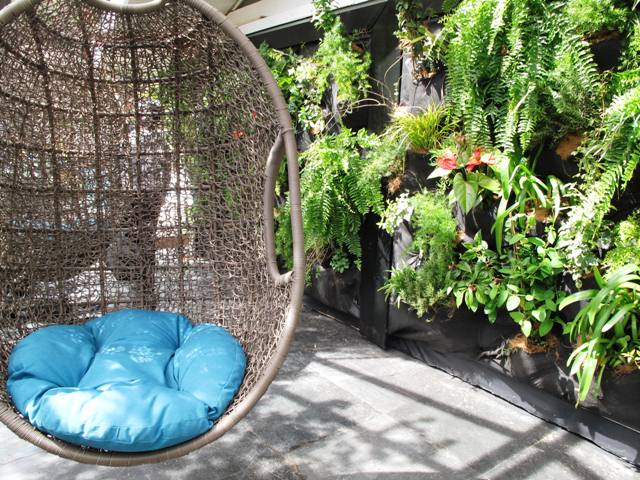
With a cluster of them, arranged like a giant patchwork quilt, pretty soon you can have your own living, green wall.
I have four dark-brown Woolly Pockets to try out and I’ll report back soon on how they are doing. I’m going to hang them outside to try and mask some of that ho-hum tan stucco we’re so lucky to have here in SoCal.