Debra Prinzing

Archive for the ‘Creativity’ Category

Slow Flowers on Design*Sponge Today!

Wednesday, April 10th, 2013

designspongelogo

by Maxwell Tielman

INTERVIEW: DEBRA PRINZING OF 50 MILE BOUQUET & SLOW FLOWERS


Here is a link to the DESIGN*SPONGE page

Over the past year or so, I have been trying, to the best of my ability, to live “slow.” While living slowly doesn’t necessarily mean halting one’s motions or moving at a snail’s pace, it does mean taking time away from the deleterious modern-day practice of Me-Want-It-Now. Whether I’m enjoying slow art, enjoying the pleasures of slow food, unwinding with a knitting project, or just learning to give myself some time to think, I’ve found that the concept of “slow” has amazing benefits, for the self and for the environment. While slow food and all it entails (eating locally, seasonally, organically, etc.) is often at the forefront of the slow/sustainable discussion, the concept really expands far beyond what we put on our plates. The act of choosing local vs. imported or organic vs. conventional has similar consequences whether you’re talking about food, furniture, or even flowers. Indeed, although flowers are often an afterthought to most consumers, picked up at the supermarket or bodega for a quick pick-me-up, the same rules apply when it comes to these tiny living things. Despite the fact that flowers may seem like a superfluous “luxury,” where they are sourced, how they grown, and who they are purchased from do make a difference, both in terms of your health and the environment. Debra Prinzing, a West Coast author and Outdoor Living Expert, has devoted much of her working life to educating people about the benefits and pleasures of raising and purchasing sustainably grown local flowers. In last year’s The 50 Mile Bouquet, Prinzing took readers on a nationwide tour of sustainable flower farms and shops, providing a few tips and ideas along the way. This year, she unveiled her latest effort, Slow Flowers, a compendium of locally-sourced seasonal bouquets, one for each week of the year. Debra took some time to chat with us about slow flowers and some of the challenges and joys that come with the act of thinking about flowers in a more sustainable way. Check out the full interview after the jump! —Max
DebraPrinzing-JelloMoldFarm-157

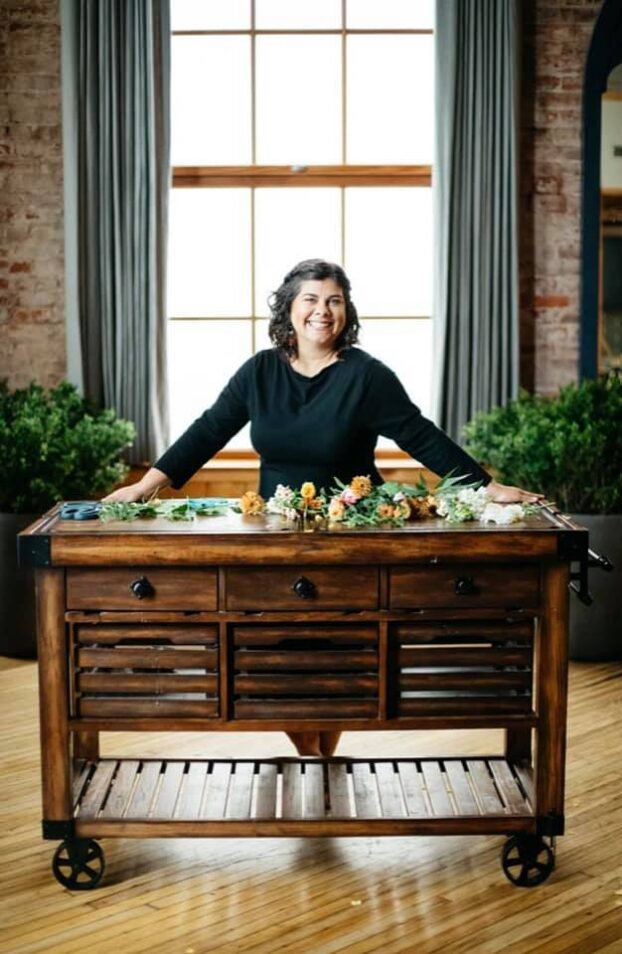
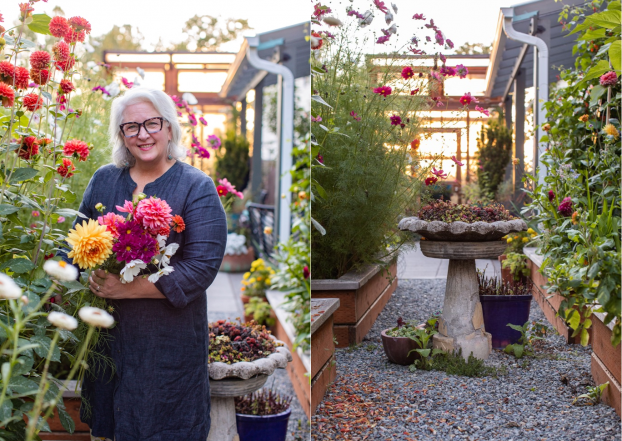
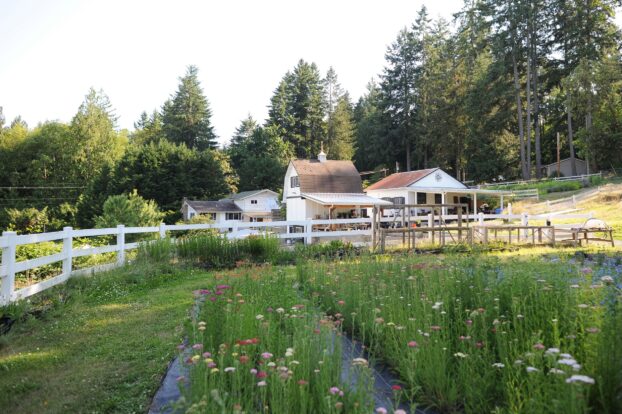
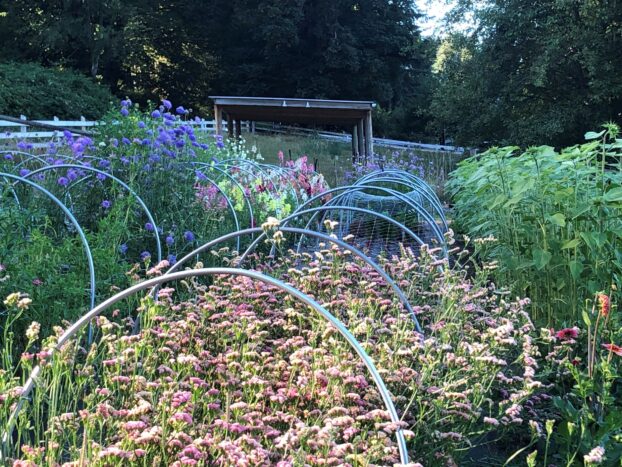
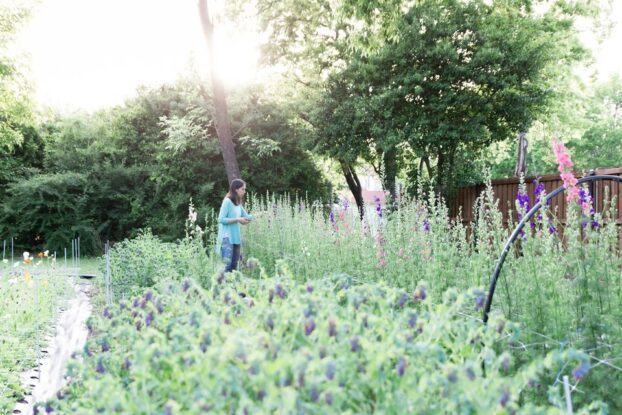
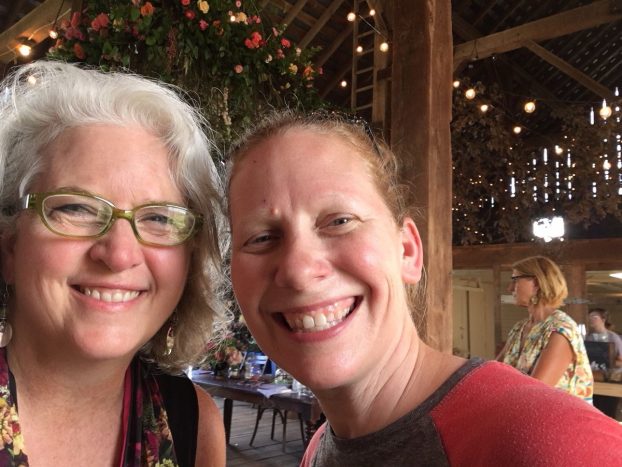
Here I am in my favorite flower field, surrounded by dahlias (c) Mary Grace Long photograph

Debra: Many people consider flowers a “luxury” or an indulgence (although I disagree – I believe bringing flowers into our homes is an essential, life-affirming way to connect with nature!). But if you take the position that flowers are a luxury, then I would argue it’s all the more reason to be responsible in the way we consume them. Buying imported flowers that have been produced with low-cost labor, in countries that do not have as stringent environmental standards as the U.S., which are THEN shipped to us on chartered cargo planes using tons of gallons of jet fuel – how is that sustainable?

Locally-grown flowers may cost a few dollars more per bunch, but when you buy them, you are supporting a family-owned farm (and farm jobs), preserving farm land, encouraging rural economic development and reducing carbon dependency.

Design*Sponge: The American consumer has grown so accustomed to a year-round availability of not just food, but flowers, that it might be difficult to convince him or her to revert to a more “seasonal” lifestyle. What are the benefits, both personally and environmentally, of making the move to seasonal and local flowers?

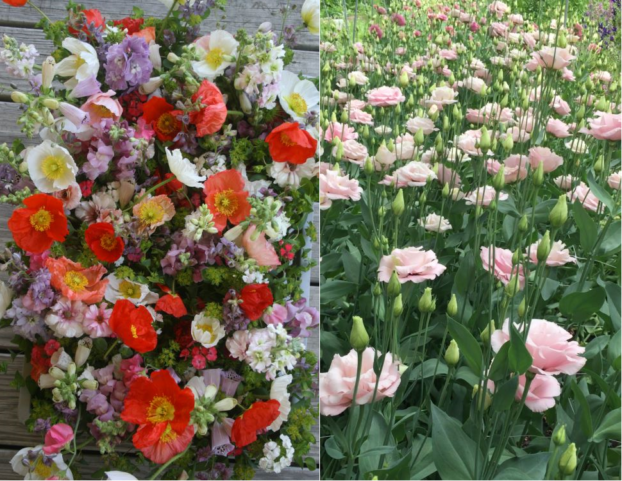
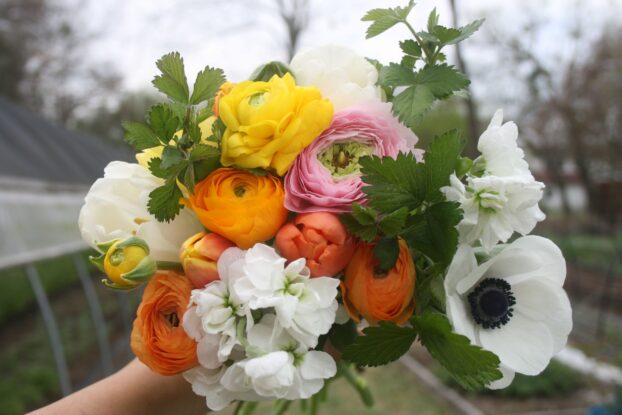
Take a visual "whiff" and enjoy this combination of three lovely flowers.

Take a visual “whiff” and enjoy this combination of three lovely flowers.

Debra: If you are a foodie, and if you embrace a seasonal, farm-to-table approach in your menu or dining choices, then you probably understand the term “slow flowers.” To me, the beauty of this practice is being observant of the seasons and appreciating each flower as a moment in time.

Sure, this might mean a less abundant selection of winter-season flower choices, but we also have a less abundant winter selection of local food. Think about a January tomato, one that you bring home shrink-wrapped from the supermarket: it’s mealy and basically tasteless. Wouldn’t you rather enjoy a heirloom tomato, picked right off the vine, in July or August? That’s flavor as it is meant to be tasted.

Similarly, out-of-season flowers can seem lifeless, scentless and, well, out of season! I like to say to brides: If you want to walk down the aisle carrying peonies, then get married when peonies are in bloom (note: this means May or June). I realize that floral artists (and wedding parties) do not want limited choice, but increasingly, there are brides asking for all local flowers (just like an all-local catering menu) and this, inherently, means those flowers will be in season.

Gardeners, of all people, really understand this notion. If you’re in tune with your personal backyard (patio, deck or windowsill), you know what blooms when — that’s what seasonality is all about. For me, that means my Seattle garden provides conifer branches and colorful twigs during the winter months. I’m happy to wait until spring arrives for my bulbs to bloom and I celebrate the advent of luscious dahlias in August. I definitely anticipate each season with each new bloom cycle.

By the way, I’m not super-rigid about seasonality. Thanks to the season-extension efforts of many American flower farmers, you can find early- or late-blooming floral options grown in hoop-houses or greenhouses — providing enough extra floral bling to satisfy one’s cravings weeks before spring really arrives or months into December. I’m lucky here in the Seattle area, because we have Alm Hill Gardens, a farm near the Washington-B.C. border, that grows organic tulips and sells them almost year-round at the Pike Place Market. One of my favorite rituals is to head down to the market and select tulips from Gretchen or Ben or Max – the farmers I’ve grown to appreciate for the healthy, vibrant crops they produce.

AmericaDesign*Sponge: What do you think are some of the biggest misconceptions held by consumers about local or sustainable flowers?

Debra: The biggest misconception is understanding where flowers come from. A majority of consumers don’t know. Flowers just mysteriously appear in buckets at the supermarket and many people never consider their origin.

When the California Cut Flower Commission conducted a national survey a few years ago, they asked: “Do you know where your flowers come from?” and a shocking 85% answered “No.” [Interestingly, in answer to the follow-up question -- "If given a choice, would you buy California-grown flowers? -- 55 percent of respondents said "Yes."]

People need correct information about the flowers they buy. Because there is no required country-of-origin labeling (such as with produce), there has not been a good way for consumers to determine the source of their flowers. Sadly, because of this, we have low expectations from the flowers we purchase, especially those stocked at supermarkets or by mass merchants outlets. We expect our flowers to be cheap because we don’t expect them to last long in a vase. Many are probably imported — a far cry from fresh and local.

The only way to change this is for flower consumers to always ask: Where were these flowers grown? and How were they grown?

I interviewed Max Gill, a SF floral designer who creates the bouquets for the famed Berkeley farm-to-table restaurant Chez Panisse. He told me he shops at the SF Flower Market and says to the vendors: “What did you grow that you did not have to spray?” Max went on to explain: “. . . by making it really clear where my dollar will go, I feel strongly that I’m including everybody in the ‘sustainable’ conversation.”

Gretel and Steve Adams, my flower farmer pals from Ohio, owners of Sunny Meadow Flower Farms.

Gretel and Steve Adams, my flower farmer pals from Ohio, owners of Sunny Meadow Flower Farms.

Design*Sponge: Many flower enthusiasts might be interested in purchasing more sustainable, environmentally friendly flowers, but are unsure of where to begin or look. What are some questions one should ask when looking for sustainable flowers?

Debra: Know your flower farmer. Start with local growers – the best place to meet them is at your community farmers’ market. Talk with them and learn about their growing practices – they love to share their knowledge.

You do have to be a bit of a sleuth. One way to find growers in your own state is to search the free database of the Association of Specialty Cut Flower Growers (www.ascfg.org – click on the Growers tab and search by state). Many of the members of ASCFG will sell direct to the consumer; some have seasonal U-pick farms; others will tell you which markets or florists carry their seasonal blooms. Look for “local labeling.” Flower farmers in many states voluntarily label their bouquets. I’ve seen logos for Alaska, California, Colorado, Illinois, Texas and Wisconsin-grown, to name a few.

I have to add a clarification here about the word “sustainable,” which has so many meanings and is a vague term. It’s very difficult for a small flower producer to gain USDA organic labeling (the regulations are clearly set up for food production; not flower production – and it is costly). But even if they don’t use the phrase “sustainable,” I can tell you that ALL AMERICAN-GROWN flowers are more sustainable than any imported ones. We have stricter environmental regulations in the US than in any flower-exporting country. In addition, the carbon footprint alone required to import flowers makes them less sustainable than domestically grown flowers. Locally grown is always going to be more “green” than imported.

And some regions have their own ways of alerting consumers that products (including flowers) are sustainable. In the Pacific Northwest, flower farmers participate in Salmon Safe (http://www.salmonsafe.org/flowers), which is a third-party environmental organization that designates whether farm practices are safe for salmon habitat.

Design*Sponge: Depending on the source you get your flowers from, they may or may not be labeled as sustainable or local. Additionally, depending on your locale, there might not be a sustainable florist or farmer’s market within reach. Are there any varieties that are more commonly grown locally, or at least domestically?

Debra: Annual and perennial flowers, such as sweet peas, cosmos, sunflowers, zinnias, calendulas, nigella, bread seed poppies, Queen Anne’s lace, phlox, yarrow and so many others are likely to be locally-grown. These simply don’t ship well and therefore are probably not imported. Spring-flowering bulbs and flowering branches are also likely to be local or domestic. Garden roses, old-fashioned flowering shrubs (lilacs, viburnum, some hydrangeas); summer bulbs like dahlias — these are best when supplied from local farms.

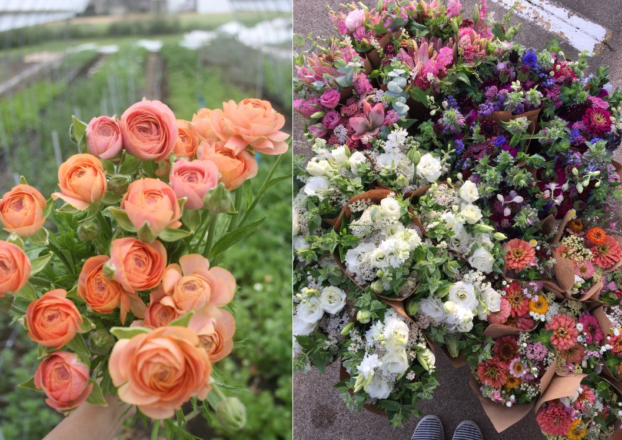
Oregon-grown roses from Peterkort - healthy, sustainably grown and simply beautiful!

Oregon-grown roses from Peterkort – healthy, sustainably grown and simply beautiful!

Design*Sponge: On the flip side, are there any varieties an earth-conscious consumer should avoid at standard flower stands?

Debra: Do you mean “conventional florists?” The wire-services are the biggest culprits in marketing and selling mass-produced, imported flowers to consumers. Most roses are imported. It makes me sad that even our so-called “green” grocery stores promote imported roses as sustainable, which to me feels like green-washing. I call South American-grown roses “softball-on-a-stick.” Big heads; fat, rigid stems; NO fragrance. That look and shape are giveaways for roses that have been bred for “ship-ability,” if that’s a word.

Domestic roses, which are still grown by family farms in Oregon and Washington, are hybrid teas or spray roses. These are more feminine and delicate (with slender stems) smaller heads and light to intense fragrance, depending on the variety. Here are a few sources for American-grown roses:

Wholesale, but you can ask your florist to order for you:

Peterkort Roses from Oregon

California Pajarosa

Direct to consumers:

Eufloria Flowers from California

David Austin cut roses from California

Rose Story Farm cut roses from California

Here are the American made vases  (and their marks) I love to use.

Here are the American made vases (and their marks) I love to use.

As a design website, our readers are often looking for ways to incorporate beautiful objects into their lives. Although your work focuses primarily on sustainable horticulture, the concept of sustainability certainly extends beyond living things to design objects. Do you have any go-to sources for beautiful, locally-made flower containers and gardening tools?

Debra: never thought I would be such a proponent of American Grown/American Made, but after writing The 50 Mile Bouquet and Slow Flowers, I appreciate the value and importance of promoting both domestic farms and domestic manufacturers. Even my books are printed in North American (not Asia!), on FSC certified paper with soy-based inks. I have my publisher to thank for making the choice to not print overseas.

Here are some of my favorite USA-Made floral resources:

Florian floral snips (for herbaceous and woody stems)

Thorn strippers (for stripping rose stems), designed by a floral designer and made in the USA

Vase Brace: A tray with bungee-style cords on all four corners, which makes it easy to transport a vase filled with flowers by car

Raw Materials work aprons

Bauer California pottery (wonderful vases, made in California)

Vintage American vases are easy to find online or at flea markets. Look for makes such as Floraline, McCoy, Haegar, Royal Copley, (vintage) Bauer and more.

**Sadly, I am still looking for USA-made women’s gardening gloves. No luck yet!

Summer dahlias remind me of my Grandad Ford's wonderful dahlia garden.

Summer dahlias remind me of my Grandad Ford’s wonderful dahlia garden.

Spring peonies remind me of my Grandpa Prinzing's peony beds.

Spring peonies remind me of my Grandpa Prinzing’s peony beds.

Design*Sponge: Your book covered a wide range of flower types and growers. What are your personal favorites— both in terms of flowers and your own local flower sellers?

Debra: Oh, what a question! I think childhood flower memories are incredibly powerful, and my personal family memories have formed my flower preferences. My maternal grandfather grew dahlias in his Indiana backyard; my paternal grandfather grew peonies in his Illinois backyard. Flower-growing skipped my parents’ generation and yet those genes came to me. I cherish dahlias and peonies to this day, thanks to my grandfathers’ flower beds.

Living in Seattle, I have the privilege of calling so many flower farmers my personal friends. They have welcomed me onto their farms and generously shared their growing secrets. Earlier this year, I joined the board of Seattle Wholesale Growers Market, our Northwest farmer-to-florist cooperative of about 15 Oregon, Washington and Alaska farms. The SWGMC is open to the public on Fridays, 10 a.m.-2 p.m., so anyone can shop for flowers direct from the farmer.

It has been a great experience to work with this group, rubbing shoulders with experienced growers and learning about their passion for heirloom varieties, unique floral crops and sustainable practices. This week at the market offers a snapshot of the incredible diversity of the moment; hellebores, snowdrops, grape hyacinths, euphorbia, pussy willow, calla lilies, tulips, daffodils, anemones, poppies, flowering dogwood, bridal wreath spirea, snowball viburnum – and some ingredients I’ve probably forgotten. It is mind-blowing and a floral designer’s dream.

Design*Sponge: What can others do to spread the word about sustainable flower production? What actions can be taken to introduce sustainable flowers to your region? 

Debra: The first thing you can do is grow your own flowers! Even if you just start by sowing one packet of sweet pea seeds, you will bring local flowers into your life. You can even grow a few in a pot with a trellis to train the vines — a small space cutting garden!

Next, seek out flower farmers in your area. If readers are stumped, they can email me and I’m happy to connect them with a grower in their region. There are passionate flower farmers in every state. Buy American Grown whenever possible and ask your local suppliers to verify the source of the flowers they stock.

Follow #Americangrown, #flowerfarmer, #originmatters and #slowflowers on Twitter to find more activity in the domestic flower world.

If you are interested in learning more about becoming a flower farmer, visit www.ascfg.org


SLOW FLOWERS: Week 14

Sunday, April 7th, 2013

Chocolate-and-Vanilla

Chocolate and Vanilla Flowers

A graphic, fresh combination: dark-chocolate-colored Anthriscus sylvestris foliage with creamy white Viburnum tinus flowers.

A graceful spring bouquet

The white square dish, elevated on a pedestal, makes this simple grouping of flowers all the more special.

Ingredients:

8-11 Viburnum tinus blooms, harvested from Charlotte Behnke’s Seattle garden

6 stems Anthriscus sylvestris ‘Ravenswing’, grown by Jello Mold Farm

6 stems bridal wreath spirea (Spiraea cantoniensis ‘Flore Pleno’), grown by Charles Little & Co.

3 stems green dogwood (Cornus sp.), harvested by Oregon Coastal Flowers

Vase:

6-inch square x 3-inch deep white ceramic nut dish (overall height is 8 inches)

Design 101
Elevate for importance: There’s something appealing about lifting a floral arrangement with a footed vase or dish. It’s like giving your bouquet a little stage or platform to help it rise above its environment. This is especially noticeable with an arrangement designed to be viewed on all sides, such as a centerpiece. If you don’t have a footed dish or urn, you can use a cake plate to elevate your flowers!

NOTE: Each Sunday of this year, I post my photographs, a how-to “recipe” and tip for that week’s floral arrangement, created for my new book, Slow Flowers.

Enjoy the floral journey through 52 weeks of the year~

Floral urns that earn my admiration

Friday, April 5th, 2013
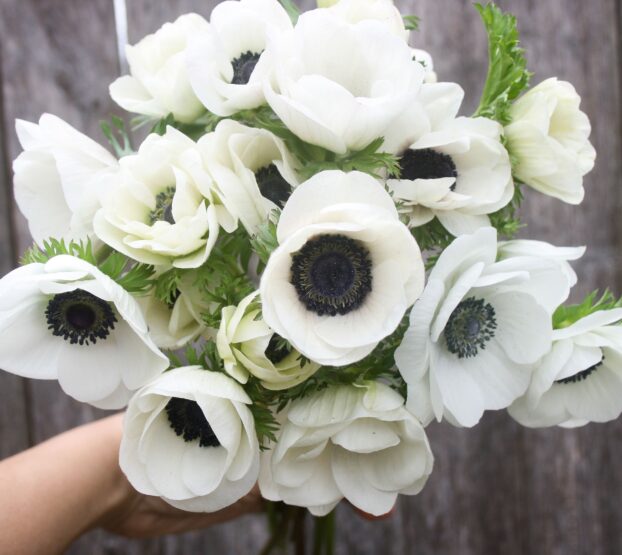
Two types of Vivian's delicious anemones

Two types of Vivian’s delicious anemones

With the arrival of spring here in Seattle, we flower lovers have lots to celebrate! That’s because the wistful beauty coming from our local flower fields, meadows and farms are simply sublime.

When I stepped inside the Seattle Wholesale Growers Market two days ago, I was stopped in my tracks. The botanical abundance in each stall made me catch my breath with happiness~ A new season is upon us – hurrah!!!

I brought home arm-loads of goodies, enough to make three lovely arrangements of three different sizes. The common threads are these blooms, including some clipped from my own garden. and the style of vase. I cannot resist a footed urn!

  •  Three bunches of anemones, including 2 clusers of a luscious, velvety maroon variety and one bunch of the coveted black-centered/white petaled variety, grown by Vivian Larson of Everyday Flowers in Stanwood, Washington.
  • One bunch of the *first-of-the-season* snowball viburnum, grown by Patrick Zweifel of Oregon Coastal Flowers in Tillamook, Oregon
  • One bunch of the *first-of-the-season* bridal wreath spirea, grown by Charles and Bethany Little of Charles Little & Co. in Eugene, Oregon
  • One bunch of Anthriscus sylvestris ‘Ravenswing’ and one bunch of garden hellebores, grown by Dennis Westphall and Diane Szukovathy of Jello Mold Farm in Mt. Vernon, Washington
  • From my garden: salmon pink tulips, grape hyacinths, delicate and pale-yellow flowers from epimedium (a ground-cover) and camellia foliage.
More yummy flower details

Hellebores play so nicely with snowball viburnums, anemones and more.

As noted above, my vase(s) of choice are footed urns or bowls. All three used here are vintage and quite dear to me.

I hope that seeing how I used them inspires you to snatch up a footed vase or bowl, an urn or anything with a pedestal base – they are indeed the superior vessels for showcasing flowers. If you frequent vintage sites online, flea markets or garage sales . . . maybe you’ll be just as lucky as I have been. I’ve used vintage metal flower frogs inside each. The frogs are like half-dome cages and because they are metal, they’re heavy enough to just sink to the bottom of the vessel (no tape or stickum required).

Constance Spry wrote about one of her favorite vases – a footed marble bowl – in her 1933 book Flower Decoration. I can only imagine how pricey one of these vases would be today! Here’s what she had to say:

“This vase is beautiful to look at whether empty or filled with flowers. It is so heavy that it is not disturbed by the heaviest branches of fruit or blossom, and its soft, pale-brown colour enhances whatever one chooses to put in it.”

Here are the designs that gave me so much pleasure:

Bouquet One

Green Floraline Pedestal Bowl

A Green Floraline Pedestal Bowl, featuring snowball viburnum, hellebores, anemones, Anthriscus foliage and bridal wreath spirea.

After I created and photographed this arrangement, I decided to see how it looked WITHOUT those spikey branches. So here’s version 2 of the same bouquet:


Green Pedestal Bowl and Turquoise Bud Vase

The spirea moved into the teal blue Haegar (vintage) bud vase, while the green Floraline footed bowl contains the remaining blooms.

Bouquet Two

Olive Glass Urn

With hellebores, white and burgundy anemones, salmon pink tulips, Anthriscus foliage, camellia foliage and bridal wreath spirea.

 Bouquet Three

Bronze Flea Market Pedestal Bowl

With Anthriscus foliage, hellebores, epimedium flowers, grape hyacinth, anemones and bridal wreath spirea.

Coming to Southern California

Friday, April 5th, 2013

SLOW FLOWERS: Week 13

Sunday, March 31st, 2013

Beauty from Branches

Beauty from Branches

A wistful combination of two spring-flowering branches, captured in the morning light. Aaah!

Ingredients:

Kerria japonica ‘Variegata’, which has white-edge leaves

Flowering quince (Chaenomeles x superba), available in coral, red, pink or white

Vase:

17-inch tall x 7-inch diameter cream urn. This is my go-to vase for last-minute arrangements and it is tall enough to handle the branches, which are nearly three feet long.

A vase filled with spring branches

If you add cut branches to the vase when the flowers haven’t yet opened, the warmth of your home will coax them into flowering indoors. . . for up to two weeks.

From the Farmer

Jump-start spring: Many flowering shrubs and trees are suitable for indoor forcing. In addition to Kerria and quince, you can cut the bare branches of forsythia, witch hazel and numerous fruit trees. Harvest branches when their buds begin to swell, taking care to use proper pruning techniques. Re-cut the stems on a 45-degree angle and place them in a vase of clean water. Over time, the buds will respond to your home’s warmer temperature and begin to flower. Be sure to change the water as you would with any floral arrangement.

NOTE: Each Sunday of this year, I will post my photographs, “recipe” and tip for that week’s floral arrangement, created for my new book, Slow Flowers.

Enjoy the floral journey through 52 weeks of the year~


SLOW FLOWERS: Week 12

Sunday, March 24th, 2013

Zen in Bloom

Showcasing a single type of flower - here, it's spring daffodils - this technique is easy and carefree.

Showcasing a single type of flower – here, it’s spring daffodils – this technique is easy and carefree.


Ingredients:

15 stems common daffodils, from my garden

Multiple lengths of coral-pink twig dogwood, cut approximately 2 inches wider than the vase opening. Any straight, woody branch will work, including vine maple, pussy willow or the colorful twig dogwood (Cornus sanguinea or C. sericea)

Vase:

6-inch tall x 6-inch square glass vase (this design adapts to any square or rectangular glass vase)

The daffodil stems are stabilized by a "raft" of twigs, lashed to cover the opening of the vase.

The daffodil stems are stabilized by a “raft” of twigs, lashed to cover the opening of the vase.

Other supplies:

Decorative pebbles

Twine-wrapped wire (available at craft stores in natural or green)

Design 101

Borrow inspiration: The idea for this bouquet came from a project featured in Design, a publication of The Flower Arranging Study Group of the Garden Club of America. Whenever you’re inspired by another designer’s technique, it’s important to give it your own twist rather than make a direct copy. For example, the original creation used florist’s foam inside the container, but I found it unnecessary, especially since the pebbles and twigs are enough to hold the daffodil stems in place.

NOTE: Each Sunday of this year, I will post my photographs, “recipe” and tip for that week’s floral arrangement, created for my new book, Slow Flowers.

Enjoy the floral journey through 52 weeks of the year~


SLOW FLOWERS: Weeks 10 and 11

Friday, March 15th, 2013

MAGNOLIAS AND MORE

Evergreen magnolia (Magnolia grandiflora), parrot tulips, rosemary, Japanese fantail willow and bare magnolia branches in bud fill one of my favorite white vases.

Evergreen magnolia (Magnolia grandiflora), parrot tulips, rosemary, Japanese fantail willow and bare magnolia branches in bud fill one of my favorite white vases.

A sweet detail of those luscious tulips - don't they play nicely with the rusty side of the magnolia foliage?

A sweet detail of those luscious tulips – don’t they play nicely with the rusty side of the magnolia foliage?

Ingredients:

5 stems southern magnolia (Magnolia grandiflora), harvested from my neighbors’ garden
12 stems apricot-hued parrot tulips, grown by Alm Hill Gardens
5 stems evergreen rosemary (Rosmarinus officinalis), harvested from my garden
3 stems Japanese fantail willow (Salix udensis ‘Sekka’), grown by J. Foss Garden Flowers
3 stems deciduous magnolia in bud, harvested by Oregon Coastal
Flowers
Vase: 17-inch tall x 7-inch diameter cream urn
Design 101
Proportion and Scale: These two related principles are among the most challenging to pull off correctly – in interiors and garden design, as well as in a vase. Proportion usually refers to size relationships within a composition, such as how each of the botanicals in this tall vessel is visually powerful. There are no wispy ingredients and the height of the arrangement is equal to the height of the vase. Scale indicates size in comparison to some constant, such as the human body. That’s where the terms “small scale” or “large scale” come in, since they refer to the out-of-the-ordinary size of things. With that in mind, think about the ideal interior setting for this vase. I think it would look stunning as the welcoming urn in a grand foyer or at the center of a large buffet table.

TULIPS & TWIGS

My cover shot, a perfect way to kick off springtime! Tulips, willows and camellia branches - all contained in a brilliant, matte green urn.

My cover shot, a perfect way to kick off springtime! Tulips, willows and camellia branches – all contained in a brilliant, matte green urn.

Ingredients:
12 stems red tulips and 10 stems yellow tulips, grown by Alm Hill Gardens
6 stems curly willow (Salix matsudana ‘Tortuosa’), grown by Oregon Coastal Flowers
8 stems Camellia japonica, from my garden
Vase:
5-inch tall x 6-inch diameter matte green urn with handles
From the Farmer
Water lovers: Unlike most floral design ingredients, tulips and willow branches seem to keep growing in a vase of water. You’ll notice that the tulip stems elongate a little each day. Some designers prefer to take the arrangement apart and re-cut the lengthened stems, but I like to observe the changes that occur. Willow is a water-loving plant, so you may discover that it sprouts tiny white roots under water and that small green leaves will push open, as if it is growing in soil. Enjoy a few days of this ever-changing dynamic.
A detail of the colors and textures of springtime.

A detail of the colors and textures of springtime.

NOTE: Each Sunday of this year, I will post my photographs, “recipe” and tip for that week’s floral arrangement, created for my new book, Slow Flowers. Enjoy the floral journey through 52 weeks of the year~


SLOW FLOWERS: Weeks 8 and 9

Sunday, March 3rd, 2013

Been busy here . . . in the midst of Flower & Garden Show season, so I missed last week’s bouquet. Let’s play catch up and here, I’ll feature Week 8 and Week 9:

 “JUST ADD LIME”

Oh how I love this combination of everyday garden blooms, including daffodils, forsythia and euphorbia - with a few sprigs of variegated geranium for contrast.

Oh how I love this combination of everyday garden blooms, including daffodils, forsythia and euphorbia – with a few sprigs of variegated geranium for contrast.

The spring green color of new growth is indescribably beautiful.

The spring green color of new growth is indescribably beautiful.

Ingredients:
All ingredients were harvested from my Seattle garden:
  • 5 stems donkey tail spurge (Euphorbia myrsinites)
  • 3 stems Euphorbia characias
  • 5 stems variegated rose mint scented geranium (Pelargonium Graveolens Group ‘Variegata’)
  • 7 stems forsythia branches (Forsythia x intermedia)
  • 7 stems daffodils (Narcissus sp.), unknown cultivars
Vase:
5¾-inch tall x 5-inch diameter glazed ceramic vase
From the Farmer
Working with euphorbia: Most plants in the spurge family produce a milky-white substance when cut. It can be irritating to the skin, so be sure to wear gloves when handling the plant. While harvesting, I place the stems in a bucket of water, separating them from any other cut ingredients. Then I bring them into my kitchen where I dunk the tip of each euphorbia stem into a bowl filled with boiling water from the teakettle. This seals the stems.  Some experts recommend searing the tips in a stove top flame, but that has proven too messy for my liking.

“HEADY HYACINTH”

A simple length of linen twine gathers these garden hyacinths. They practically arrange themselves!

A simple length of linen twine gathers these garden hyacinths. They practically arrange themselves!

Ingredients:

8 stems hyacinths (Hyacinthus orientalis), grown by Alm Hill Gardens

Vase:
7-inch tall x 7-inch square glass cube
Detail of the gathered bouquet

Detail of the gathered bouquet

Seasonal Choices

About those long stems: The typical garden hyacinth blooms on a relatively short stem – maybe 4-5 inches at the most. This limits the way hyacinths can be used in floral arrangements. According to Gretchen Hoyt, the way to stretch those stems is to trick them into wanting more light. “The longer you can deny them light, the more they stretch,” she explains. At the commercial flower farm, this process begins in dark coolers where bulbs are pre-chilled. When they are transferred to the greenhouse, the hyacinth crates are placed (in the shadows) beneath tables where tulips grow. If Gretchen wants to elongate those stems even further, “I’ll throw newspaper over them,” she says. Leaving bulbs on the stems is optional, but some designers do so to give the arrangement a rustic appearance.

SLOW FLOWERS: Week 7

Sunday, February 17th, 2013

“Lilies, Two Ways”

Two "lily" elements fill my antique majolica cachepot, set in the dining room window to catch the rare winter rays of sunshine

Two “lily” elements fill my antique majolica cachepot, set in the dining room window to catch the rare winter rays of sunshine

Ingredients:
12 stems lily-of-the-valley shrub (Pieris japonica), harvested by Oregon Coastal Flowers
5 stems white ‘Navona’ Asiatic lilies, grown by Peterkort Roses
Vase:
9-inch tall x 9¼-inch diameter majolica cachepot from the late 1800s. I found this unique piece in Palm Springs, in a shop otherwise filled with 1950s art glass. I simply couldn’t resist the botanical charm of the piece, so I splurged and ended up flying home with it on my lap!
A detail from inside the vase . . .

A detail from inside the vase . . .

Eco-technique

Flower frogs: I’ve made it a personal goal to stabilize flower stems with organic methods rather than the conventional florist’s foam or “Oasis.” That product, I have learned, contains formaldehyde and does not break down in landfills. An old-fashioned flower frog (in ceramic, glass or metal) is a great alternative. You can find flower frogs at flea markets or tag sales for a few dollars (or raid your grandmother’s supply). One of my favorites is a half-dome cage. It sinks to the bottom of the container and has ¾-inch square openings, ideal for woody stems. This is an arranging tool of the past, seriously useful for the present-day!

NOTE: Each Sunday of this year, I will post my photographs, “recipe” and tip for that week’s floral arrangement, created for my new book, Slow Flowers. Enjoy the floral journey through 52 weeks of the year~


Thank you, Constance Spry

Wednesday, February 13th, 2013
Yes, I have her signature in my used copy of "Flowers in House and Garden," published in 1937.  Signed in pencil, the inscription is dated February 1939.

Yes, I have her signature in my used copy of “Flowers in House and Garden,” published in 1937. Signed in pencil, the inscription is dated February 1939.


Lately, I’ve been reading a lot about the first celebrity floral designer, Constance Spry.

The famous Mrs. Constance Spry

The famous Mrs. Constance Spry

If you haven’t heard about her, check out the newish biography called The Surprising Life of Constance Spry, by Sue Shephard (2011). Mrs. Spry was at her peak of popularity between the two World Wars, and I loved reading about her magnificent cutting garden that supplied her London studio and shop called Flower Decoration in the ’30s, ’40s and ’50s.

Speaking of Flower Decoration, that is the name of a volume that Mrs. Spry wrote in 1933. Re-issued in 1993, you can find it online used, filled with her strong opinions, witticisms, and black-and-white photographs of floral arrangements. These are a little dated, of course, but what stands out to me is the eclectic lineup of ingredients, which includes many flowers, foliage and edibles that today’s hip floral designers think they’ve popularized.

Guess what? Mrs. Spry did it first!

The rest of us have just discovered the ingredients with which she created lush, naturalistic, unfussy bouquets. Cherry tomatoes, grape clusters, gourds, fig leaves, sea-kale, agapanthus seed heads, amaranth, rhubarb and artichokes are wonderful floral elements showing up in couture bouquets and magazine spreads. But Constance Spry used them first – and that’s quite fun to RE-discover.

READ MORE…