Debra Prinzing

Archive for the ‘Plants’ Category

SLOW FLOWERS: Week 20

Sunday, May 19th, 2013

A Softer Side of Green

Pastel bouquet

An unexpected combination, inspired by the pale ‘Supergreen’ hybrid tea roses given to me by the grower


Pastel flowers in detail

This sweet detail shows the delicate features of the apricot verbascum and the varietgated Star of Bethlehem

Ingredients:

15 stems Dusty Miller foliage (Centaurea cineraria), grown by Charles Little & Co.
5 stems lamb’s ears (Stachys byzantina), grown by Charles Little & Co.
15 stems ‘Supergreen’ hybrid tea roses, grown by Peterkort Roses
9 stems Star of Bethlehem (Ornithogalum nutans), grown by Choice Bulb Farms
6 stems Verbascum ‘Caribbean Crush’, grown by Jello Mold Farm
Vase:
7½-inch tall x 7-inch diameter woven basket with a 6-inch tall x 6½ inch wide glass insert
Eco-technique
Vase in an instant: Any container can double as a flower vase as long as you can hide a watertight vessel inside of it. This simple, budget-conscious technique instantly expands your design choices. I frequently pick up glass vases for 50-cents to a few dollars at the thrift store, which means I always have extras on hand to tuck inside boxes, baskets, tins – and even leaky watering cans .


SLOW FLOWERS: Week 19

Sunday, May 12th, 2013

FIRST PEONIES OF THE SEASON

Peonies from Ojeda Farms
These luscious red peonies from a local grower reflect the garnet-colored art glass and complement two forms of ornamental allium.
Foliage detail

The lady’s mantle foliage is absolutely the BEST for spring bouquets. And if your garden is like mine, it’s super abundant right now!

Ingredients:
10 stems red peonies, grown by Ojeda Farms
7 stems each ‘Purple Sensation’ and ‘Cowanii’ ornamental alliums, grown by Choice Bulb Farms
12 stems lady’s mantle foliage (Alchemilla mollis), harvested from my garden

Vase:
9-inch tall x 5-inch diameter hand-blown glass vase

Design 101
Create a collar: You can use flowers or foliage to ring the base of a bouquet or arrangement as a finishing detail. This technique is usually done as the bouquet’s last step. For this arrangement, I pre-cut the greenery and then added it beneath the peonies, slightly overlapping each stem as I worked around the circumference of the bouquet. Here, the lady’s mantle visually separates the dark red peonies from the wine-red vase.


By the Bunch: A NEW and beautiful local source for flowers

Thursday, May 9th, 2013

Lots of news to share, including this very timely interview that Seattle’s NPR station KPLU-FM aired today. Environment reporter Bellamy Pailthorp contacted me to discuss “sustainable flowers for Mother’s Day,” and thanks to her incredible interviewing and editing talents, a 25-minute conversation turned into a 4-1/2 minute segment. You can listen to it here.

By the Bunch

Remember this cool logo: By the Bunch. It means these gorgeous bouquets are possible because their ingredients were grown by a bunch of awesome NW flower farmers

The interview gave me a chance to talk about the excitement at the Seattle Wholesale Growers Market – a just-launched supermarket bouquet program called “By the Bunch.” The beauty of this program is that it produces a sizeable income stream for every farmer-member at the SWGM Cooperative. Together they are so much more than the sum of their parts (or their flower fields, for that matter).

Today, the Thursday before Mother’s Day, was perhaps the most insane work day ever experienced by the Bouquet team, including managers Kristen Parris and Nicole Cordier, along with their new design team members, Carly and Michelle.

But in order to produce a staggering number of bouquets today – something like 700 bunches – flower farmers Diane Szukovathy and Vivian Larson had to show up and volunteer their time as bouquet-makers. I stopped by at around 9:30 a.m. to catch the activity.

Nicole with flowers

SWGMC Front-Desk Manager, talented designer and inspiring leader for the local flower movement, Nicole Cordier.

Oh, bouquet-making sounds so romantic, doesn’t it? But by 7 p.m., when I had to bring by supplies for a special event tomorrow morning, Kristen and Nicole were still there, finishing up the final 100 bunches. Ever-positive, but clearly exhausted, these women believe so much in getting sustainable and locally-grown blooms into the hands of Seattle area consumers that they are willing to go without food and breaks just to achieve the goal. As I told them: If you can get through Mother’s Day, you can do anything. (They probably didn’t need to hear it from me!)

Read more about the By the Bunch program here. The brand development, graphic design and packaging is supported by a USDA Multi-State Specialty Crop Block Grant through the Washington State Department of Agriculture and the Oregon Department of Agriculture.

My photos from today’s visit will wow you. If you haven’t figured out what to give Mom for her special day on Sunday, May 12th, stop by these outlets for LOCAL, SEASONAL Bouquets – straight from Northwest fields: PCC Natural Markets, Town & Country Markets and Madison Market.

My camera snatched some of today’s delicious springtime beauty to share:

Sweet Peas

Sweet peas – so yummy in color, fragrance and form~

Snowball Viburnum

For the most perfect “fresh” green color of springtime, snowball viburnum. Aaah!

Ranunculus & Cherry blossoms

Just-picked floral elements await inclusion in mixed bouquets. Ranunculus and cherry blossoms

Michelle with bouquets

At 9:30 a.m. today, Michelle was ready to wheel an entire cart of bunches into the cooler. So exciting to have her on the SWGMC team!

Field-grown Tulips

The combination of green and pink petals make this the most sublime tulip I’ve ever seen.

Diane & Carly

A moment to smile, and who wouldn’t? Creating bouquets for Mother’s Day is a special job – and Diane Szukovathy of Jello Mold Farm (and SWGMC president) was on hand to help designer Carly and the rest of the team this morning.

Cherry blossoms and sweet peas

Buckets of flowers, ready to gather into sweet Mother’s Day bouquets

Diane & Vivian

Two of the founding farmers of SWGMC, Diane Szukovathy and Vivian Larson, spent the morning making bouquets with the team.

By the Bunch at PCC

Later this morning I stopped by my local PCC Natural Market to see the By the Bunch floral display. Gotta love this messaging~

For every mother out there, HAPPY MOTHER’S DAY ~ and may you enjoy your garden, your flowers and your families.

Eight Days: From Santa Barbara to San Diego . . . and points in between

Wednesday, April 24th, 2013

Here’s what I’ve been up to lately. I traveled to Southern California all of last week  - from Saturday, April 13th through Saturday, April 20th.  I experienced many great highlights; too many to mention. Here are some of them:

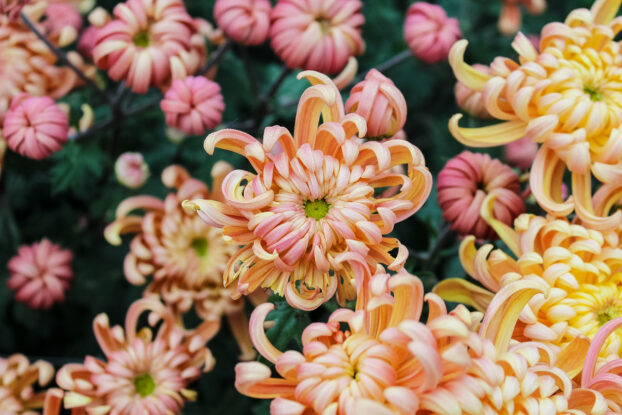
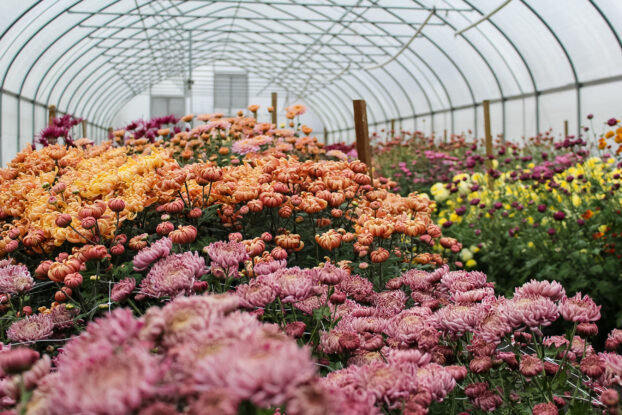
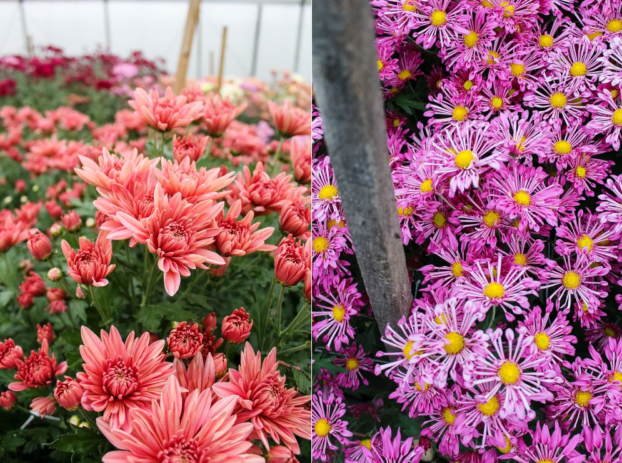
Miles of mums at Ocean Breeze

Tours focused on the entire process – from planting and growing to harvesting and grading. Mums, also known as pom poms, are one of the last commercially grown flowers still grown in soil.

My name badge

Fun to wear the VIP badge!

Chalkboard welcome

Chalkboard welcome at Padaro Floral in Carpinteria, California

DAY One: Carpinteria Greenhouse & Nursery Tour, sponsored by the California Cut Flower Commission. I was hosted by Harry and Michele Van Wingerden, the great folks at Myriad Roses and Padaro Floral Design for a day of book-signings and eco-floral demonstrations. A special thanks to the Van Wingerden family, CCFC CEO/Ambassador Kasey Cronquist and Event Planner Anna Kalins for making it a successful and enjoyable day!

botanik owner Erin Taylor

Erin Taylor, designer of flowers, interiors, landscapes and more~ The talented owner of botanik in Summerland, California hosted my lovely book event.

DAY Two: Book signing and flower demos at botanik in Summerland. Loved spending time with very talented owner Erin Taylor and her team. After several hours at botanik, I met up with Cristi Walden and we headed to Sea Crest Nursery, her father Jack Stevenson’s palm and cycad collection. It was so exciting to return to this beautiful place and hear how my talented friend is learning the business of growing and selling amazing landscaping plants (oh, and propagating, too!).

READ MORE…

SLOW FLOWERS: Week 16

Sunday, April 21st, 2013

Fresh and Fragrant

Lilacs and more

A yummy spring bouquet – straight from local farms and fields

Beautiful blooms

Another closeup – I can’t resist!


Ingredients:

10 stems purple lilacs (Syringa vulgaris), grown by Oregon Coastal Flowers

10 stems garden hellebores (Helleborus orientalis), grown by Jello Mold Farm

10 stems Fritillaria assyriaca, a spring-flowering bulb, grown by Choice Bulb Farms

Vase:

17-inch tall x 7-inch diameter cream urn

From the Farmer

Hellebore how-to: Anyone who grows hellebores in their garden knows how frustrating it is to cut a few blooms and bring them inside, only to watch them wilt in a vase of water. Now I enjoy success when I use hellebores in my bouquets, thanks to an important lesson shared by Diane Szukovathy, co-owner of Jello Mold Farm. “Harvest hellebores after they have matured past the flower stage and the seed pods are beginning to form,” she advises. “By then, the petals have started to leather up and those hellebores will be rock solid in an arrangement for ten days.”


SLOW FLOWERS: Week 14

Sunday, April 7th, 2013

Chocolate-and-Vanilla

Chocolate and Vanilla Flowers

A graphic, fresh combination: dark-chocolate-colored Anthriscus sylvestris foliage with creamy white Viburnum tinus flowers.

A graceful spring bouquet

The white square dish, elevated on a pedestal, makes this simple grouping of flowers all the more special.

Ingredients:

8-11 Viburnum tinus blooms, harvested from Charlotte Behnke’s Seattle garden

6 stems Anthriscus sylvestris ‘Ravenswing’, grown by Jello Mold Farm

6 stems bridal wreath spirea (Spiraea cantoniensis ‘Flore Pleno’), grown by Charles Little & Co.

3 stems green dogwood (Cornus sp.), harvested by Oregon Coastal Flowers

Vase:

6-inch square x 3-inch deep white ceramic nut dish (overall height is 8 inches)

Design 101
Elevate for importance: There’s something appealing about lifting a floral arrangement with a footed vase or dish. It’s like giving your bouquet a little stage or platform to help it rise above its environment. This is especially noticeable with an arrangement designed to be viewed on all sides, such as a centerpiece. If you don’t have a footed dish or urn, you can use a cake plate to elevate your flowers!

NOTE: Each Sunday of this year, I post my photographs, a how-to “recipe” and tip for that week’s floral arrangement, created for my new book, Slow Flowers.

Enjoy the floral journey through 52 weeks of the year~

Floral urns that earn my admiration

Friday, April 5th, 2013
Two types of Vivian's delicious anemones

Two types of Vivian’s delicious anemones

With the arrival of spring here in Seattle, we flower lovers have lots to celebrate! That’s because the wistful beauty coming from our local flower fields, meadows and farms are simply sublime.

When I stepped inside the Seattle Wholesale Growers Market two days ago, I was stopped in my tracks. The botanical abundance in each stall made me catch my breath with happiness~ A new season is upon us – hurrah!!!

I brought home arm-loads of goodies, enough to make three lovely arrangements of three different sizes. The common threads are these blooms, including some clipped from my own garden. and the style of vase. I cannot resist a footed urn!

  •  Three bunches of anemones, including 2 clusers of a luscious, velvety maroon variety and one bunch of the coveted black-centered/white petaled variety, grown by Vivian Larson of Everyday Flowers in Stanwood, Washington.
  • One bunch of the *first-of-the-season* snowball viburnum, grown by Patrick Zweifel of Oregon Coastal Flowers in Tillamook, Oregon
  • One bunch of the *first-of-the-season* bridal wreath spirea, grown by Charles and Bethany Little of Charles Little & Co. in Eugene, Oregon
  • One bunch of Anthriscus sylvestris ‘Ravenswing’ and one bunch of garden hellebores, grown by Dennis Westphall and Diane Szukovathy of Jello Mold Farm in Mt. Vernon, Washington
  • From my garden: salmon pink tulips, grape hyacinths, delicate and pale-yellow flowers from epimedium (a ground-cover) and camellia foliage.
More yummy flower details

Hellebores play so nicely with snowball viburnums, anemones and more.

As noted above, my vase(s) of choice are footed urns or bowls. All three used here are vintage and quite dear to me.

I hope that seeing how I used them inspires you to snatch up a footed vase or bowl, an urn or anything with a pedestal base – they are indeed the superior vessels for showcasing flowers. If you frequent vintage sites online, flea markets or garage sales . . . maybe you’ll be just as lucky as I have been. I’ve used vintage metal flower frogs inside each. The frogs are like half-dome cages and because they are metal, they’re heavy enough to just sink to the bottom of the vessel (no tape or stickum required).

Constance Spry wrote about one of her favorite vases – a footed marble bowl – in her 1933 book Flower Decoration. I can only imagine how pricey one of these vases would be today! Here’s what she had to say:

“This vase is beautiful to look at whether empty or filled with flowers. It is so heavy that it is not disturbed by the heaviest branches of fruit or blossom, and its soft, pale-brown colour enhances whatever one chooses to put in it.”

Here are the designs that gave me so much pleasure:

Bouquet One

Green Floraline Pedestal Bowl

A Green Floraline Pedestal Bowl, featuring snowball viburnum, hellebores, anemones, Anthriscus foliage and bridal wreath spirea.

After I created and photographed this arrangement, I decided to see how it looked WITHOUT those spikey branches. So here’s version 2 of the same bouquet:


Green Pedestal Bowl and Turquoise Bud Vase

The spirea moved into the teal blue Haegar (vintage) bud vase, while the green Floraline footed bowl contains the remaining blooms.

Bouquet Two

Olive Glass Urn

With hellebores, white and burgundy anemones, salmon pink tulips, Anthriscus foliage, camellia foliage and bridal wreath spirea.

 Bouquet Three

Bronze Flea Market Pedestal Bowl

With Anthriscus foliage, hellebores, epimedium flowers, grape hyacinth, anemones and bridal wreath spirea.

SLOW FLOWERS: Week 13

Sunday, March 31st, 2013

Beauty from Branches

Beauty from Branches

A wistful combination of two spring-flowering branches, captured in the morning light. Aaah!

Ingredients:

Kerria japonica ‘Variegata’, which has white-edge leaves

Flowering quince (Chaenomeles x superba), available in coral, red, pink or white

Vase:

17-inch tall x 7-inch diameter cream urn. This is my go-to vase for last-minute arrangements and it is tall enough to handle the branches, which are nearly three feet long.

A vase filled with spring branches

If you add cut branches to the vase when the flowers haven’t yet opened, the warmth of your home will coax them into flowering indoors. . . for up to two weeks.

From the Farmer

Jump-start spring: Many flowering shrubs and trees are suitable for indoor forcing. In addition to Kerria and quince, you can cut the bare branches of forsythia, witch hazel and numerous fruit trees. Harvest branches when their buds begin to swell, taking care to use proper pruning techniques. Re-cut the stems on a 45-degree angle and place them in a vase of clean water. Over time, the buds will respond to your home’s warmer temperature and begin to flower. Be sure to change the water as you would with any floral arrangement.

NOTE: Each Sunday of this year, I will post my photographs, “recipe” and tip for that week’s floral arrangement, created for my new book, Slow Flowers.

Enjoy the floral journey through 52 weeks of the year~


SLOW FLOWERS: Week 12

Sunday, March 24th, 2013

Zen in Bloom

Showcasing a single type of flower - here, it's spring daffodils - this technique is easy and carefree.

Showcasing a single type of flower – here, it’s spring daffodils – this technique is easy and carefree.


Ingredients:

15 stems common daffodils, from my garden

Multiple lengths of coral-pink twig dogwood, cut approximately 2 inches wider than the vase opening. Any straight, woody branch will work, including vine maple, pussy willow or the colorful twig dogwood (Cornus sanguinea or C. sericea)

Vase:

6-inch tall x 6-inch square glass vase (this design adapts to any square or rectangular glass vase)

The daffodil stems are stabilized by a "raft" of twigs, lashed to cover the opening of the vase.

The daffodil stems are stabilized by a “raft” of twigs, lashed to cover the opening of the vase.

Other supplies:

Decorative pebbles

Twine-wrapped wire (available at craft stores in natural or green)

Design 101

Borrow inspiration: The idea for this bouquet came from a project featured in Design, a publication of The Flower Arranging Study Group of the Garden Club of America. Whenever you’re inspired by another designer’s technique, it’s important to give it your own twist rather than make a direct copy. For example, the original creation used florist’s foam inside the container, but I found it unnecessary, especially since the pebbles and twigs are enough to hold the daffodil stems in place.

NOTE: Each Sunday of this year, I will post my photographs, “recipe” and tip for that week’s floral arrangement, created for my new book, Slow Flowers.

Enjoy the floral journey through 52 weeks of the year~


SLOW FLOWERS: Weeks 10 and 11

Friday, March 15th, 2013

MAGNOLIAS AND MORE

Evergreen magnolia (Magnolia grandiflora), parrot tulips, rosemary, Japanese fantail willow and bare magnolia branches in bud fill one of my favorite white vases.

Evergreen magnolia (Magnolia grandiflora), parrot tulips, rosemary, Japanese fantail willow and bare magnolia branches in bud fill one of my favorite white vases.

A sweet detail of those luscious tulips - don't they play nicely with the rusty side of the magnolia foliage?

A sweet detail of those luscious tulips – don’t they play nicely with the rusty side of the magnolia foliage?

Ingredients:

5 stems southern magnolia (Magnolia grandiflora), harvested from my neighbors’ garden
12 stems apricot-hued parrot tulips, grown by Alm Hill Gardens
5 stems evergreen rosemary (Rosmarinus officinalis), harvested from my garden
3 stems Japanese fantail willow (Salix udensis ‘Sekka’), grown by J. Foss Garden Flowers
3 stems deciduous magnolia in bud, harvested by Oregon Coastal
Flowers
Vase: 17-inch tall x 7-inch diameter cream urn
Design 101
Proportion and Scale: These two related principles are among the most challenging to pull off correctly – in interiors and garden design, as well as in a vase. Proportion usually refers to size relationships within a composition, such as how each of the botanicals in this tall vessel is visually powerful. There are no wispy ingredients and the height of the arrangement is equal to the height of the vase. Scale indicates size in comparison to some constant, such as the human body. That’s where the terms “small scale” or “large scale” come in, since they refer to the out-of-the-ordinary size of things. With that in mind, think about the ideal interior setting for this vase. I think it would look stunning as the welcoming urn in a grand foyer or at the center of a large buffet table.

TULIPS & TWIGS

My cover shot, a perfect way to kick off springtime! Tulips, willows and camellia branches - all contained in a brilliant, matte green urn.

My cover shot, a perfect way to kick off springtime! Tulips, willows and camellia branches – all contained in a brilliant, matte green urn.

Ingredients:
12 stems red tulips and 10 stems yellow tulips, grown by Alm Hill Gardens
6 stems curly willow (Salix matsudana ‘Tortuosa’), grown by Oregon Coastal Flowers
8 stems Camellia japonica, from my garden
Vase:
5-inch tall x 6-inch diameter matte green urn with handles
From the Farmer
Water lovers: Unlike most floral design ingredients, tulips and willow branches seem to keep growing in a vase of water. You’ll notice that the tulip stems elongate a little each day. Some designers prefer to take the arrangement apart and re-cut the lengthened stems, but I like to observe the changes that occur. Willow is a water-loving plant, so you may discover that it sprouts tiny white roots under water and that small green leaves will push open, as if it is growing in soil. Enjoy a few days of this ever-changing dynamic.
A detail of the colors and textures of springtime.

A detail of the colors and textures of springtime.

NOTE: Each Sunday of this year, I will post my photographs, “recipe” and tip for that week’s floral arrangement, created for my new book, Slow Flowers. Enjoy the floral journey through 52 weeks of the year~