Do search

Archive for the ‘Plants’ Category

Flowers, friends and fun in Colorado

Thursday, May 26th, 2011

Here I am with Arthur Williams, talented floral designer from Babylon Floral in Denver.

Where have I been lately? Last week, I hopped on an airplane and flew to Denver, which surprisingly is only 2-1/4 hours away from Seattle.

At the invitation of the Denver Botanic Gardens, my collaborator David Perry and I spent three lovely days giving talks and workshops about some of our favorite topics. We met some wonderful new friends and were inspired by the DBG’s beauty as a public space for all of Denver to enjoy.

Last Wednesday evening, I spoke about the “Personal Outdoor Dwelling,” aka “stylish sheds,” featuring many of Bill Wright’s gorgeous photos from our book Stylish Sheds and Elegant Hideaways.

Then on Thursday, David and I made a joint presentation on “A Year in Flowers: Seasonal, Local and Sustainable Ingredients.” We split the talk into two parts, an illustrated lecture and a flower design demonstration.

My arrangement from the demonstration, featuring Colorado-grown flowers and choke-cherry foliage from the Denver Botanic Gardens.

I was so fortunate that Denver floral artist and designer Arthur Williams, of Babylon Floral, helped procure locally-grown cut flowers for me to work with. Not only that, but he lent me some vases to use. We so enjoyed meeting Arthur and visiting his colorful shop (he’s pretty colorful, too – check out his arms!).

The following morning, Dave taught a hands-on photo workshop that wowed his students with new-found skills for their point-and-shoot digital cameras.

David's photography talk included practical, hands-on training at the botanic garden.

While Dave was with his students, I wandered along the Botanic Garden paths and through the various themed displays, taking in early Rocky Mountain spring day.

We found that the pace of spring’s unfolding in Denver is quite similar to Seattle’s this year. In other words, cooler than normal and later than normal. You’ll see what I mean in the photos I took.

On Friday, we spent a delightful afternoon with my friend and former editor Marlene Blessing. Marlene was my editor on The Abundant Garden and she also created the Pacific Northwest Garden Survival Guide and asked me to write it in 2004. She is an awesome writing coach and an encouraging advisor from whom I learned a lot about storytelling and book creation. I gained much confidence as a writer while working with this dear woman.

Marlene is presently the editor-in-chief of Interweave Press Books. After all the hue and cry about the publishing world falling apart, we took great comfort in the inspired, aggressive and confident approach to niche publishing embodied by this Loveland, Colorado-based imprint. With an emphasis on fiber arts and craft books, Interweave is led by a highly creative and innovative group, including Marlene. You can only imagine the compelling topics we covered during dinner later that evening. Marlene calls Interweave Press founder and creative director Linda Ligon her “Sensei,” but we kinda want to call Marlene our very own Sensei — what a breath of fresh air in a world of book-making!

Chet Anderson (center), with his mom Belle (left) and wife Kristy (right) at their Boulder County Farmer's Market booth.

After eating a delicious meal at Sugarbeet, a hip Longmont restaurant, we retired rather late and incredibly satisfied with our productive day. Bright and early Saturday morning, I picked Dave up at his hotel and we drove about 30 minutes to Boulder. There, we met up with Chet and Kristy Anderson, owners of The Fresh Herb Co., at their Boulder County Farmer’s Market booth.

Chet and Kristy’s farm is actually in Longmont, and they sell most of what they grow through Whole Foods and other retail outlets, but they still bring herb plants, hanging baskets and cut flowers to this market every Saturday. It is the only market in this part of Colorado that requires its vendors to sell what they produce. No dealers or re-sellers here. You meet the growers, purveyors and farmers who have raised or produced their goods – from amazing mushrooms to colorful Easter egg-colored radishes, to beautiful bouquets and more.

Rows and rows of luscious lilies fill 15,000-square-feet of covered growing area at The Fresh Herb Co.

It was fun to walk the market with Chet, who, I swear, could easily be called the “mayor” of the Boulder County Farmer’s Market. His popularity seems second only to his mother Belle’s popularity. She is there every week, helping at The Fresh Herb Co. booth, talking with new and returning customers, and greeting other vendors as longtime friends. It was fun to meet her!

David, Leesly Leon from the Denver Botanic Garden, me, Kristy and Chet Anderson - a group portrait at The Fresh Herb Co.

We followed Chet back to the family’s homestead and farm so that David could do some photography before a tour group from Denver Botanic Garden arrived. Leesly Leon, the DBG’s adult program coordinator, lined up the field trip so that some of the students in our workshops could have a first-hand visit to a flower farm. Chet and Kristy are very successful at what they do, but they are also passionate and humble about their role in bringing flowers from their fields to the customer’s vase.

 ”When you know and meet the grower, and when the flowers are fresh and locally grown, there’s no better flower bargain,” Chet told the group. We couldn’t agree more!

Here are some more photographs from our trip – I loved every moment, every visual impression, and the great people we met.

Friday garden field trip

Thursday, May 12th, 2011

Sigh. What else can you say in response to these gorgeous, white bleeding hearts?

Well, this field trip was LAST Friday, but you’ll enjoy my photos all the same. If you don’t know about the July 22-25th Garden Bloggers Seattle Fling, then check it out here.

My pals Lorene, Marty and Mary Ann  and I were persuaded to “host” this horticultural free-for-all that can be best decribed as a weekend of garden touring and networking for bloggers around the globe.

Lorene and I headed out last Friday to scout a couple amazing residential gardens that we want to include on the tour, as well as the Bellevue Botanical Garden. It’s truly still spring here in Seattle; I’ve been away for four years, living and gardening in Zone 10-+, but I don’t remember this persistent rain, wet, gray, chilliness as late as mid-May. So when you see the photos I took on May 6th, you might be surprised! They look very April-ish, don’t they?

Even still, it was exhilarating to have a glimpse of the soon-to-arrive “season” of blooming and unfurling. Please enjoy along with me:

What a sultry combo, spotted at Michelle and Christopher Epping's garden in Newcastle. This will be a stop on the Bloggers' Fling. Yummy Rodgersia + sooty-black Mondo grass.

I love this modern, see-through, cube-planter at BBG. I want one, preferably in this gorgeous weathered steel.

More steel, this time in an orb, suitably displayed in a bed of tumbled riverrock.

Stone totems paired with grasses create a lovely entrance at the Bellevue Botanical Garden.

When lilacs meet hellebores . . . and play with fritillaries

Friday, April 29th, 2011

A yummy spring bouquet - straight from local farms and fields

 Springtime is embodied in this vase, isn’t it?

Take a visual "whiff" and enjoy this combination of three lovely flowers.

You can almost smell that heady perfume associated with Syringa vulgaris, or the common lilac. To me, the fragrance is associated with my lifelong relationship with flowers. 

We lived in rental house in Connecticut when I was in elementary school; the backyard was home to an overgrown lilac that drew me to its blossoms (we loved playing underneath the flower-laden branches and smelling spring). 

Later, when I was a teenager, I remember secretly harvesting armloads at a city park and carrying them to school in May, as if I was in a pageant! 

When we planted our former Seattle garden in the late 1990s, I asked my friend Karen to select a lilac for the border. She chose one called ‘Sensation’ – it has deep purple florets and each petal is rimmed in white. That shrub never disappointed. . . and I waited for its blooms each year until we moved away. 

And most recently, while living in Southern California, I nearly fainted when I happened upon a lilac farmer at my local market. I was so fascinated to learn lilacs can grow there at a high elevations, such as in Lancaster, Calif., north of LA. I even had to run back to my car for my camera so I could interview her about those unforgettable flowers

Another closeup - I can't resist!

Today’s bouquet features the addition of several Jadeite-green garden hellebores and a few sultry plum-and-yellow Fritillaria assyriaca. These companions turn two bunches of just-cut lilacs into a sweet bouquet for my fireplace mantel. 

And the best thing about these blooms? They’re from local Northwest flower farmers – yeah! 

The lilacs were grown by Oregon Coastal Flowers in Tillamook, Ore. 

The hellebores were grown by Jello Mold Farm in Mt. Vernon, Wash. 

The fritillarias were grown by Choice Bulb Farms in Mt. Vernon, Wash. Check out David Perry’s gorgeous still life of this unusual flower at our blog, A Fresh Bouquet

If you’re a floral, event or wedding designer, be sure to meet these fabulous farmers at Seattle Wholesale Growers Market. If you’re a customer, be sure to ask your designer to patronize this amazing cooperative of local growers. Their motto is awesome: From Farm to Florist.

Here’s a link to a little post and gallery from my visit earlier this week.

Got twigs? Branch out and decorate your garden

Monday, April 25th, 2011

As you’re tidying up the spring garden with pruning, trimming and other projects, inevitably you will end up with a pile of twigs. Yes, they can go into the chipper or the compost bin, but these pliable, young branches can also be pressed into service in the garden.

I wrote about “saving twigs” for my Debra’s Garden column in the upcoming May issue of Better Homes & Gardens (you can already find it on newsstands). All you need is a clean, sharp pair of secateurs (pruners) or loppers and a pair of gloves to protect your hands while working.

Spring pruning projects usually produce armloads of branches and twigs. Give those cuttings a new purpose and build simple, natural-looking plant supports. Use twigs to stake young seedlings — just poke sticks into the soil a few inches to anchor them. Lash three or more branches together at the top to form a tee-pee trellis for sweet peas or edible peas. I also curve thin branches into a half-circle shape — stick both ends into the soil and overlap several of them to create scalloped edging for veggie and herb beds.

Here are some photos to inspire your next pruning project:

Designed by landscape architect Joseph Marek, these zesty veggie garden teepees are made by painting twigs Chinese red and lashing them together.

Twigs are bent into a half-circle, with each tip inserted into the ground; when these "scallops" overlap each other, they create a tidy edging along a path or planting bed.

P.S., someone asked about my reference to “lashing together” on my Facebook page. I do not know exactly how the teepee was lashed together, but having made similar structures in the past, I can say that I’ve used anything handy – twine, garden twistie ties, wire and even rubber bands. Use your ingenuity!

All about designing with gravel

Sunday, April 3rd, 2011

A few weeks ago I had a phone date with Stephen Orr, the guy who has held all the jobs I’d love to have: Garden Editor for House & Garden magazine; Garden Editor for Domino magazine . . . and now, garden editorial director for Martha Stewart Living magazine.

He is one of the friendliest and most genuine individuals I’ve ever had the pleasure to meet in the magazine world. It was a treat for me to interview Stephen about the publication of Tomorrow’s Garden, his first book. I’ve met Stephen in person a few times, both in Los Angeles at a Garden Conservancy symposium, and in San Francisco when I spoke at Flora Grubb Nursery after Stylish Sheds and Elegant Hideaways, my own book, was published. We garden writers really do live in a small world!

Thanks to Craig Nakano, my editor at the Los Angeles Times HOME section, for agreeing to feature my Q&A with Stephen.

You can click here for the full story. And click here for a web gallery of Stephen’s photography that accompanies his book. Here is an excerpt of my interview with Stephen:

“People don’t think much about where gravel comes from as a resource,” Orr said, yet gravel gardens are becoming increasingly popular. His book features gravel landscapes from Venice and Ojai to Austin, Texas, to Nantucket, Mass. We asked him to discuss gravel as a sustainable design material:

What appeals to you about the use of gravel?

It is such a great base for many styles, from traditional to modern. There are plenty of people in Los Angeles and San Francisco who have jumped on the bandwagon wanting to make low-water gardens, but I’m happy to see it catching on in other parts of the country. The California lifestyle is so amazing, with outdoor rooms, and they can be “floored” differently. One room could be floored with grass, another with stone pavers or gravel.

Designers praise gravel gardens as permeable and an alternative to lawns. How has your view of the material changed?

I was visiting nursery owner Flora Grubb in San Francisco, and she told me she often recommends gravel to customers. And then the question “Where does it come from?” came up. Our conversation opened my eyes to begin viewing gravel as a finite resource.

Where does it come from?

As with so many environmental choices, the decisions we make trying to do the right thing are complex and often somewhat overwhelming. In many cases, gravel does indeed come from local quarries. The Austin gardens in my book used local gravel. Those gardeners like how it matches the colors of the natural geology around them. But in other areas, its origin is a big question mark. Even after a lot of research, I found I still have a lot of questions about how responsibly gravel is mined. The EPA monitors gravel production, which is a huge industry mainly for construction and highway building. In comparison, gravel for gardening use is minor, but it’s still something to be conscious of.

What questions should homeowners be asking about the gravel they buy?

I suggest you approach it like having a local consciousness of food. Don’t buy bags of gravel if you don’t know where it comes from. It may be shipped longer distances than is environmentally responsible. Try instead to source the material close to home.

What type of gravel do you recommend?

There is a difference between “crushed stone,” which has sharper edges, and “pea gravel,” which is rounded. Some people prefer walking on the rounded pea gravel, but consider the environmental impact it takes to extract it from ancient stream-beds formed by alluvial processes over millennia. Pea gravel isn’t a manufactured product. It’s not even a renewable resource. Many forward-thinking designers are switching to more jagged, crushed limestone or granite instead.

Any tips on how gravel should be installed?

One major thing I learned is that the depth of gravel is important. If it’s laid too deep, it’s like trudging through deep snow. Most of the designers I interviewed recommend you first put down a layer of “road base,” bigger pieces of crushed stone — an inch or two in length. Lay it very flat with a compactor and then place just a few inches of crushed gravel or pea gravel on top. This approach makes a very stable surface.

What are some of the interesting ways people use gravel?

I love the modern look of some of the gardens in my book. But I also really love gravel gardens with a more traditional influence where plants are encouraged to self-sow. I’m a plant nut. I come at gardening because I love plants. So to me, the space that contains the plant — the garden — is a frame to show them off. I love seeing volunteers like verbena or a spire of silver verbascum in the gravel. Or, I like to see gravel as the flooring for a spare space containing just a water feature.

Do you see gravel as the anti-lawn?

I like to see gravel and lawn used in combination. Just as a lot of us live without wall-to-wall carpet and instead have rugs with wood floors, I encourage people to think of their lawn as an area rug. Think about using it with an element of crushed rock, such as a flat area under a tree or where you need better drainage.

Inspiration comes in many forms

Wednesday, March 30th, 2011

A spring bouquet in a Mason Jar inspires . . .

The other day, while talking with my friend Lorene (one of the most creative people I have known since we were college classmates together), I described some of the cool design ideas I’ve spotted in the past few weeks. My own enthusiasm for all this visual stimulation made me realize my “list” could be a blog post here.

After seeing these ideas in Seattle, Los Angeles and New York, my own idea-bank has been rekindled. Witnessing the talent of others doesn’t ever make me envious. No, it makes me want to up my own game and push myself further to do something wonderfully better as a writer, a gardener, a designer.

The type of inspiration I’ve seen lately has been truly exquisite. Great design is great design, whether in the garden, the home, or the restaurant. When you see it, you know it!

There may be no other response than to gaze in awe and say – WOW. But if your muse can be stirred or awakened by these ideas, by all means, use them as a starting point for your own artistic expression. I hope you enjoy where all this beauty takes you!

A TEENAGER WINS

17-year-old garden designer Courtney Goetz won a Gold Medal at the Northwest Flower & Garden Show. Her mom, designer and writer Sue Goetz, is one of her influences.

At last month’s Northwest Flower & Garden Show, one of my most favorite annual events, I was invited by Julie Chai of Sunset Magazine to help “judge” the Sunset Outdoor Living Award.

We were smitten by a small but extremely innovative garden called “Paradise (to be) Regained . . . borrowing Thoreau,” which we honored with the Sunset award.

The critera recognizes a garden that exemplifies “fresh, useful and achievable ideas.” In this instance, the designer was 17-year-old Courtney Goetz.

Courtney, the daughter of garden designer and writer Sue Goetz, grew up in the garden-making business. In 2005, when she was 11, Courtney helped mom Sue design a display garden named “A Child of the Garden Grows .  .  .  .” for this same show. Now, she has made a garden herself – and guess what? In addition to the Sunset Award, the show judges honored Courtney with a Gold Medal.

This half-circle garden floor treatment by Courtney Goetz shows how to pair salvaged metal grates with colorful groundcovers to create a "welcome mat" at the entry to a garden shelter.

As her Senior Thesis Project for Gig Harbor High School, Courtney wanted her design to be all about ”recycling, re-purposing, and ‘re-characterizing’ used materials for use in the garden,” she says. “My goal and intent for this garden is to have green ideas for everyone to instill in their lives. I want the message to get out that not everyone can buy solar panels or hybrid cars, but anyone can and will make a difference by using a little bit less and utilizing what we already have.”

One of the many wonderful – and really clever — details of Courtney’s display garden was the checkerboard ”floor” treatment, combining recycled metal grates with ground covers and rocks.

We loved this idea as a modern twist on a “welcome mat.” Courtney selected varieties of sedum and sempervivums in gold and dark green, as well as smooth rocks and the metal grates. It all adds up to a really gorgeous detail in the garden.

Look for exciting things to come from this young talent. We can’t wait to see more!

ROUGH AND SMOOTH TEXTURES

Openings between each paver makes room for a permeable detail of smoth stones.

Design detail

Another wonderful “floor” treatment appeared in a garden called “Wrinkle in Time,” designed by Karen Stefonick of Karen Stefonick Design. Her garden won the Best in Show Award, also called the “Founder’s Cup.”

Since I was able to tour it up close during the judging, I realized how truly creative Karen is when it comes to working with landscaping materials. She devised a patio using two simple ingredients: Concrete Pavers and Tumbled Stone.

Look closely at this pattern created by the slightly offset 1-by-2 foot concrete pavers. By staggering their placement and filling a 2-inch gap at either end of each paver with small rocks, Karen has accomplished two things.

First, she uses the texture of stone to contrast with the smooth concrete, which results in an attractive pattern. Second, this treatment turns a patio into a permeable surface for collecting rainwater into the ground rather than allowing it to stream down to the curb and disappear. Very cool!

BIRTHDAY BOUQUET

What a gorgeous grouping of flowers and vases!

During all the Flower Show activity, including giving three talks in two days, I almost forgot to celebrate my birthday. But thankfully, my friends and family didn’t forget.

Flower detail

One of the best surprises was the delivery of flowers from a local West Seattle shop called Fleurt Studio.

The gift-giver was my sister-in-law Sandra B. Henriquez. Her touching gesture of sending flowers was made more amazing because instead of resorting to the generic, 1-800 route, Sandi did her homework to find a local flower shop that offers unique, one-of-a-kind gift bouquets. She called (long-distance from Washington, DC) and spoke with Samantha, the owner, and discussed exactly what would be included in the delivery.

And here’s what arrived: A “floralscape,” an eclectic grouping of five differently-sized vases holding mostly purple and plum ingredients. I loved the whimsical inclusion of two canning jars, a bud vase, a vintage bottle and a miniature glass cup. Together, they created a floral display that no single bunch could equal. Magical, huh?

LOS ANGELES VIBE

Stunning!

After February’s Flower Show madness, March welcomed a trip to Los Angeles, my former home town. Living there for the past four years was an amazing adventure, especially when it comes to learning about design with new eyes. The city, and in fact all of Southern California, was for me a big design graduate school – with lessons in architecture, industrial design, sculpture and history.

While living in LA, I spent a lot of time scouting homes and gardens for the Los Angeles Times HOME section, as well as visiting retail sources for plants, furniture, gardening accents and more.

Rolling Greens Nursery in Hollywood is one of my favorite haunts. It was the site of our Garden Design magazine Hollywood Issue party last April – one of those exciting moments when I said to myself: I can’t believe I’m living here and doing this type of work I love!

Teabags, thousands of them!

When I returned to LA last week to work on a photo shoot for Better Homes & Gardens, I took our art director Scott Johnson to visit Rolling Greens. I wanted him to see several of the area’s cool nurseries. We stocked up on some plants for the next day’s shoot, and poked around buying ourselves tiny agaves to bring home to our colder climes (Seattle for me; Des Moines, Iowa, for Scott – yes, I know. It’s really futile, but we try).

But the wow-factor occurred when I walked into the large space where cookbooks and culinary/gourmet products are typically sold. There along the far wall hung a new installation that I can only describe as a Tea Bag Curtain. One of the staffers told me that the artful treatment had just been hung by Rolling Greens creative director Angela Hicks and her crew.

Hundreds (maybe thousands!) of hand-dyed tea bags, attached to long strings create a beautiful semitransparent cascade, suspended from rods attached at the ceiling. I can only imagine how much time and care was taken to create this rosy-melon masterpiece.

Organic and delicate, this “curtain” is so charming. I am eager to figure out how to replicate it somehow. Simple ingredients paired with masterful execution . . . it adds up to something truly remarkable. This Tea Bag Curtain isn’t “selling product,” but who cares? It goes miles at saying to Rolling Greens customers: we care about design and we’re a place where you can be inspired.

ON TO NEW YORK CITY

Anthropologie's lavish zipper gown - look close and see how it was made with straight pins!

Here's how the crushed paper skirt emerges from the tight, pastel-colored bodice....

Only days after spending 48 hours in Los Angeles, I flew to New York City. I’ve previously written about visiting the awesome High Line Park, but here’s another visual treat, shown purely for its beauty and innovation.

I turned the corner on my way to the Chelsea Market, a huge warehouse-turned-hipster food mall, and there on the corner was a gorgeous Anthropologie window display.

Some super-creative designer turned a dressmaker’s form, yards of zippers, straight pins and crushed butcher paper into a fanciful ball gown. The way the separated zippers form the bodice so the gold and silver metallic zipper teeth sparkle in the light . . . dazzling. But at the top of each zipper, the “end” has been spiraled into a little rosette.

Just take a look and feast your eyes on the charming way a few simple ingredients become Cinderella’s new gown!

Now, go out and do something uninhibited and artistic today. I dare you! I’m going to try it myself.

Field trip: New York’s High Line Park

Thursday, March 24th, 2011

The High Line is NYC's newest public space.

I spent about 48 hours in New York City last week, staying at my favorite bed and breakfast at West 81st Street and Columbus Avenue on the Upper West side.

I mistakenly scheduled the visit to coincide with St. Patrick’s Day, one of the many days when people in Manhattan go crazy, whether they are Irish or not.

Yet, the weather was “pure spring” – certainly milder than we have had in Seattle lately – and my spirits were lifted just getting off the subway from JFK to the city.

My objective for stopping through NYC on my way to speak in Toronto was to meet some editors face-to-face and to spend time with some very dear friends. I had a half-day “free” and unscheduled, so last Thursday morning I hopped the downtown C Train across the street from Central Park and rode it to West 23rd Street. My destination: the nearly two-year-old public park called The High Line.

You’ve probably read about this amazing public-private endeavor – an elevated park that runs along 10 to 12 blocks on a former 1930s freight track high above Tenth Avenue between Chelsea and the Meat Packing District. I’ve read lots about it, too. But for a landscape design and horticulture observer like me, nothing compares to the first-person tour.

A true sign of spring: Viburnum x bodnantense 'Pink Dawn'

Wonderful witch hazel in bloom.

When I had dinner the night before with my talented NYC go-to-gals, Ellen Spector-Platt and Ellen Zachos, co-creators of the popular NYC gardening blog Gardenbytes, they gave me some tips on where to disembark from the subway (23rd Street Stop) and warned me that not much would be in bloom.

Blooms were not essential, yet I did enjoy spotting crocuses, witch hazel and a couple beautiful flowering ‘Pink Dawn’ viburnum shrubs showing off in the warm, spring sun.

The edgy, industrial setting was just as delightful to my eyes. The rails of this RR-in-the-sky last carried a train of frozen turkeys in 1980.

Over the ensuing decades nature has had her way with the long-abandoned site. According to the High Line web site, its designers selected plants to “echo the wild, self-seeded landscape that grew up on the structure after the trains stopped running.” The landscape was designed by James Corner Field Operations in partnership with Diller Scofidio + Renfro.

A beautiful grove of trees, planted between the rails.

The origins of this reimagined public space can be traced to 1999, when community residents founded Friends of the High Line, the nonprofit public conservancy that today operates under a license agreement with the NYC Department of Parks and Recreation.

The forward-thinking citizen group fought for preservation and transformation at a time when the historic structure was under threat of demolition. Friends of the High Line now provides approximately 70 percent of its annual operating budget and is responsible for both stewardship of the park and its public programs.

Beginning my tour at the northernmost entrance on West 20th Street, I climbed the steps and arrived to see a new view of the Hudson River and surrounding buildings. Light and airy, the park’s design has retained original crisscrossing steel tracks where groves of trees, shrubs and grasses are planted. The main walkway, which is wheelchair and stroller-friendly, appears to be formed by staggered bands of granite that emulate railroad tracks and also accommodate soft vegetation.

Even parks in major metropolises can be "QUIET"

Look up: it's a park!

Plenty of seating encourages people to rest, admire the scenery or eat a sandwich.

I happened upon a group of schoolchildren on a class tour near the bleacher-style amphitheatre where public performances often take place. A docent held a sign that read QUIET, and I smiled as I overheard her telling the children that the designers wanted to create a place where the noise of the city streets wasn’t so powerful. You know, quiet is one of the strongest sensations I experienced on my visit.

The juxtaposition of a park-in-the-sky with a city’s hustle-and-bustle down below seemed to amplify the silence. And I envy those folks in Manhattan who can visit The High Line whenever they want.

Makeover ideas for your concrete garden ornaments

Saturday, December 4th, 2010

Meet Mark (aka "Marco") Henry ~ in his garden

On Friday, I enjoyed a rare luxury – a return to a favorite garden I’ve written about twice in the past decade: 

I hopped in the car and drove to Snohomish, Wash., where I lunched with two long-time friends from my days working for The Herald, the daily newspaper in Everett, Wash. (it’s a mid-sized city located about 30 miles north of Seattle). 

Here is a beautiful planter; once dreary gray concrete, it has been warmed up with a coating of terra cotta-colored Latex paint.

In the process, I learned something new about how to save drab, lifeless cast-stone (concrete) containers and garden ornamentation.

Read on for the simple steps

Marco Henry, a gifted artist, garden and interior designer and Venetian expert, hosted a little luncheon at his amazing home. We were joined by our mutual friend Darlene Huntington, one of my very first “sources” when I joined The Herald’s Home & Garden section in 2000.

Over the years, I have had the privilege of writing about both of these incredibly talented gardeners and their verdant, plant-filled environments. The two introduced me to other Snohomish County plant fanatics, owners of vintage homes, collectors of antiques and garden-makers. I have been so enriched as a writer and gardener from that 4-1/2-year episode of my life. 

After lunch we, of course, ventured out to Marco’s garden. Yes, it’s winter here in the Pacific Northwest, but when you have structural plants (such as Italian cypresses and ball-shaped boxwood shrubs), there’s lots to appreciate. When you see these elements, you understand what people mean when they say to design the “bones” of the garden for year-round interest.

A simple coat of Terra Cotta pigment, from a can of Latex paint, transformed an old concrete pedestal and finial into a work of art.

I first wrote about Marco and his garden when it was included on the Northwest Perennial Alliance’s “Open Garden” tour  in 2000. Darlene marched me over to Mark’s home for an introduction. When I entered the Gothic-inspired wood gate, mounted into a niche in the beautifully-groomed hedgerow, I gasped and gazed in awe at what I saw inside: plant collections, art collections, vintage furniture, water features, sculpture and more – all surrounding a circa 1912 farmhouse and yard, complete with chicken coop and green house. 

This garden has the power to transport its viewer to a horticultural world we all yearn to possess. Is it a formal Italian garden? Or a cottage-style English estate? Maybe it’s a a landscape in the South of France. Each of these influences has a voice in Marco’s garden.

A teacher early in his career, Marco can be credited with giving a generation of fortunate kindergardeners an appreciation for art, color and beauty. Now, the grown-ups in his world can learn from his garden design techniques and his unique aesthetic.

My June 2000 article was called “Secret Garden.” I just unearthed that article and re-read it, savoring some of Marco’s choice quotes: 

“I’m a plant collector, a collector period. Some people put all of their collection together in one place. I don’t. I like to make something artistic out of it. 

“If I buy one of something I like, it’s the beginning of a collection. I could be Chinese porcelain or it could be coleus.” 

My eyes were drawn to the Green Man plaque, all the more noticeable now that he's been coated in Terra Cotta paint

Looks like original Terra Cotta, doesn't he?

In 2006, I was asked by Cottage Living magazine to again write about Marco’s garden. We had fun with that story, which was photographed by Richard Warren. I loved sharing Marco’s gardening style with a national readership, especially his tips on growing and designing with hydrangeas. 

Marco is passionate about Venice, a city he first visited in 1968 as a young man.  In a post-card written to his parents that year, he said he could imagine living in Venice. Now that dream is practically true, since Marco travels to Venice at least twice annually. He has guided many tours there for fans of Venetian architecture, art and gardens, and he lectures on the lessons we can learn from the gardens of Venice. 

Today’s lesson was all about Terra Cotta and the way it can warm up a garden, especially ones here in the Pacific Northwest that exist under a grayish cloud cover all winter long. Marco showed me several ornamental pieces that began their lives as uninteresting blobs of concrete. Concrete, he says, often recedes and is visually obscured by the greenery around it. Now he’s infused these pieces with the sun-drenched character of Italy. It’s a simple process and one I’m eager to try myself:

The little Terra Cotta "shelf" was transformed from gray cast-stone concrete to rich Terra Cotta - with Latex paint!

1. Find a piece of broken Terra Cotta pottery or a flowerpot with the perfect red-pink shade you love.

2. Take it to the paint store and ask the guys to mix up a can of paint that matches your sample. Be sure to order exterior Latex (water base) paint.

3. Fill a plastic bucket with some of the paint and drizzle in a bit of water to dilute it to a consistency that’s easy to work with. It can be more like a glaze or a stain in thickness.

4. Start painting any old piece of ordinary garden concrete. You may wish to coat the concrete with one, two, or three coats. The water-base pigment will “take” to the concrete differently, depending on how porous it is. Marco says the Terra Cotta-colored paint definitely “soaks” into the pores of the concrete.

5. Finally, you will enjoy what looks like perfectly-cast Terra Cotta. It weathers nicely and may soon take on a patina of age, moss, or lichen.

You’ll be pleased with the resulting appearance of your efforts. Old concrete gets a Mediterranean-style upgrade – to classic Terra Cotta. How easy is that? Thank you, Marco - great tip!

POST-Script: Thanks to Jim Bishop of San Diego-based Bishop Garden Design, who originally saw this post on my Facebook page, I want to share his cool ideas for painting concrete:

If you want to give (terra cotta) an immediate aged look, get a second can of (paint) in a darker version of the first color.

Water this down too or add a glazing agent and paint lightly over the object especially in the recesses. Rub off the excess until you get the aged look you want. Oil based gel stains work well too for creating an aged look and give you a longer working time.

Get out that paint, people! Have some fun!

New Garden Products for 2011 – Part Two

Tuesday, November 30th, 2010

Preserve the Harvest with Burgon & Ball's charming jam, marmalade, pickles and chutney jars.

Trend-spotters are reading the horticultural tea leaves these days.

It’s an annual practice that I remember so well from my newsroom career when, without fail, we reporters were asked to compile the obligatory “forecast” story. I covered retail, and you could imagine how loathe Seattle’s major retail CEOs were to tell me anything about the coming year when it was just days after Christmas and they hadn’t tallied up the current year’s performance.

But, alas, we all want a glimpse into the future. And that’s what going to industry trade shows can help reveal. A peek into the products, plants, tools and design items you may be seeing in 2011′s backyards.

This post continues with even more interesting offerings. Or the ones that caught my interest anyway. I welcome your reaction. Are these items you can see yourself purchasing for your garden? Do you even NEED more products? (That’s a long conversation, isn’t it?).

Here is the "sun" bracket from M Brace - simply brilliant!

I really enjoyed meeting Jill Plumb, a school teacher who came up with a brilliantly simple method of building raised beds.

Her product is called M Brace. It is a decorative steel corner bracket that holds lumber at a 45-degree angle WITHOUT HARDWARE (note: this is a big selling point for anyone who has dragged the electric drill and 100-foot-long orange extension cord out to the backyard to try and wrestle together a box for the tomatoes).

Here's Jill demonstrating the nifty packaging for a pair of brackets.

Jill told me that she got this “big idea” one day while re-loading paper napkins into a “slot” style napkin holder.

Something clicked and she saw in her mind’s eye how easy it would be to have a bracket that emulated that napkin holder. Just larger, more durable and also pretty. Several prototypes later, including the support of her students who she involved in the design process, packaging development and marketing, Jill’s M Brace is looking very professional and has already hit garden center shelves in some markets.

Made from recycled steel (natural or powder-coated), with decorative cut-outs including a squiggle, sun, carrot or bamboo fronds, the set of 4 brackets has a $165/set recommended retail price. Jill continues to offer new product ideas such as “edging” made from the leftover swirl pieces or plant stakes from the leftover carrot cutouts. Brilliant!

The Feeney 3-in-1 trellis, shown in a fan pattern

I spotted another clever system to corral plants – especially in this case, vines – in the Feeney Architectural Products booth.

A detail of the Somerset II Trellis

We see so much over-designed crap in the marketplace, which is one reason why I appreciated Feeney’s simple use of stainless steel cables to create a trellis for climbing plants. Feeney’s 3-in-1 Trellisis an easy-to-assemble wall-mount trellis kit with 1/8-inch diameter rods and special mounting components that can be configured into a Fan, Grid or Diamond design. This is a lightweight solution that does require measuring and drilling skills to install, but can turn a blah wall or fence into something quite beautiful. Just add a vine of your choice and voila! Something quite pretty. Suggested retail: $199.

Feeney also uses stainless steel cables in its inexpensive “It’s a Cinch” plant hanger and in a freestanding trellis panel kit. The Greenway Trellis has a frame of aluminum tubing and a square-grid pattern for the vines. The frame legs can be set in compacted gravel or concrete footings, or they can be base-mounted on a deck or patio. That square-grid pattern also shows up in the Somerset II Trellis, which has top and bottom powder-coated aluminum brackets. It is also a wall-mount system but a little larger than the 3-in-1. (more…)

Meet the new generation of mums

Tuesday, November 23rd, 2010

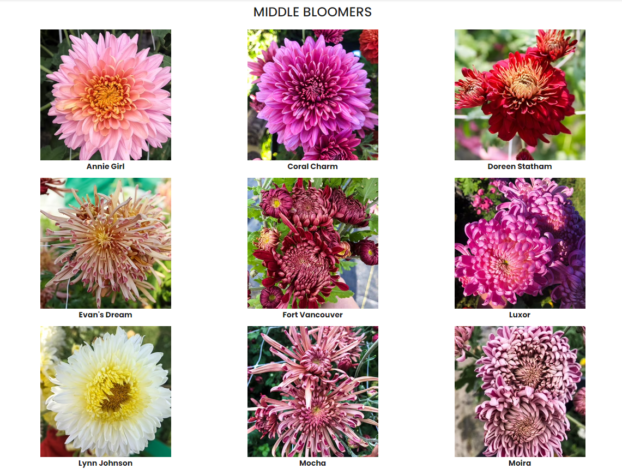
Seatons Toffee, a 'quill' form with deep bronze petals.

I have great memories of the giant yellow chrysanthemum corsage my dad bought me for a college homecoming when I was a little girl. That curly ball of petals was so unwieldy it was hard to keep from crushing it with my chin. To me, that mum didn’t even feel real – it was like something from a fantasy world of my dreams.

My relationship with mums hasn’t really changed much since then. I’ve always kept them at arm’s length, both in garden design and in floral arranging.

The only time mums registered on my radar in the past decade was the celebrated arrival of ‘Kermit’, a lime green mum with a button-like flower that gained a huge following for its zesty color and knack for looking good in a vase for up to two weeks. But what about other mums?

Lots to learn

'Yoko Ono' is a top pompom-style mum with that awesome green hue.

Any ambivalence I’ve had about mums changed for the positive after I met two leading mum experts at the Association of Specialty Cut Flower Growers annual symposium in Tulsa, Oklahoma earlier this month.

On one of the long bus rides, I sat with Ray Gray of King’s Mums, an Oregon City, Ore.-based grower of “exhibition, specialty and vintage chrysanthemum rooted cuttings.”

Ray shared a bit of the story behind how he and his wife Kim purchased King’s Mums in 2008. The Grays are longtime wholesale nursery owners who were looking for ways to diversify their crops. They learned from Janet Foss, another grower, that King’s Mums was for sale.

'Yodogimi' is a semi-double mum with dark red petals tipped in gold.

For more than 40 years, the King family operated a huge Chrysanthemum-growing operation in Central California. The business served the amateur gardener and professional grower with more than 200 cultivars of exhibition and spray mums, one of the largest sources in the U.S.

After buying the business, Ray and Kim in January 2009 moved this amazing collection to their small family farm in Oregon City. They are carrying on the tradition begun by the Kings while also implementing new technologies and growing methods.

'Two Tone Pink' has petite pink-purple petals with white tips.

Ray gave me a copy of the King’s Mum catalog and right away I started drooling over the cultivars between the covers. As a cut flower choice, the mum is superb. The palette leans toward the warm end of the color spectrum, which is very en voguewith today’s floral designers: bronze, gold, terra cotta, salmon, champagne, orange, crimson, pink-red, lime green, apricot, burgundy, and all sorts of luscious bi-colored petal combinations. And of course, there are also pastel, cream and white flowers.

'Senkyo Kenshin' is a dark bronze 'spider' form - magical!

I know this is probably all old news to people in the National Chrysanthemum Society, and to specialty cut flower growers and their floral design clients. But I found it thrilling to meet Ray and learn how he and Kim are keeping alive this important cut flower category. Yes, I started to fantasize about growing some of these blooms in my own garden.

Note to self: King’s Mums is open to the public each October. Located about 20 minutes south of Portland (Oregon City is the end of the historic Oregon Trail), you can visit during business hours and see these yummy flowers up close and personal.

A beautiful punch of color comes from mums filling the hoop house at Bear Creek Farm.

There is another reason why mums stayed on my mind at the ASCFG conference. After meeting Ray and flipping through the beautiful flowers in his catalog, I was stunned to walk into one of Vicki Stamback’s hoop houses at Bear Creek Farms to discover rows of these very mums I’d just seen in that catalog.

I have to confess, I was a bit antisocial while skipping out of the demonstration of releasing beneficial insects in the greenhouse. But I wasn’t the only one climbing between the shoulder-high rows of mums, taking photos of these really superb blooms and making sure to jot down the name of each. These flowers were impossible to ignore as you can see here.

The following day, I sat in on “The Comeback of the Mum,” a presentation by Chehalis, Wash., grower Janet Foss. I learned enough to become a confirmed mum fanatic. You can read a summary of her presentation at A Fresh Bouquet.

I’ve got to share the rest of these incredible specimens: