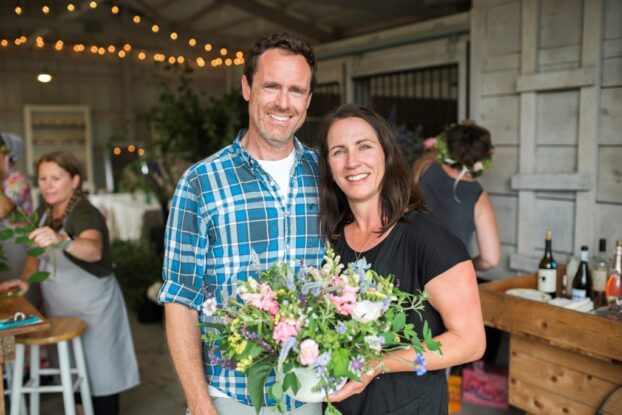
My Q&A Interview with Norman Peterkort and Sandra Peterkort Laubenthal
Peterkort Roses Greenhouse Tour
Happy 9th Anniversary to the Slow Flowers Podcast!
This week, we are celebrating our 9th anniversary of the Slow Flowers Podcast. Yes, folks, as the first-ever flower podcast and the longest-running flower podcast series, with 469 episodes, we are committed to delivering fantastic episodes to you each week — all free for your education and enlightenment.
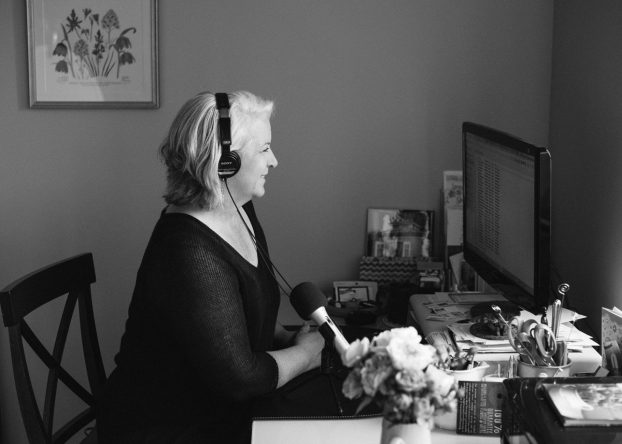
You can find me in the recording studio every week! (c) Mary Grace Long Photography
It’s truly amazing to look back on how this show has become the voice of the Slow Flowers movement since our first episode #100, broadcast on July 23, 2013. We’ve brought you inside the Slow Flowers Movement, up close and personal, with hundreds of inspiring and intimate conversations with individuals who are deeply immersed in growing specialty cut flowers and designing with them. These are advocates who care deeply about a sustainable, safe, and local supply of seasonal floral ingredients — and they share their stories with heart and passion.
One year ago, to mark the 8th anniversary, we added a video component to the Slow Flowers Podcast, so you have a chance to watch the conversations as well as listen to them — including seeing videos of flower farm tours and floral studio tours. We hope you value this content, created specifically for our Slow Flowers Community. It’s such a privilege to be your host as I share new episodes, week in and week out, can you believe it — for 9 entire years! As we enter our 10th year, this means we’ll be making a big splash by sharing more people and their flowers with you!
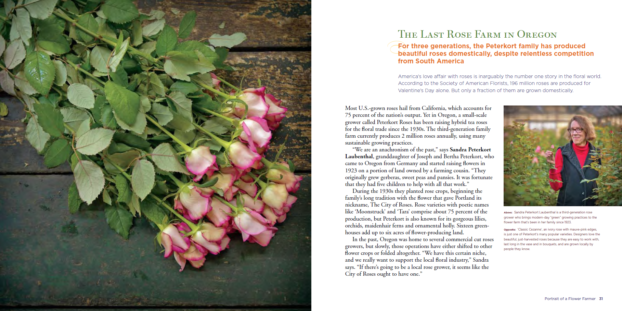
Opening spread of “The Last Rose Farm in Oregon,” from The 50 Mile Bouquet (St. Lynn’s Press, 2012)
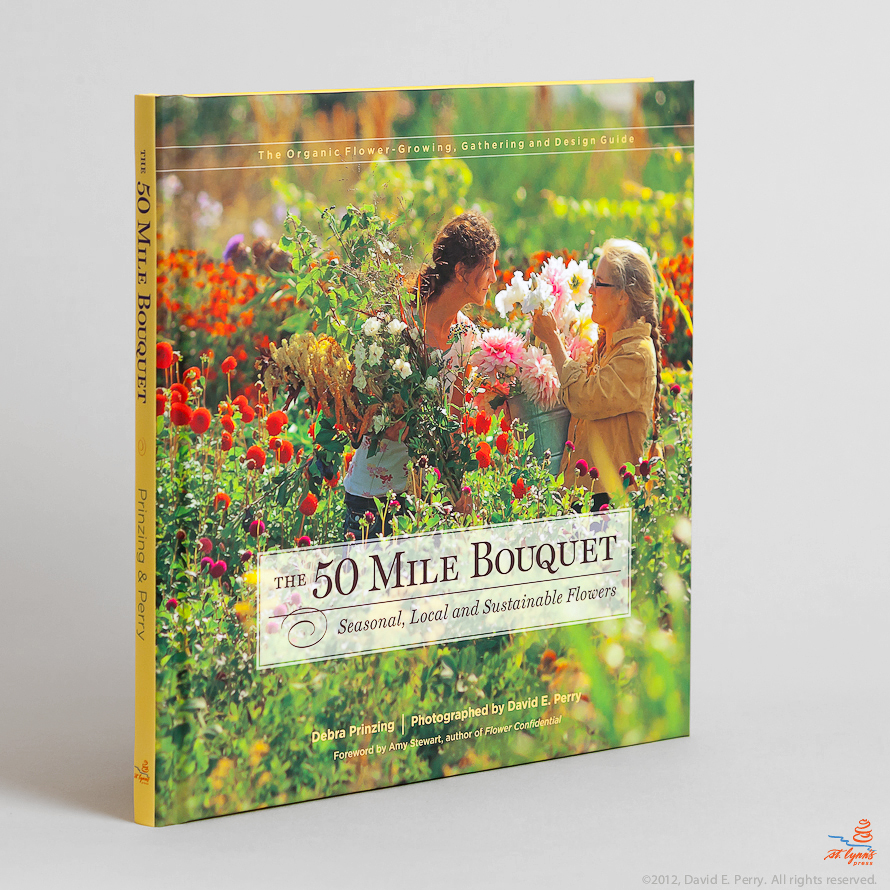
In another milestone of celebration, I’m devoting 2022 to a year-long series that revisits a book I wrote ten years ago — The 50 Mile Bouquet.
Today’s guests, siblings Norman Peterkort and Sandra Peterkort Laubenthal, are featured in the pages of this pioneering book, published by St. Lynn’s Press with photography by David Perry. The chapter about Peterkort Roses is titled “The Last Rose Farm in Oregon” and we’re bringing you both a reflection and a look ahead.
Second spread: “The Last Rose Farm in Oregon,” from The 50 Mile Bouquet (St. Lynn’s Press, 2012)
I have visited Norman and Sandra on several occasions, but this week, I made a point of traveling to their greenhouses outside of Portland, Oregon, to film our conversation. Learn what’s been happening at this unique and resilient flower farm over the past decade, and gain new insights on diversification and innovations they have implemented.
Of Note: Last week’s episode included a visit to the Seattle Wholesale Growers Market, a farmer-owned cooperative. As you heard us discuss, Peterkort Roses is not only a founding member farm of SWGMC, their family was also a founding member of the Oregon Flower Growers Association, which opened in 1942 as a farmer-owned wholesale hub. Pretty amazing history for one boutique specialty cut flower farm! Shop for Peterkort Roses at the Seattle Wholesale Growers Market. And if you’re in Portland, you can often catch Sandra and her roses in their stall at the Oregon Flower Growers Association.
Thank you to our Sponsors
This show is brought to you by Slowflowers.com, the free, online directory to more than 850 florists, shops, and studios who design with local, seasonal and sustainable flowers and to the farms that grow those blooms. It’s the conscious choice for buying and sending flowers.
Thank you to our lead sponsor, Farmgirl Flowers. Farmgirl Flowers delivers iconic burlap-wrapped bouquets and lush, abundant arrangements to customers across the U.S., supporting U.S. flower farms by purchasing more than $10 million dollars of U.S.-grown fresh and seasonal flowers and foliage annually. Discover more at farmgirlflowers.com.
Thank you to Details Flowers Software, a platform specifically designed to help florists and designers do more and earn more. With an elegant and easy-to-use system–Details is here to improve profitability, productivity, and organization for floral businesses of all shapes and sizes. Grow your bottom line through professional proposals and confident pricing with Details’ all-in-one platform. All friends of the Slow Flowers Podcast will receive a 7-day free trial of Details Flowers Software. Learn more at detailsflowers.com.
Thank you to CalFlowers, the leading floral trade association in California, providing valuable transportation and other benefits to flower growers and the entire floral supply chain in California and 48 other states. The Association is a leader in bringing fresh cut flowers to the U.S. market and in promoting the benefits of flowers to new generations of American consumers. Learn more at cafgs.org.
Thank you to Store It Cold, creators of the revolutionary CoolBot, a popular solution for flower farmers, studio florists and farmer-florists. Save $1000s when you build your own walk-in cooler with the CoolBot and an air conditioner. Don’t have time to build your own? They also have turnkey units available. Learn more at storeitcold.com.
Thanks so much for joining us today! The Slow Flowers Podcast is a member-supported endeavor, downloaded more than 870,000 times by listeners like you. Thank you for listening, commenting and sharing – it means so much. As our movement gains more supporters and more passionate participants who believe in the importance of our domestic cut flower industry, the momentum is contagious. I know you feel it, too.
If you’re new to our weekly Show and our long-running Podcast, check out all of our resources at SlowFlowersSociety.com and consider making a donation to sustain Slow Flowers’ ongoing advocacy, education and outreach activities. You can find the donate button at slowflowerspodcast.com.
I’m Debra Prinzing, host and producer of the Slow Flowers Show & Podcast. The Slow Flowers Podcast is engineered and edited by Andrew Brenlan. The content and opinions expressed here are either mine alone or those of my guests alone, independent of any podcast sponsor or other person, company or organization. Next week, you’re invited to join me in putting more Slow Flowers on the table, one stem, one vase at a time.
Today, you’re invited into the pottery studio and cutting garden of celebrated ceramic artist, Frances Palmer of Frances Palmer Pottery. We recently recorded a preview of Frances’s upcoming presentation at the Slow Flowers Summit. Our theme this year is Flowers as Artists’ Muse, and in the conversation that follows, you’ll learn why we invited Frances to the Summit.
Left (c) Frances Palmer; artist portrait (c) Marion Brenner
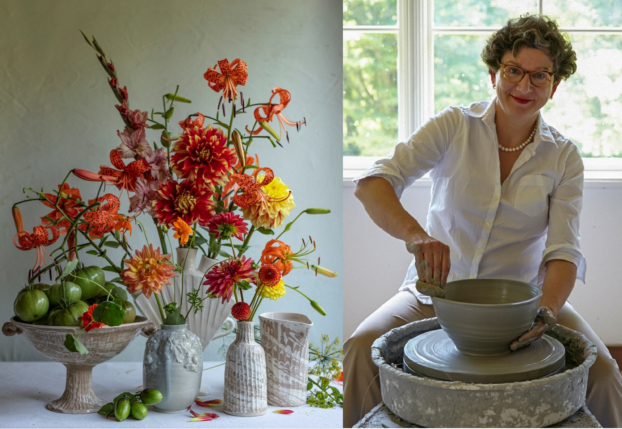
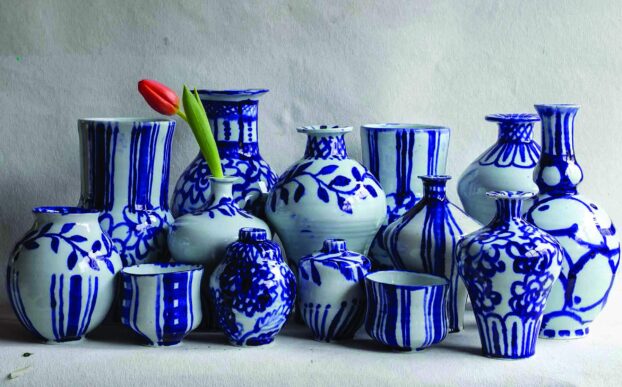
Frances Palmer is a renowned potter, gardener, photographer, cook, and beekeeper. Over the course of three decades, she has caught the attention not only of the countless people who collect and use her ceramics but also of designers and design lovers.
(c) Frances Palmer
Her pieces have been carried in dozens of stores and galleries, among them Barneys New York, Takashimaya, and the Neue Galerie. They have recently been exhibited at Object & Thing and her photographs at Wave Hill Garden in the Bronx. Frances has made special limited collections for Moda Operandi, Aerin Lauder, and MARCH in San Francisco.
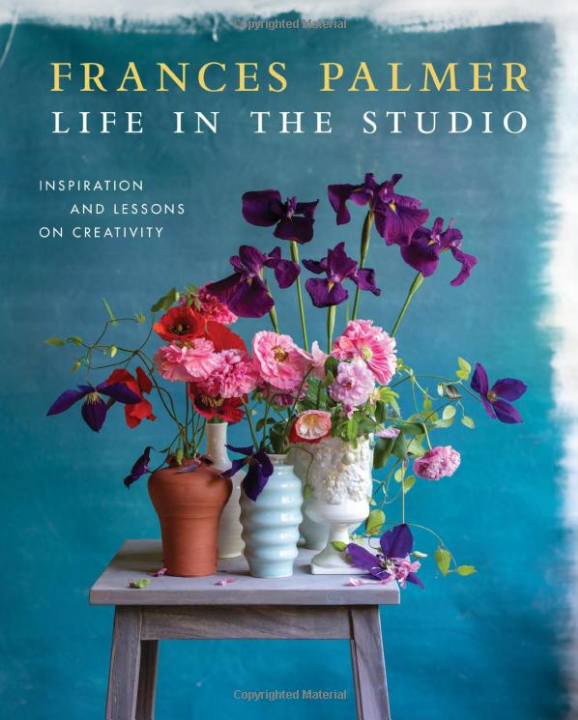
In 2020, Artisan Books published Frances’ Life In the Studio. The book is as beautiful and unexpected as Palmer’s pottery, as breathtakingly colorful as her celebrated dahlias, and as intimate as the dinners she hosts in her studio for friends and family.
If you missed joining the May Slow Flowers member meet-up, last Friday, May 13th, check out the replay video, which I’ve posted in our Episode 558 show notes at slowflowerspodcast.com. In a Designer’s Preview of the upcoming Slow Flowers Summit, we welcomed Xenia D’Ambrosi of Sweet Earth Co. and TJ McGrath of TJ McGrath Design as each shared their floral enterprises and how they stay true to their individual missions. As a bonus, both showed off seasonal and sustainable floral design, discussed their individual design processes, and shared how they connect clients, customers, and their communities with the beauty and meaning of flowers. Click the replay video above — you’ll want to check it out!
Thank you to our Sponsors!
This show is brought to you by Slowflowers.com, the free, online directory to more than 850 florists, shops, and studios who design with local, seasonal and sustainable flowers and to the farms that grow those blooms. It’s the conscious choice for buying and sending flowers.
Thank you to our lead sponsor, returning for 2022, Farmgirl Flowers. Farmgirl Flowers delivers iconic burlap-wrapped bouquets and lush, abundant arrangements to customers across the U.S., supporting U.S. flower farms by purchasing more than $10 million dollars of U.S.-grown fresh and seasonal flowers and foliage annually. Discover more at farmgirlflowers.com.
Thanks to Store It Cold, creators of the revolutionary CoolBot, a popular solution for flower farmers, studio florists and farmer-florists. Save $1000s when you build your own walk-in cooler with the CoolBot system and an air conditioner. Don’t have time to build your own? They also have turnkey units available. Learn more at storeitcold.com.
Thanks to Details Flowers Software, a platform specifically designed to help florists and designers do more and earn more. With an elegant and easy-to-use system–Details is here to improve profitability, productivity, and organization for floral businesses of all shapes and sizes. Grow your bottom line through professional proposals and confident pricing with Details’ all-in-one platform. All friends of the Slow Flowers Podcast will receive a 7-day free trial of Details Flowers Software. Learn more at detailsflowers.com.
Thanks to CalFlowers, the leading floral trade association in California, providing valuable transportation and other benefits to flower growers and the entire floral supply chain in California and 48 other states. The Association is a leader in bringing fresh cut flowers to the U.S. market and in promoting the benefits of flowers to new generations of American consumers. Learn more at cafgs.org.
Thanks so much for joining us today! The Slow Flowers Podcast is a member-supported endeavor, downloaded more than 849,000 times by listeners like you. Thank you for listening, commenting and sharing – it means so much. As our movement gains more supporters and more passionate participants who believe in the importance of our domestic cut flower industry, the momentum is contagious. I know you feel it, too.
If you’re new to our weekly Show and our long-running Podcast, check out all of our resources at SlowFlowersSociety.com and consider making a donation to sustain Slow Flowers’ ongoing advocacy, education and outreach activities. You can find the donate button in the column to the right.
Thank you for listening! Sending love, from my cutting garden to you! (c) Missy Palacol Photography
I’m Debra Prinzing, host and producer of the Slow Flowers Show & the Slow Flowers Podcast. The Slow Flowers Podcast is engineered and edited by Andrew Brenlan. The content and opinions expressed here are either mine alone or those of my guests alone, independent of any podcast sponsor or other person, company or organization. Next week, you’re invited to join me in putting more Slow Flowers on the table, one stem, one vase at a time.
Music credits: One Little Triumph; Turning on the Lights; Gaena by Blue Dot Sessions http://www.sessions.blue
The tagline for today’s episode should be “how to see nature’s palette in deeper, more meaningful ways,” because that’s the lesson Lorene Edwards Forkner wants to share with everyone.
Lorene Edwards Forkner (c) Mary Grace Long
As many of you know, Lorene is a dear friend and inspiration to me in all things horticulture. She is an author, artist, and speaker; you can read her GROW stories every week in the Sunday Seattle Times, and catch her daily on Instagram, at @gardenercook, her popular feed.
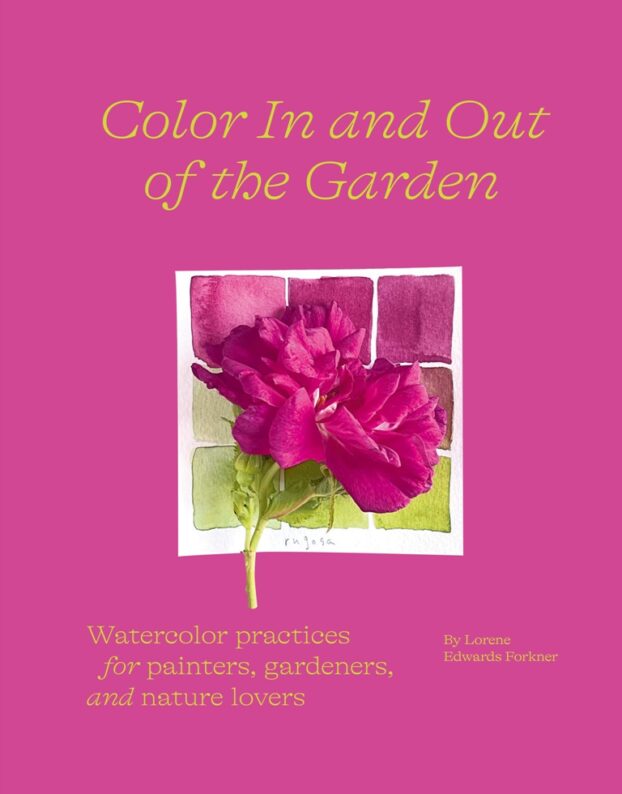
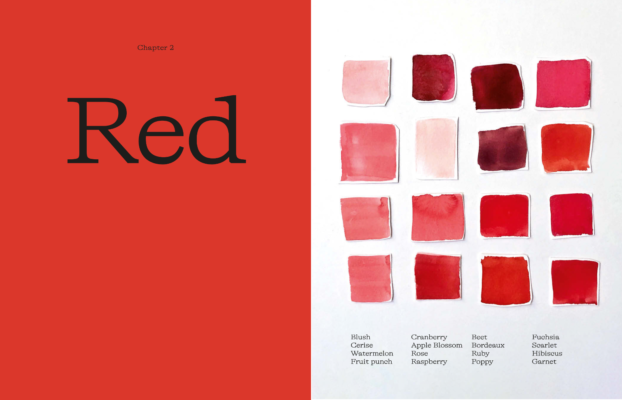
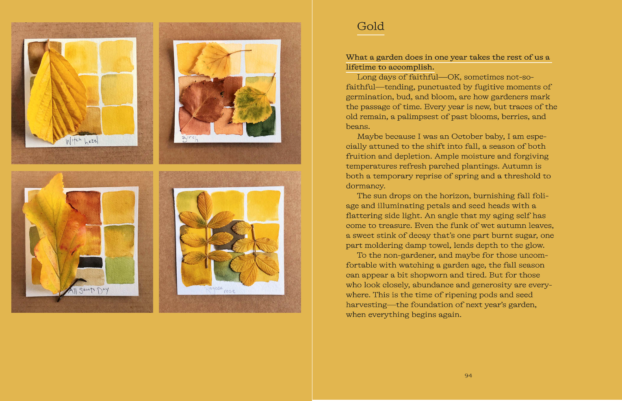
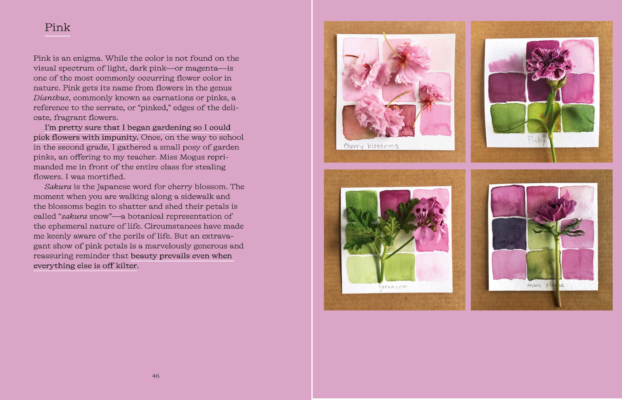
We recently recorded a tour through Lorene’s Seattle garden, which led to her studio indoors, where Lorene demonstrated the daily practice of seeing through a watercolor study of a winter pansy. This practice is also the topic of her forthcoming book, Color In and Out of the Garden: Watercolor Practices for painters, gardeners, and nature lovers.
I know you’ll enjoy our episode today. Thanks to Abrams for providing two copies of Lorene’s beautiful book for our Slow Flowers Podcast giveaway. Listen for details for how you can be entered into a random drawing to win — I’ll share them after the interview. So, let’s jump right in to meet Lorene.
Thank you so much for joining us today. To enter the book giveaway, please post a comment in our show notes below and share an observation about color in your garden — or look for this episode post on our @slowflowerssociety at Instagram. You can comment between today, April 20th and midnight PT on Sunday, April 24th. We will announce the winners the following week.
Speaking of artists and their books, check out @slowflowerssummit on IG this Friday, April 22nd, Earth Day, for a special ticket promotion for this year’s Slow Flowers Summit. It involves a special book giveaway for anyone who grabs their ticket registration during Earth Day. I hope you take advantage of this special package!
Thank you to our Sponsors
This show is brought to you by Slowflowers.com, the free, online directory to more than 880 florists, shops, and studios who design with local, seasonal and sustainable flowers and to the farms that grow those blooms. It’s the conscious choice for buying and sending flowers.
Thank you to our lead sponsor, returning for 2022, Farmgirl Flowers. Farmgirl Flowers delivers iconic burlap-wrapped bouquets and lush, abundant arrangements to customers across the U.S., supporting U.S. flower farms by purchasing more than $10 million dollars of U.S.-grown fresh and seasonal flowers and foliage annually. Discover more at farmgirlflowers.com.
Thank you to:
The Gardener’s Workshop, which offers a full curriculum of online education for flower farmers and farmer-florists. Online education is more important this year than ever, and you’ll want to check out the course offerings at thegardenersworkshop.com.
Details Flowers Software, a platform specifically designed to help florists and designers do more and earn more. With an elegant and easy-to-use system–Details is here to improve profitability, productivity, and organization for floral businesses of all shapes and sizes. Grow your bottom line through professional proposals and confident pricing with Details’ all-in-one platform. All friends of the Slow Flowers Podcast will receive a 7-day free trial of Details Flowers Software. Learn more at detailsflowers.com.
CalFlowers, the leading floral trade association in California, providing valuable transportation and other benefits to flower growers and the entire floral supply chain in California and 48 other states. The Association is a leader in bringing fresh cut flowers to the U.S. market and in promoting the benefits of flowers to new generations of American consumers. Learn more at cafgs.org.
Thanks so much for joining us today! The Slow Flowers Podcast is a member-supported endeavor, downloaded more than 839,000 times by listeners like you. Thank you for listening, commenting and sharing – it means so much. As our movement gains more supporters and more passionate participants who believe in the importance of our domestic cut flower industry, the momentum is contagious. I know you feel it, too.
If you’re new to our weekly Show and our long-running Podcast, check out all of our resources at SlowFlowersSociety.com and consider making a donation to sustain Slow Flowers’ ongoing advocacy, education and outreach activities. You can find the donate button at slowflowerspodcast.com.
Thank you for listening! Sending love, from my cutting garden to you! (c) Missy Palacol Photography
I’m Debra Prinzing, host and producer of the Slow Flowers Show & Podcast. The Slow Flowers Podcast is engineered and edited by Andrew Brenlan. The content and opinions expressed here are either mine alone or those of my guests alone, independent of any podcast sponsor or other person, company or organization. Next week, you’re invited to join me in putting more Slow Flowers on the table, one stem, one vase at a time.
Music credits: Glass Beads; Turning on the Lights; Gaena by Blue Dot Sessions http://www.sessions.blue
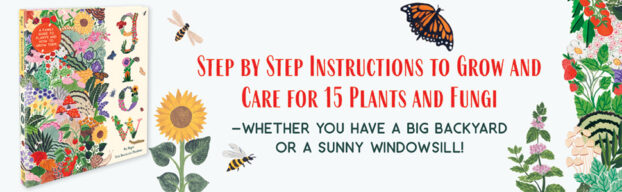
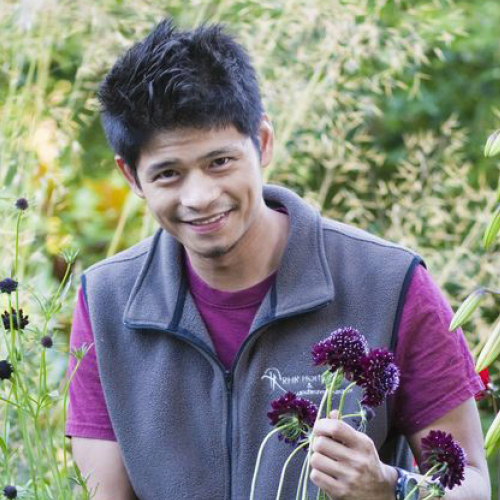
It’s Spring, so it’s garden book season, of course. Last week, you met Teresa J. Speight, author of Black Flora. Today, it’s my pleasure to introduce you to Riz Reyes of RHR Horticulture, a longtime Slow Flowers member and friend who has authored his first book for young readers and their families.
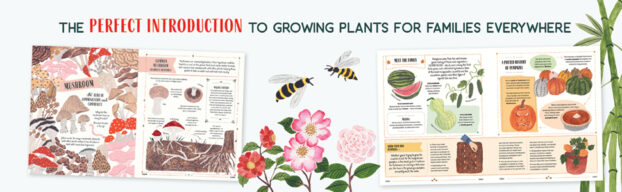
Riz profiles 15 plants, beautifully illustrated by Sara Boccaccini Meadows, and in each section, readers will meet the often surprising plant relatives (for example, the tasty tomato is a cousin of deadly nightshade!). Interesting plant stories are accompanied with step-by-step instructions to grow and care for each one, whether you have a big backyard garden or a sunny windowsill.
Here’s a little bit more about Riz:
Rizaniño Reyes is a horticulturalist, speaker, and educator. Growing up in the Philippines, Riz spent his childhood on a fruit plantation managed by his father before moving to the Pacific Northwest at age seven. Upon arrival in the United States, he learned the names of the new and strange flowers and continued to nurture his love of horticulture—“the art and science of plants”—at the University of Washington. Of his work, he says he hopes to inspire more young people, “especially people of color, to be involved with interacting with nature and learning about the environment . . . If everyone did this, can you imagine what a beautiful world this could be?”
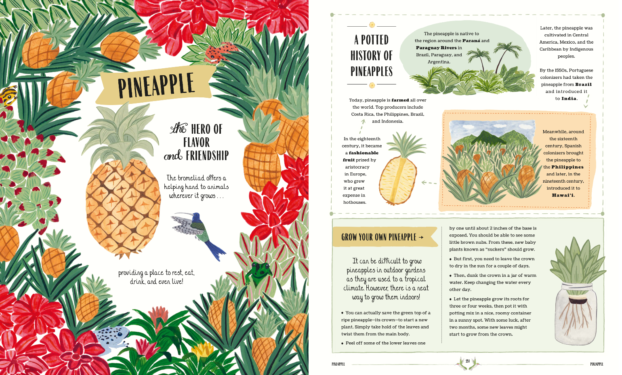
The story of the Pineapple in GROW, by Riz Reyes
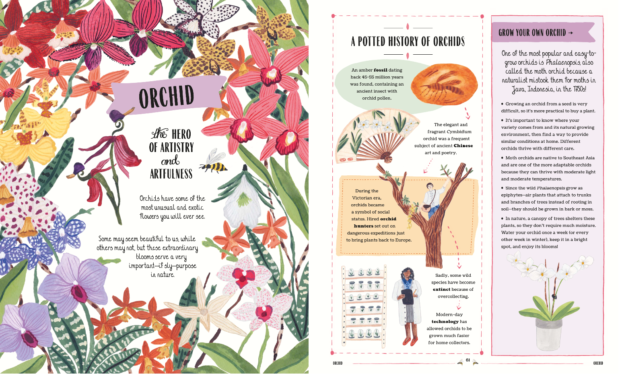
The story of Orchids in GROW
I hope you enjoy our conversation, recorded a few weeks ago inside my cozy greenhouse. I’ve edited some of the whimsical, info-packed illustrations by Sara Boccaccini Meadows throughout this video.
This show is brought to you by Slowflowers.com, the free, online directory to more than 880 florists, shops, and studios who design with local, seasonal and sustainable flowers and to the farms that grow those blooms. It’s the conscious choice for buying and sending flowers.
Thank you to our lead sponsor, returning for 2022, Farmgirl Flowers. Farmgirl Flowers delivers iconic burlap-wrapped bouquets and lush, abundant arrangements to customers across the U.S., supporting U.S. flower farms by purchasing more than $10 million dollars of U.S.-grown fresh and seasonal flowers and foliage annually. Discover more at farmgirlflowers.com.
Thank you to CalFlowers, the leading floral trade association in California, providing valuable transportation and other benefits to flower growers and the entire floral supply chain in California and 48 other states. The Association is a leader in bringing fresh cut flowers to the U.S. market and in promoting the benefits of flowers to new generations of American consumers. Learn more at cafgs.org.
Thank you to Store It Cold, creators of the revolutionary CoolBot, which you just heard Carlee mention as a new addition to her studio. Save $1000s when you build your own walk-in cooler with the CoolBot and an air conditioner. Don’t have time to build your own? They also have turnkey units available. Learn more at storeitcold.com.
Thank you to Flowerfarm.com. FlowerFarm is a leading wholesale flower distributor that sources from carefully-selected flower farms to offer high-performing fresh flowers sent directly from the farm straight to you. You can shop by flower and by country of origin at flowerfarm.com. Find flowers and foliage from California, Florida, Oregon and Washington by using the “Origin” selection tool in your search. It’s smarter sourcing. Learn more at flowerfarm.com.
Thanks so much for joining us today! The Slow Flowers Podcast is a member-supported endeavor, downloaded more than 830,000 times by listeners like you. Thank you for listening, commenting and sharing – it means so much. As our movement gains more supporters and more passionate participants who believe in the importance of our domestic cut flower industry, the momentum is contagious. I know you feel it, too.
If you’re new to our weekly Show and our long-running Podcast, check out all of our resources at Slow Flowers Society.com and consider making a donation to sustain Slow Flowers’ ongoing advocacy, education and outreach activities. You can find the donate button in the column to the right at debraprinzing.com
Thank you for listening! Sending love, from my cutting garden to you! (c) Missy Palacol Photography
I’m Debra Prinzing, host and producer of the Slow Flowers Show & Podcast. The Slow Flowers Podcast is engineered and edited by Andrew Brenlan.
The content and opinions expressed here are either mine alone or those of my guests alone, independent of any podcast sponsor or other person, company or organization. Next week, you’re invited to join me in putting more Slow Flowers on the table, one stem, one vase at a time.
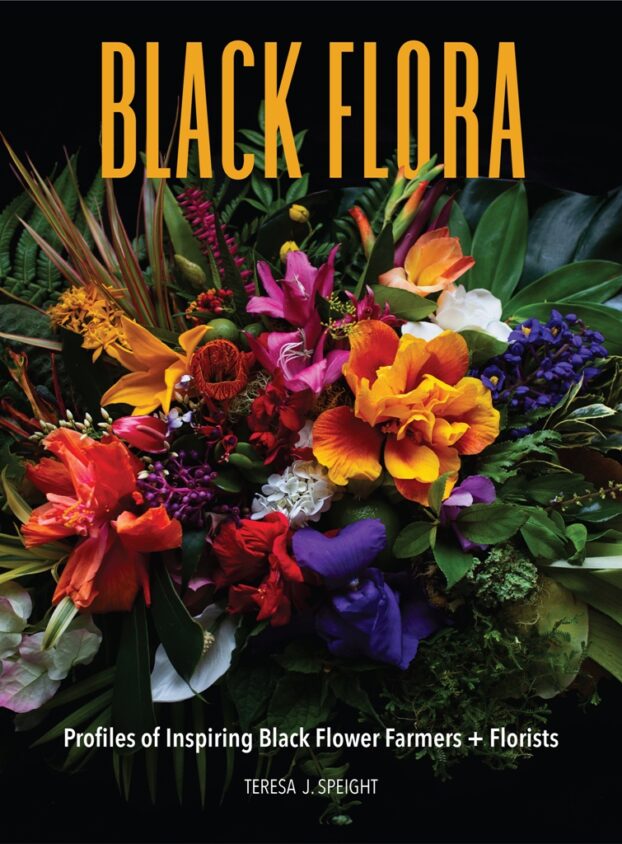
I’m so excited this week to share the video from our March Slow Flowers member meet-up featuring author Teresa J. Speight as our special guest, along with many of our Slow Flowers members who appear in the pages of the new bookBlack Flora,just released by Bloom Imprint.
Black Flora is a book that is long overdue and it showcases the excellence and contributions of Black flower farmers and floral designers throughout the country.
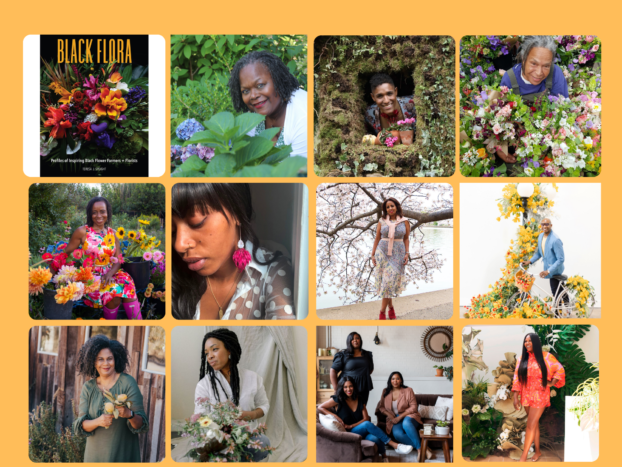
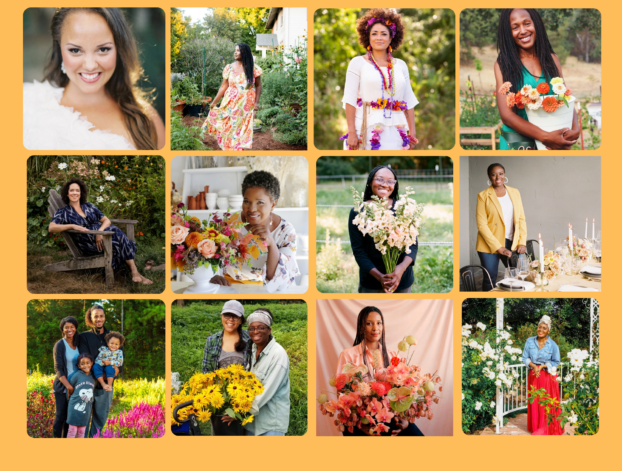
Above portraits of Black floral creatives – from the pages of Black Flora
This book recognizes the rich, beautiful, complex, and diverse narrative being told by African Americans in today’s floral marketplace. Based in the Washington, D.C., area, garden writer, podcaster and blogger Teri Speight interviewed 25 Black floral personalities to learn how they have rooted their lives in the floral world.
Black Flora’s pages are filled with more than 90 vivid photographs illustrating the talent and artistry of Black floral designers and creative directors coast to coast. There are stories and images from cutting gardens and flower farms, rural acreage to urban lots. Each profile explores family legacy and professional influences, as women and men of varied backgrounds and generations share the journey that led to careers in wedding and event design, botanical art, horticultural therapy, cut flower farming, entrepreneurship and activism.
I’m so pleased to introduce you to this project, and for you to meet Teri as we discuss and introduce many of the creatives featured in Black Flora. Order your copy of Black Flora at bloomimprint.com or find it via any online bookseller! Or, ask you independent local bookseller to order it for you!
This book recognizes the rich, beautiful, complex, and diverse narrative being told by African Americans in today’s floral marketplace. Based in the Washington, D.C., area, garden writer, podcaster and blogger Teri Speight interviewed 25 Black floral personalities to learn how they have rooted their lives in the floral world.
Black Flora’s pages are filled with more than 90 vivid photographs illustrating the talent and artistry of Black floral designers and creative directors coast to coast. There are stories and images from cutting gardens and flower farms, rural acreage to urban lots. Each profile explores family legacy and professional influences, as women and men of varied backgrounds and generations share the journey that led to careers in wedding and event design, botanical art, horticultural therapy, cut flower farming, entrepreneurship and activism.
I’m so pleased to introduce you to this project, and for you to meet Teri as we discuss and introduce many of the creatives featured in Black Flora. Order your copy of Black Flora at bloomimprint.com or find it via any online bookseller! Or, ask you independent local bookseller to order it for you!
I love what Teri wrote in her introduction to Black Flora:
“Younger generations of Black plant-lovers are seeking inspiring examples of successful floral artists and entrepreneurs. When they see their potential — through representation of people who look like them in farming and floristry — the possibilities of the future enable their dreams.”
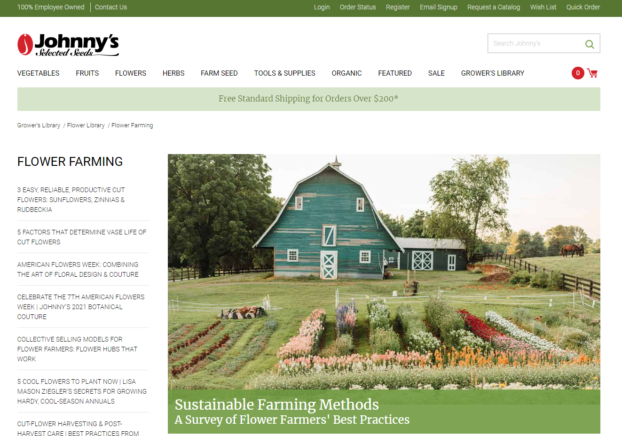
If you’re interested in learning more about sustainable flower farming practices on Slow Flowers member farms across North America, check out our recent story on the topic, published in the March issue of Johnny’s Advantage Newsletter. For the past several years, the Slow Flowers Society has surveyed our members on a wide array of topics. The insights gained have helped inform our annual Slow Flowers Floral Insights & Industry Forecast. For 2022, inspired by conversations with Johnny’s Selected Seeds’ flower experts, we asked survey-takers to share their preferred sustainable farming methods.
Curious about the specifics, I spoke with six of the respondents, who elaborated on their approaches to farming with sustainable methods. These six conversations included Stacey Chapman, of Westwind Flowers in Orange, Virginia; Becky Feasby, of Prairie Girl Flowers in Calgary, Alberta; David Brunton, of Right Field Farm in Millersville, Maryland; Susan Schultze, of Joy de Fleur Flower Farm in St. Paul, Minnesota; Jennifer McClendon, of JenniFlora Farm in Sebastopol, California; and Stacey Denton, of Flora Farm & Design Studio in Williams, Oregon. Each of these growers has a different story, with farm location, size, and scale and crop specialties varying widely. I learned so much from my conversations with each of these flower farmers, who are all very thoughtful about what they do on their land, as well as articulate about the “why” of what they practice.
This show is brought to you by Slowflowers.com, the free, online directory to more than 880 florists, shops, and studios who design with local, seasonal and sustainable flowers and to the farms that grow those blooms. It’s the conscious choice for buying and sending flowers.
Thank you to our lead sponsor, returning for 2022, Farmgirl Flowers. Farmgirl Flowers delivers iconic burlap-wrapped bouquets and lush, abundant arrangements to customers across the U.S., supporting U.S. flower farms by purchasing more than $10 million dollars of U.S.-grown fresh and seasonal flowers and foliage annually. Discover more at farmgirlflowers.com.
Thank you to Mayesh Wholesale Florist. Family-owned since 1978, Mayesh is the premier wedding and event supplier in the U.S. and we’re thrilled to partner with Mayesh to promote local and domestic flowers, which they source from farms large and small around the U.S. Learn more at mayesh.com.
Thank you to The Gardener’s Workshop, which offers a full curriculum of online education for flower farmers and farmer-florists. Online education is more important this year than ever, and you’ll want to check out the course offerings at thegardenersworkshop.com.
Thank you to Details Flowers Software, a platform specifically designed to help florists and designers do more and earn more. With an elegant and easy-to-use system–Details is here to improve profitability, productivity, and organization for floral businesses of all shapes and sizes. Grow your bottom line through professional proposals and confident pricing with Details’ all-in-one platform. All friends of the Slow Flowers Podcast will receive a 7-day free trial of Details Flowers Software. Learn more at detailsflowers.com.
Thanks so much for joining us today! The Slow Flowers Podcast is a member-supported endeavor, downloaded more than 828,000 times by listeners like you. Thank you for listening, commenting and sharing – it means so much. As our movement gains more supporters and more passionate participants who believe in the importance of our domestic cut flower industry, the momentum is contagious. I know you feel it, too.
If you’re new to our weekly Show and our long-running Podcast, check out all of our resources at Slow Flowers Society.com and consider making a donation to sustain Slow Flowers’ ongoing advocacy, education and outreach activities. You can find the donate button in the column to the right.
Thank you for listening! Sending love, from my cutting garden to you! (c) Missy Palacol Photography
I’m Debra Prinzing, host and producer of the Slow Flowers Show & Podcast. The Slow Flowers Podcast is engineered and edited by Andrew Brenlan. The content and opinions expressed here are either mine alone or those of my guests alone, independent of any podcast sponsor or other person, company or organization. Next week, you’re invited to join me in putting more Slow Flowers on the table, one stem, one vase at a time.
Music credits: Game Hens; Turning on the Lights; Gaena by Blue Dot Sessions http://www.sessions.blue
I believe that springtime brings out the creativity in all of us and even though we’re still nearly a month from the start of Spring, our thoughts are turning to another bountiful season of growing and design.
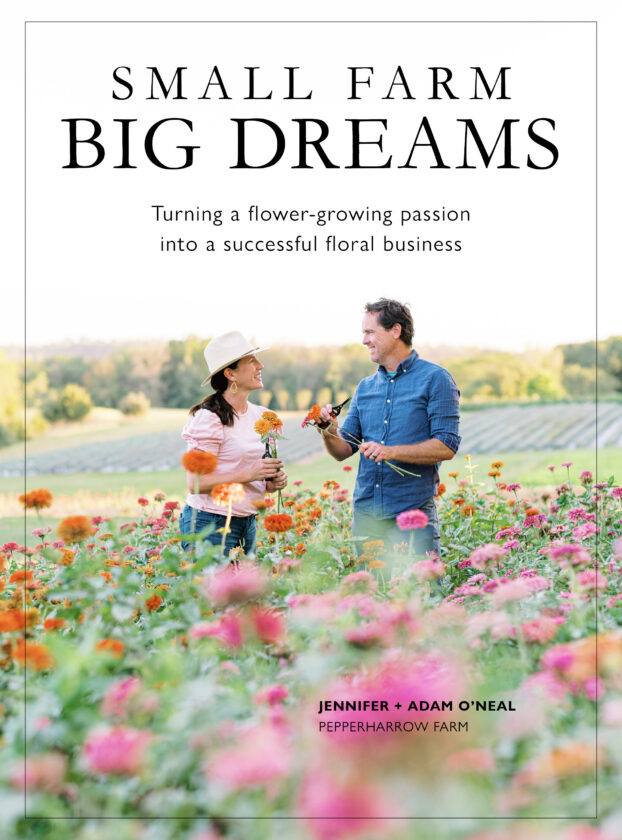
Adam and Jennifer O’Neal of PepperHarrow Farm, authors of the new book, “Small Farm, Big Dreams”
Adam and Jennifer O‘Neal, flower farmers and designers who own PepperHarrow Farm in Winterset, Iowa, were here to speak and teach at the flower show. We sat down for a conversation on the final day of the five-day event, after a whirlwind 24 hours in which they competed head-to-head in a container design competition (listen closely to learn who won the prize ribbon), lectured on the main stage on the topic: “Big Flower Dreams: Flower Farming Tips for the Backyard Cutting Garden”; and demonstrated “DIY Market Bouquets: Easy Tips From the Pros.”
Join our fun, flower-filled conversation, recorded in the lobby of the Washington Convention Center — apologies for the background noise. Meet Jennifer and Adam, or shall I say, re-meet them as they’re past guests of the Slow Flowers Podcast.
Thank you so much for joining us today. We’ve added the replay video of today’s interview at the top of t his post, which is followed by bonus video from Jenn and Adam’s DIY Market Bouquet presentation. You might learn a thing or two! And of course, you can pre-order Small Farm, Big Dreams at this link.
Find and follow PepperHarrow Farm at these social places:
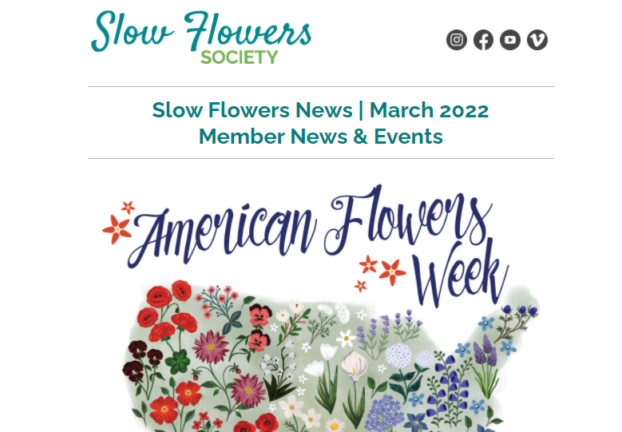
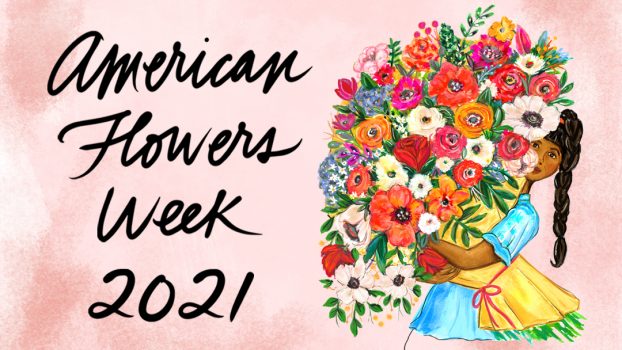
We just dropped the March 2022 Slow Flowers newsletter and if you missed it, you can find the link here. Highlights include the debut of our beautiful new 2022 American Flowers Week branding illustration and free social media badges; as well as details about our March 11, 2022 Member Meet-Up introducing the author and many of the creatives featured in the pages of Black Flora; plus a new Sustainable Sympathy Flowers survey you’ll want to complete because it will inform future content for our members. We’ve compiled all the floral news that’s important to know and I hope you find it useful.
Take our Sustainable Sympathy Flowers Survey
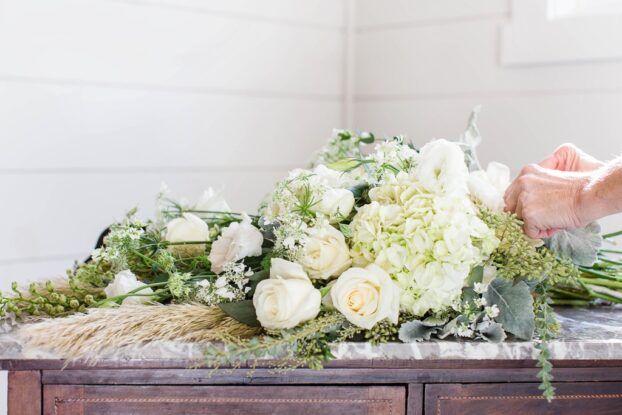
Above: Lori Poliski of Flori designed a sheaf bouquet, which she describes as a frequent choice for farewell flowers in the UK, symbolizing a sheaf of wheat. (c) Missy Palacol Photography
Two Slow Flowers Society members in the Seattle, Washington, area, Lori Poliski of Floriand Tammy Myers of First and Bloom, are taking the lead to collect your input about sustainable sympathy/funeral/celebration of life/farewell flowers in the industry.
They have prepared a short survey for Slow Flowers Members. If you participate, you are eligible for a drawing to win a gift of the Oshun pouch and a block of Agrawool by Sideau. Both mechanics are 100% compostable alternatives to floral foam.
The survey results will be shared by Lori and Tammy in a Slow Flowers Podcast episode in April 2022. THANK You in advance for sharing your insights and experiences!
This show is brought to you by Slowflowers.com, the free, online directory to more than 880 florists, shops, and studios who design with local, seasonal and sustainable flowers and to the farms that grow those blooms. It’s the conscious choice for buying and sending flowers.
Thank you to our lead sponsor, returning for 2022, Farmgirl Flowers. Farmgirl Flowers delivers iconic burlap-wrapped bouquets and lush, abundant arrangements to customers across the U.S., supporting U.S. flower farms by purchasing more than $10 million dollars of U.S.-grown fresh and seasonal flowers and foliage annually. Discover more at farmgirlflowers.com.
Thank you to Details Flowers Software, a platform specifically designed to help florists and designers do more and earn more. With an elegant and easy-to-use system–Details is here to improve profitability, productivity, and organization for floral businesses of all shapes and sizes. Grow your bottom line through professional proposals and confident pricing with Details’ all-in-one platform. All friends of the Slow Flowers Podcast will receive a 7-day free trial of Details Flowers Software. Learn more at detailsflowers.com.
Thank you to CalFlowers, the leading floral trade association in California, providing valuable transportation and other benefits to flower growers and the entire floral supply chain in California and 48 other states. The Association is a leader in bringing fresh cut flowers to the U.S. market and in promoting the benefits of flowers to new generations of American consumers. Learn more at cafgs.org.
Thank-you goes to Store It Cold, creators of the revolutionary CoolBot system. Save $1000s when you build your own walk-in cooler with the CoolBot and an air conditioner. Don’t have time to build your own? They also have turnkey units available. Learn more at storeitcold.com.
Thanks so much for joining us today! The Slow Flowers Podcast is a member-supported endeavor, downloaded more than 821,000 times by listeners like you. Thank you for listening, commenting and sharing – it means so much. As our movement gains more supporters and more passionate participants who believe in the importance of our domestic cut flower industry, the momentum is contagious. I know you feel it, too.
If you’re new to our weekly Show and our long-running Podcast, check out all of our resources at SlowFlowersSociety.com and consider making a donation to sustain Slow Flowers’ ongoing advocacy, education and outreach activities. You can find the donate button in the column to the right.
Thank you for listening! Sending love, from my cutting garden to you! (c) Missy Palacol Photography
I’m Debra Prinzing, host and producer of the Slow Flowers Show & Podcast. The Slow Flowers Podcast is engineered and edited by Andrew Brenlan. The content and opinions expressed here are either mine alone or those of my guests alone, independent of any podcast sponsor or other person, company or organization. Next week, you’re invited to join me in putting more Slow Flowers on the table, one stem, one vase at a time.
It’s that time again — our chance to review and reflect on all we achieved and experienced in the year that’s just come to a close — this time, 2021. I’m joined by two key members of the Slow Flowers Team — Karen Thornton, our operations and events manager, and Niesha Blancas, our social media manager, who helped review our highlights and wrap things up for 2021. As historians have taught us, you can’t plan for the future without knowing the past, right?!
Karen and Niesha are such valuable members of our team and I’m so grateful for their talents and commitment to the Slow Flower Mission! This year, rather than taking a chronological, month-by-month walk through 2021, we thought it would be useful to touch on each of our programs, channels and activities by topic.
Membership:
In 2021, we achieved our highest level of membership since the launch of Slowflowers.com in 2013 — 880 members in all 50 states and most Canadian provinces. What a wonderful growing community of progressive, sustainably-minded, flower people.
Our monthly Member Meet-ups were a highlight for me — beginning last January when we hosted Rachel Johnson of Simply Grounded, who led our session on Sogetsu Ikebana. The monthly meet-ups averaged 50 attendees all year long — some more, some less. Sometimes we had a number of presenters; other times we included break-out sessions. The meet-ups began in 2020 as a way to connect with each other during the early days of the COVID pandemic. None of us realized how valuable these Zoom calls would become over the ensuing months. In 2021, we averaged 50 attendees each meet-up, and the replay videos have been watched more than 1,200 times.
Continuing with Membership, one of my favorite accomplishments of the year was designing and producing the Member Marketing Toolkit, a digital 42-page booklet that answers all the questions our members might have regarding ways to participate and get the most out of your membership. And more recently, during October Member Appreciation Month, we produced a special Member Benefits Booklet with discounts and coupons from Slow Flowers Society and our sponsors.
Member Survey:
The Slow Flowers Member Survey informs our planning and forecasting for the year to come. Here are some highlights:
Annual member survey
4.6 satisfaction rating
2021
75.26% (73 people) rate the value of their Slow Flowers membership as high value or very high value
78.35% (76 people) are very satisfied or extremely satisfied with their Slow Flowers membership
82.48% (80 people) are very likely or extremely likely to renew their membership in the upcoming year
Congratulations to our Winners! Everyone who completed the Survey and shared their details was included in a special drawing for two prizes.
Complimentary Slow Flowers Premium Membership for 1 year ($249 value): April Vomfell, Flathead Farmworks
Free Slow Flowers Dinner at Blue Hill at Stone Barns – June 27, 2022 in Pocantico Hills, New York ($350 value): Jennifer Kouvant, Six Dutchess Farm
Slowflowers.com
At Slowflowers.com, our original home online, we invested in some important upgrades to the software platform. Just unveiled in December, we’re calling it Slowflowers.com 3.0. It was our goal to improve user experience for the consumer and functionality for our members. We are planning a virtual “spring cleaning” later in January to share some of the ways our members can maximize their profile and brand through Slowflowers.com 3.0, so keep an eye out for that in the coming weeks. We’ll be sure to record the tutorial for replay viewers.
American Flowers Week
American Flowers Week – June 28-July 1
12 botanical couture looks
# of downloads of the Botanical Couture Webinar: 45
local and national press generated
Plus, we celebrated Canadian Flowers week – 7 day Instagram series July 15-21, 2021
The American Flowers Week looks were featured in the digital edition of Slow Flowers Journal “Botanical Couture.” This was the debut of a digital flip book, and we’re excited to launch the quarterly magazine in 2022, with our winter edition coming later this season. Our members have contributed articles to the slowflowersjournal.com website over the past few years — a popular feature — and now we expect to get more members involved in the new project, which we’re publishing in conjunction with BLOOM Imprint (more on that later).
Slow Flowers Summit
Two years in the making, the Slow Flowers Summit was our 4th annual gathering. When I asked Karen to share her feedback, she gave it in one word: Wowzer
What a memorable and successful gathering last June at Filoli Historic House & Garden in Woodside, California.
I have to thank Niesha Blancas for going to Filoli in June 2020, during what would have been our Summit there, and taking beautiful video and photography, as well as filming a design session with Emily Saeger and my IG live interview/tour with Jim Salyards — all while masked, of course! You pulled of a social media feat in 2020 and again in 2021 when the rescheduled Summit took place!
We are especially grateful to our friends at Filoli, who were incredibly supportive in welcoming Slow Flowers and the Summit to their amazing grounds.
Social Media and Communications
Ninety-one percent of our members follow Slow Flowers Society on Instagram, while more than 45 percent follow us on Facebook.
We renamed our Instagram home: @slowflowerssociety
Followers: 39.1K
Reach: 2.4 Million
Impressions: 2.6 Million
We launched a new Instagram account: @slowflowerssummit
Reach: 18.5K
Impressions: 17K
New Video
There are so many ways that we share inspiring news and resources with you. In 2021, we invested in a short 3-minute Slow Flowers video to introduce the organization to potential members, strategic partners and supporters. The video was filmed and edited by Alayna Erhart of Alayna Erhart Studio. It features me clipping flowers in the Slow Flowers Cutting Garden, the fabulous gathering of members at Filoli Historic House & Garden at the recent 2021 Slow Flowers Summit and a visit to the UW Farm with member Riz Reyez of RHR Horticulture. Special thanks to the members who share their voices of endorsement and support, including Sarah Reyes of Wildflower & Fern, Tobey Nelson of Tobey Nelson Events and Design and Laura Gonzales of Swallows Secret Garden! Look closely – do you see yourself here in our community!? We’re ready to welcome you as a member!
Storytelling, Newsletter, Original Content
We love producing our monthly newsletter to send to you at the beginning of each month. The Slow Flowers newsletter is a popular resource for our members — in fact, in the recent survey, more than 3/4 of you tell us you usually or always read it! Our content is rich, informative and inspiring — and newsletters keep you up to date on events and PR opportunities available to members. I like to treat the newsletter as a chronicle of all we’ve achieved from month to month, and the archives are easy to find in the footer of slowflowers.com.Subscribe to the newsletter here.
Stories about our Members: Whenever I’m asked to write for another floral or farming publication, I make it a priority to feature our members and their expertise as my sources. In 2021, that meant including you in several articles for Johnny’s Seeds’ newsletter called JSS Advantage; a guest piece for Details Flowers Software; guest articles for Florists’ Review, Growing for Market and Longfield Gardens, among other outlets.
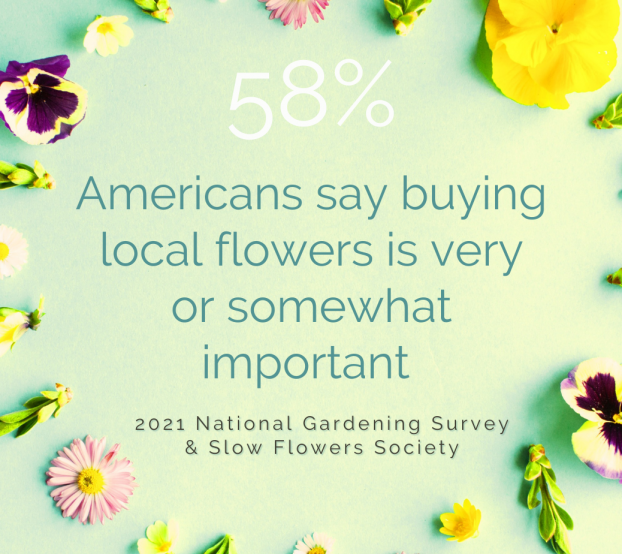
You could file these stories under Slow Flowers advocacy and outreach, and I’m especially excited about our partnership with the National Gardening Association and GardenResearch.com to include cut flower questions in the 2021 National Gardening Survey.
The findings were published in April, revealing encouraging national attitudes about local and domestic cut flowers. And in 2022, we’re joining with NGA to dig deeper into attitudes and consumer behavior — this time about where people buy their local and domestic flowers — can’t wait to share with you!
Our ongoing commitment to Justice, Equity, Diversity, and Inclusion
Ongoing support of women business owners
Updated Slow Flowers Manifesto
BIPOC and LGBTQ+ presenters and speakers at meet ups and Summit
Female BIPOC AFW artist
BIPOC botanical couture models
To proactively pursue equity, inclusion and representation in the floral marketplace, intentionally valuing Black floral professionals (farmers, floral designers and vendors) in our business practice with as much support as we give to environmental sustainability.
new Slow flowers manifesto statement (2021)
Education
In addition to our Monthly Member Meet-Up, other educational offerings include offering you free access to webinars with our partners, including Johnny’s Seeds, Bloom Imprint, AIFD and Fleurvana Floral Summit. We also taught the Slow Flowers Creative Workshop in January and helped so many aspiring writers flex their writing muscles and learn new skills.
BLOOM Imprint
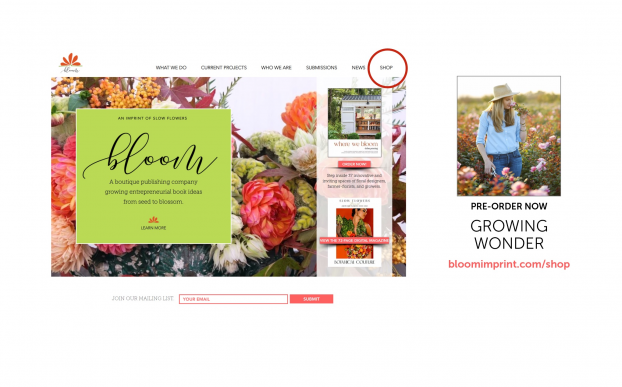
In 2021, we launched our publishing branch of Slow Flowers — BLOOM Imprint. As a boutique publisher, we are committed to producing floral lifestyle books by and about our Slow Flowers members.
Where We Bloom published (May)
Virtual book launch
Garden Design magazine webinar
Mornings with Mayesh webinar
A Life in Flowers published (Oct)
Growing Wonder & Black Flora coming up and more books to follow with Slow Flowers members like Adam and Jennifer O’Neal of PepperHarrow Farm and Cynthia Zamaria of House + Flower
Slow Flowers Podcast
Finally, we must note all of our Podcast achievements. If you watched this conversation that Niesha, Karen and I are having on Facebook Live or YouTube, you’ll realize this is one of our new initiatives for 2021 — since our 8th anniversary in late July, we have added video interviews aka Vodcasts to the mix.
This is the weekly podcast about Slow Flowers and the people who grow and design with them. It’s all about making a conscious choice and I invite you to join the conversation and the creative community as we discuss the vital topics of saving our domestic flower farms and supporting a floral industry that relies on a safe, seasonal and local supply of flowers and foliage.
This show is brought to you by Slowflowers.com, the free, online directory to more than 880 florists, shops, and studios who design with local, seasonal and sustainable flowers and to the farms that grow those blooms. It’s the conscious choice for buying and sending flowers.
Thank you to our lead sponsor, returning for 2022, Farmgirl Flowers. Farmgirl Flowers delivers iconic burlap-wrapped bouquets and lush, abundant arrangements to customers across the U.S., supporting more than 20 U.S. flower farms by purchasing more than $9 million dollars of U.S.-grown fresh and seasonal flowers and foliage annually. Discover more at farmgirlflowers.com.
Lead Sponsor: Farmgirl Flowers Major Sponsors: Longfield Gardens, Johnny’s Seeds, The Gardener’s Workshop, FlowerFarm.com, Red Twig Farm, Seattle Wholesale Growers Market, the Association of Specialty Cut Flower Growers, and Rooted Farmers Channel Sponsors: Mayesh Wholesale, CalFlowers, Roadie.com, Details Flowers Software, CoolBot and Scenic Place Peonies.
Thanks so much for joining us today! The Slow Flowers Podcast is a member-supported endeavor, downloaded more than 804,000 times by listeners like you. I value our loyal members and supporters! If you’re new to our weekly Show and our long-running Podcast, check out all of our resources at Slow Flowers Society.com and consider making a donation to sustain Slow Flowers’ ongoing advocacy, education and outreach activities. You can find the donate button in the column to the right.
Thank you for listening! Sending love, from my cutting garden to you! (c) Missy Palacol Photography
I’m Debra Prinzing, host and producer of the Slow Flowers Show & Podcast. Next week, you’re invited to join me in putting more Slow Flowers on the table, one stem, one vase at a time. The content and opinions expressed here are either mine alone or those of my guests alone, independent of any podcast sponsor or other person, company or organization.
The Slow Flowers Podcast is engineered and edited by Andrew Brenlan. You can learn more about Andrew’s work at soundbodymovement.com.
Thanks so much for joining us today and I’ll see you next week!
Music Credits:
For We Shall Know Speed; Turning on the Lights; Gaena by Blue Dot Sessions http://www.sessions.blue
Kristine Albrecht of Santa Cruz Dahlias with ‘KA’s Khaleesi’
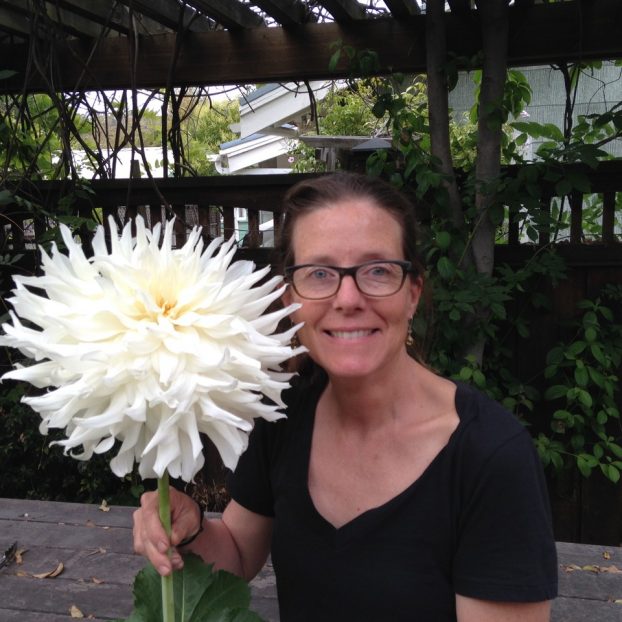
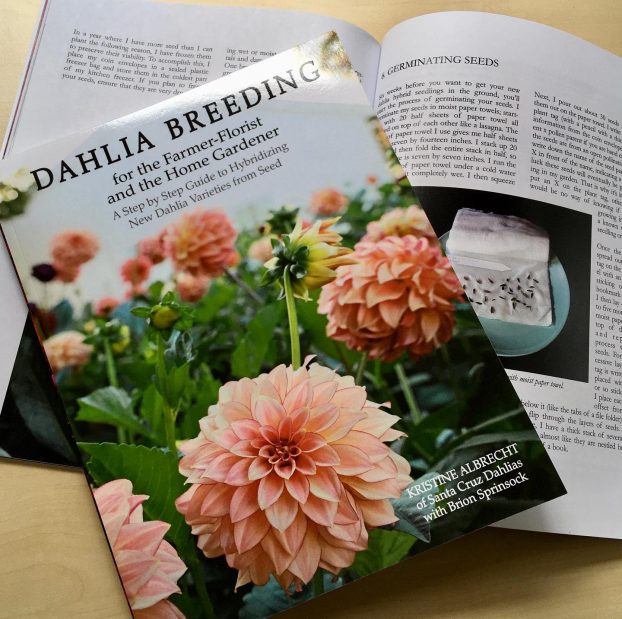
Of course you’ve heard me talk about my road trip to California in late June for the 4th Slow Flowers Summit. A few days before the Summit took place, I was treated to a morning visit at Santa Cruz Dahlias, the micro- flower farm owned by award-winning dahlia breeder Kristine Albrecht, a Slow Flowers member. I’d been wanting to learn more about Kristine’s work as a flower farmer whose curiosity about breeding has led to incredibly unique – new – named cultivars, a devoted following among cut flower farmers, and now, a new book, published in 2020: Dahlia Breeding for the Farmer-Florist and the Home Gardener, with Brion Sprinsock, Kristine’s spouse, as co-author.
I ordered my copy and asked Kristine if she would sit down with me when I was in the area late last month. She kindly invited me for a tour and I enjoyed a deeply informative lesson on her work and her passion.
In the foreword to Dahlia Breeding, Kristine writes:
“I am fortunate that I have the opportunity to talk and write to people about dahlias almost every day. While familiar with growing dahlias from tubers, many growers simply have no idea that unique varieties of dahlias can be generated from seed. The more I thought about that, the more I was inspired to write this short book and share my hybridizing knowledge.”
Jan Palia (left) and Kristine Albrecht (right) – met me in June and treated me to a beautiful morning
She continues: “I’m not a typical dahlia hybridizer who breeds mainly show dahlias. I have as much interest in breeding varieties loved by florists and designers as I do in breeding dahlias for show. I don’t have a scientific background: the advice in this book comes from practical experience at my farm. I currently grow on a quarter-acre suburban farm in the California Central Coast. I generate hundreds of dahlia blooms every week, and when they are not being cut for shows, I sell them to designers and florists. These floral designers give me wonderful feedback on what colors and forms are the most commercially viable. Their input helps me set my hybridizing goals.”
‘KA’s Cloud’
In 2014, after years of learning and experimentation, Kristine hand-crossed pollen parent Kenora Jubilee with seed parent Elma Elizabeth for a new variety called ‘KA’s Cloud’. She excitedly sent it off to the American Dahlia Society trial gardens across the U.S. and the blooms won the Derrill W. Hart and the Lynn B. Dudley medals, the two top awards in the country.
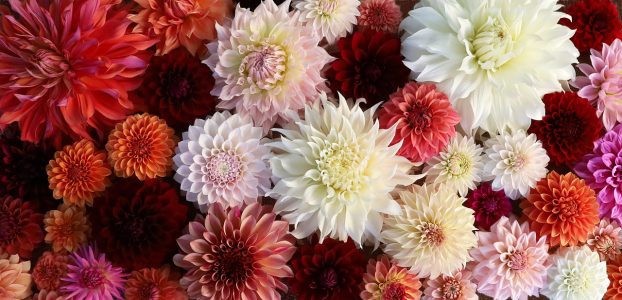
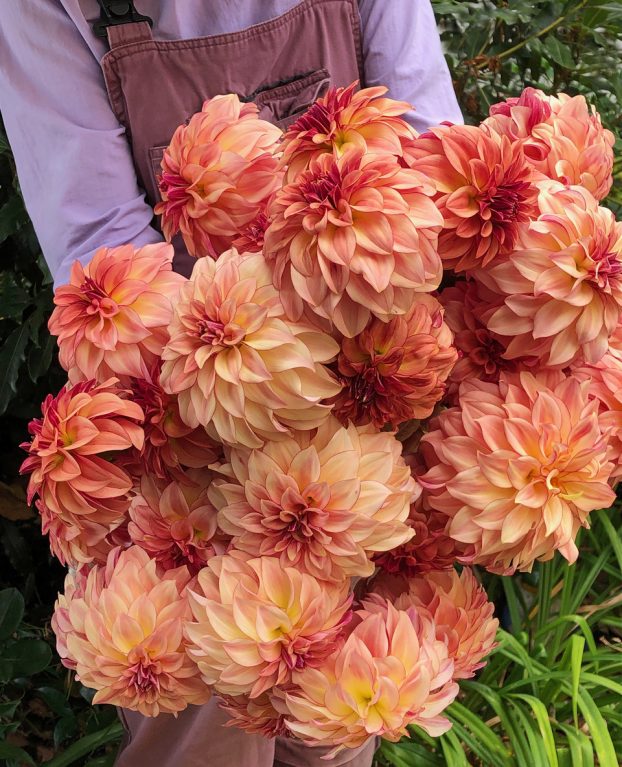
A bucket of just-harvested Santa Cruz Dahlia blooms, including dahlia companion plants (c) Debra Prinzing
Blue ribbons aside, she was hooked. And that experienced ignited what has become one woman’s amazing journey with dahlias, one she generously shares with you today. I know you’ll enjoy the rest of the story, as I introduce Kristine Albrecht in today’s episode.
‘KA’s Bella Luna’ – a delicious Kristine Albrecht introduction
‘KA’s Mocha Katie’
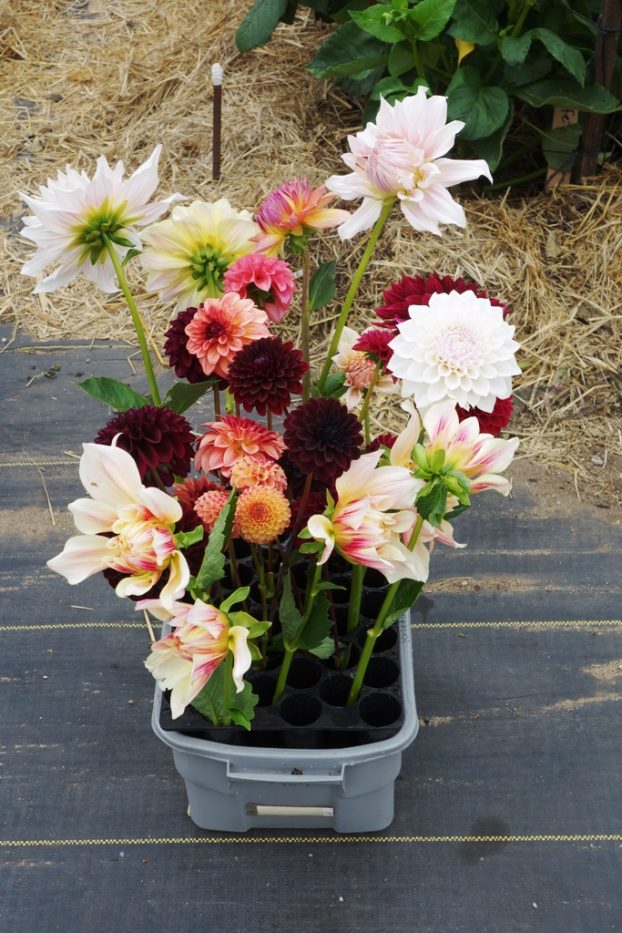
A detail shot of the storage tub that Santa Cruz Dahlias uses for deliveries and transportation
Thanks so much for joining us today as you learned more about dahlias specifically bred for floral design. Enjoy photos of my visit to Santa Cruz Dahlias and some of the gorgeous dahlia introductions that Kristine has bred!
More about the Slow Flowers Podcast
Interviewing Meg McGuire at Red Daisy Farm
This podcast is a vehicle for storytelling and for sharing the stories of our Slow Flowers Members. Several years ago, I made the conscious decision to put a priority on featuring Slow Flowers members as Podcast guests.
There may be an occasional episodes with a floral celebrity or book author, but the majority of our weekly guest slots are devoted to our members’ stories. We strive for inclusion, representation and diversity among our guests. We also mix things up when it comes to geographical location and different facets in the floral industry.
Then, put together a proposal email. Please share your name, business name and bio; a selection of 5-7 photos that illustrate you, your farm/shop/studio/enterprise; and your flowers. We use these images in our “Show Notes.”
Tell me the topics and themes you propose for the episode. What’s new, exciting, timely and relevant to our audience? What is the “takeaway” that will resonate with listeners?
Our ideal guest has a personal story to tell and is generous with information and inspiration to share with other floral professionals. We plan several months in advance, so start thinking about sharing your story! I look forward to hearing from you!
Join our NEW Video Podcast on July 21st
Today, as we wrap up the seventh consecutive year producing and hosting the Slow Flowers Podcast, I have to take a moment and reflect on the amazing community of experts, visionaries, artists, educators and pioneers in the Slow Flowers Movement who have shared their insights on this program — during 414 consecutive weekly episodes. What a privilege and honor to hear and share your voices. And beginning next week, with Episode 515, as we celebrate this show’s 8th anniversary, you will not only hear the voices of our guests, you’ll see their faces, their farms, their shops and their studios — and most of all, their flowers.
Beginning on July 21st, the Slow Flowers Podcast is launching a new live-stream video format, which you will be able to view on YouTube and Facebook Live. Each Wednesday you’ll watch a new video episode and then, on the following week, we’ll release the show’s audio through our established podcast channels, including iTunes, Spotify and at debraprinzing.com, and more.
Let’s see how it goes! Change is exhilarating, but technology isn’t always my friend, so I’m asking for your patience as we work out the new platform. My goal is to enhance your relationship with the Slow Flowers Podcast, or, as I’ve been told to call it now, a Vodcast, the video-podcast hybrid term.
Sponsor Thank You’s
This podcast is brought to you by Slowflowers.com, the free, online directory to more than 880 florists, shops, and studios who design with local, seasonal and sustainable flowers and to the farms that grow those blooms. It’s the conscious choice for buying and sending flowers.
And thank you to our lead sponsor for 2021, Farmgirl Flowers. Farmgirl Flowers delivers iconic burlap-wrapped bouquets and lush, abundant arrangements to customers across the U.S., supporting more than 20 U.S. flower farms by purchasing more than $9 million dollars of U.S.-grown fresh and seasonal flowers and foliage annually. Discover more at farmgirlflowers.com.
Seattle Wholesale Growers Market, a farmer-owned cooperative committed to providing the very best the Pacific Northwest has to offer in cut flowers, foliage and plants. The Growers Market’s mission is to foster a vibrant marketplace that sustains local flower farms and provides top-quality products and service to the local floral industry. Visit them at seattlewholesalegrowersmarket.com.
Red Twig Farms. Based in Johnstown, Ohio, Red Twig Farms is a family-owned farm specializing in peonies, daffodils, tulips and branches, a popular peony-bouquet-by-mail program and their Spread the Hope Campaign where customers purchase 10 tulip stems for essential workers and others in their community. Learn more at redtwigfarms.com.
Longfield Gardens, which provides home gardeners with high quality flower bulbs and perennials. Their online store offers plants for every region and every season, from tulips and daffodils to dahlias, caladiums and amaryllis. Check out the full catalog at Longfield Gardens at longfield-gardens.com.
Thanks so much for joining us today! The Slow Flowers Podcast has been downloaded more than 744,000 times by listeners like you. Thank you for listening, commenting and sharing – it means so much. As our movement gains more supporters and more passionate participants who believe in the importance of our domestic cut flower industry, the momentum is contagious. I know you feel it, too.
I value your support and invite you to show your thanks to support Slow Flowers’ ongoing advocacy, education and outreach activities. You can find the donate button in the column to the right at debraprinzing.com.
The content and opinions expressed here are either mine alone or those of my guests alone, independent of any podcast sponsor or other person, company or organization.
The Slow Flowers Podcast is engineered and edited by Andrew Brenlan. Learn more about his work at soundbodymovement.com.
Today’s guest is Felicia Alvarez of Menagerie Farm + Flower (c) Jill Carmel Photography
June was a super-busy and invigorating month and I have lots to share with you! I’m recording the intro to today’s episode on July 5th. Yesterday, my husband and I arrived back in Seattle after driving home from the SF Bay Area, my car filled with Slow Flowers Summit supplies; my heart filled with love for our amazing community of members, supporters, sponsors, partners — and especially the small but mighty Slow Flowers team of creatives who work with me. Oh, and my mind spinning with ideas and inspiration from last week’s Slow Flowers Summit, our fourth and best one to date.
Our fabulous Slow Flowers Summit 2021 speaker lineup included (from left): Susan McLeary, Max Gill, founder Debra Prinzing, Pilar Zuniga (with her adorable daughter, Paloma), Jennifer Jewell, Abra Lee, Molly Oliver, Kelee Matsushita-Tseng, Emily Saeger and Lorene Edwards Forkner (c) Missy Palacol photography
You’ll hear much more in the coming weeks as I share recaps and resources from the Slow Flowers Summit 2021. Suffice it to say, the timing worked out wonderfully for an all-outdoor conference as we safely gathered at Filoli Historic House & Residence in Woodside, California.
To arrive there, I departed Seattle on Wednesday, June 23rd, giving myself two days to make the drive south.
It was a good time to be alone with my thoughts, and to schedule a few stops along the way. One stop was in Live Oak, California, located halfway between Chico and Sacramento.
I was lured to Menagerie Flower + Farm, where Felicia Alvarez lives with her family in the beautiful Sacramento Valley.
The farm raises field grown garden roses, specialty flowers, French prunes, assorted stone fruits, nuts and rice.
Menagerie Farm + Flower’s beautiful roses, including (left) Scarlett & Grace’s arrangement (c) Kelly Marie Photography and (right) Felicia’s montage of just-harvested garden roses
Now, I had a very important reason to see Menagerie Farm + Flower in person! BLOOM Imprint, our book venture, is publishing Felicia’s first book this fall. We are so excited about Growing Wonder, which the book is called. You’ll hear all about this new project in our conversation — and learn how you can pre-order your own copy.
Here’s a bit more about Felicia Alvarez before we get started: On her website, she writes:
“I’ve been farming for over two decades and every day I fall in love with the simplicity & nostalgia of life on the farm. My mission is simple – to grow exceptional flowers & foods with distinctive quality. As a third generation farmer, my favorite memories as a child were tending to my grandmother’s farm garden filled with fragrant garden roses. Her love of flowers made me an avid gardener and now accidental flower farmer. Today I farm French prunes, garden roses and specialty cut flowers with the help of my husband and two little sons in tow.“
Felicia Alvarez on “Growing Wonder” (c) Jill Carmichael Photography
After more than a year of recording most of our episodes over Zoom, it was such a joy to sit at a picnic table next to Felicia’s barn and record live and in person. The ambient farm sounds only help to underscore that feeling of immediacy. I hope you enjoy this conversation, so let’s jump right in and get started!
Thanks so much for joining us today! What a lovely preview of Growing Wonder! You can pre-order your copy of Felicia’s book via a link to BLOOM Imprint – we’ll mail it to you in September after publication. In the meantime, there are a lot of resources available to you at Felicia’s website — check out links below and follow her on social media.
Sign up for Menagerie Academy, Felicia’s membership for rose lovers, gardeners and growers. There are three levels of membership, depending on your own needs and goals.
We just wrapped up American Flowers Week, our 7th annual celebration, June 28th through July 4th. For all of you who participated, THANK YOU for sharing photos of your beautiful flowers, designs, farms and special activities.
Our botanical couture collection was the most extensive ever and we’ve collected one-dozen floral fashions in our special edition digital flip book — it’s free to read (click here for link).
AND, I’m going to say it right now: If you have any inspiration to grow and design a botanical couture garment for our 2022 collection, please get in touch right away. I find that summer races along so quickly that it’s easy to miss the tiny window of time between now and first frost during which you can harvest, create and photograph a wearable floral garment for next year! I won’t let you forget the opportunity to promote your flowers and floral art through this high-visibility member opportunity. Learn more at americanflowersweek.com.
Thank you to our Sponsors
This podcast is brought to you by Slowflowers.com, the free, online directory to more than 880 florists, shops, and studios who design with local, seasonal and sustainable flowers and to the farms that grow those blooms. It’s the conscious choice for buying and sending flowers.
And thank you to our lead sponsor for 2021, Farmgirl Flowers. Farmgirl Flowers delivers iconic burlap-wrapped bouquets and lush, abundant arrangements to customers across the U.S., supporting more than 20 U.S. flower farms by purchasing more than $9 million dollars of U.S.-grown fresh and seasonal flowers and foliage annually. Discover more atfarmgirlflowers.com.
For each Podcast episode this year, we thank three of our Podcast Sponsors.
Today, we welcome Roadie.com as a new Podcast and Newsletter sponsor for 2021. Roadie is a same-day delivery platform that connects you and your flower deliveries with drivers already heading in the right direction. Roadie can handle the delivery of your fragile flowers and plants, so you can get back to creating masterpieces or helping them grow. Check out the link in today’s show notes for more details or visit https://www.roadie.com/small-business/florists-nursery
Flowerfarm.com, a leading wholesale flower distributor that sources from carefully-selected flower farms to offer high-performing fresh flowers sent directly from the farm straight to you. You can shop by flower and by country of origin at flowerfarm.com. Find flowers and foliage from California, Florida, Oregon and Washington by using the “Origin” selection tool in your search. It’s smarter sourcing. Learn more at flowerfarm.com.
Association of Specialty Cut Flower Growers. Formed in 1988, ASCFG was created to educate, unite, and support commercial cut flower growers. It mission is to help growers produce high-quality floral material, and to foster and promote the local availability of that product. Learn more at ascfg.org.
Thanks so much for joining us today! The Slow Flowers Podcast has been downloaded more than 742,000 times by listeners like you. Thank you for listening, commenting and sharing – it means so much. As our movement gains more supporters and more passionate participants who believe in the importance of our domestic cut flower industry, the momentum is contagious. I know you feel it, too.
I value your support and invite you to show your thanks to support Slow Flowers’ ongoing advocacy, education and outreach activities. You can find the donate button in the column to the right at debraprinzing.com
The content and opinions expressed here are either mine alone or those of my guests alone, independent of any podcast sponsor or other person, company or organization.
The Slow Flowers Podcast is engineered and edited by Andrew Brenlan. Learn more about his work at soundbodymovement.com.
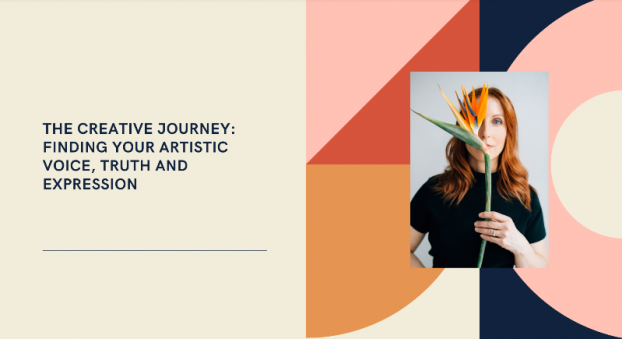
In March 2017, I wrote a 10-page profile of Susan Mcleary for Florists’ Review magazine’s “Creativity” issue. It’s this article that inspired me to invite Sue to be our Keynote speaker at the upcoming Slow Flowers Summit, taking place next week on June 28-30th in the San Francisco Bay Area at the amazing venue, Filoli Historic House & Garden. Sue’s personal story of seeking, claiming and boldly nurturing her creative process and practice as an artist will inspire and embolden everyone who hears her at the Summit.
Susan McLeary — such an artist and inspiration!
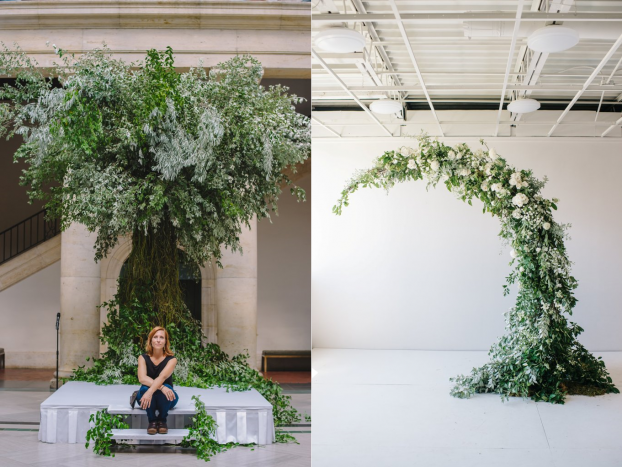
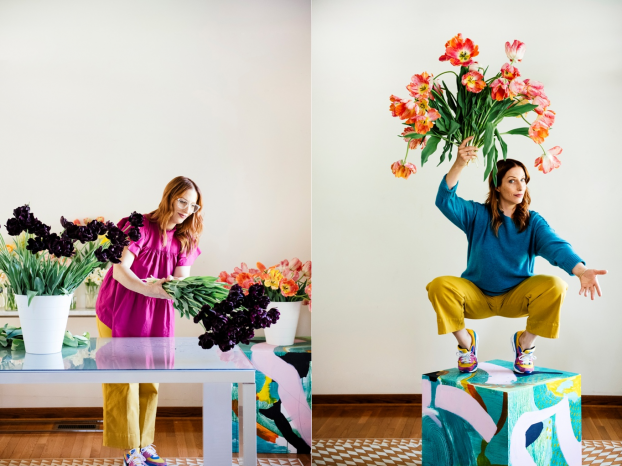
Susan is a floral designer, artist and instructor who creates unusual, boundary-pushing floral art including elaborate floral wearables, large-scale installations, and her signature succulent jewelry. Her soulful, seasonally-inspired creations have been described as exquisite living artwork. A passionate teacher, Susan offers private design instruction for new and professional florists in her studio, on her online class platform, and through destination workshops.
Floral artist Susan Mcleary is a design influencer who advocates for foam-free practices in her large-scale botanical installations (c) Amanda Dumouchelle
Susan’s work has been featured on the cover of Fusion Flowers Magazine twice, and in leading industry publications and websites including Martha Stewart Weddings, Florist’s Review, My Modern Met, Refinery 29, SELF, Buzzfeed, Belle Armoire, Cosmopolitan, Ebony, and Grace Ormond Wedding Style. Susan is a member of Slow Flowers Society and Chapel Designers. Her first book, The Art of Wearable Flowerswas released March 3, 2020.
A few weeks ago, in anticipation of Sue’s keynote presentation The Creative Journey, she and I met up over Zoom to record this special episode. I hope you enjoy it as much as I have. As I mention in the interview, Sue has appeared as a co-guest on two past episodes of the Slow Flowers Podcast, but that was many years ago.
Here are the many ways to study with Sue McLeary: Online Courses (a la carte) The Essentials Toolkit (bundle) The Virtual Studio (membership-based), includes Live Sessions and new courses. Total of 60 courses in the library to date
Susan McLeary (c) e.e. berger
As Sue mentioned, she launched a new course yesterday, June 22nd, called The Floral Mentor: A transformative floral learning opportunity.
Transform the 3 Key Areas of Your Floral Business in the Next 30 Days:
The Heart – Cultivate your unique creative voice, overcome limiting beliefs, and cultivate a more purpose-driven floral business.
The Art – Unlock the magic of the principles of design to create more advanced, artful and balanced work every time.
The Business – Learn practical business, branding, and marketing skills to grow a more profitable and life-giving floral business.
The Floral Mentor opened on June 22nd and is available for signup through June 30th. In this course, Sue and her cohort of friends and colleagues help youmaster the art, the heart, and the business of floral design. It’s all about aligning your core values with your business, Sue explains. She writes: “Pull up a virtual chair in my personal studio to learn from me and some of my key mentors!” Sue introduces students her wonderful mentors who teach valuable lessons Sue has learned from each of them. Together, Sue and her mentors will help you create the art you’re truly capable of, build a fulfilling business you love, and join hands to move the floral industry forward together. I can get behind those aspirations! Maybe this course has your name on it, too. check it out!
Next week is also our 7th annual American Flowers Week, June 28th through July 4th. Please help us celebrate! You can find all the free social media badges, logos, branding and other resources like a coloring map of all 50 USA-state flowers at americanflowersweek.com! Show your floral patriotism and post photos of your red, white and blue, or any other color of your seasonal and local floral harvest! Be sure to use the hashtag #americanflowersweek when you post! I’ll be doing just the same, friends.
Thank you to our Sponsors
This podcast is brought to you by Slowflowers.com, the free, online directory to more than 880 florists, shops, and studios who design with local, seasonal and sustainable flowers and to the farms that grow those blooms. It’s the conscious choice for buying and sending flowers.
And thank you to our lead sponsor for 2021, Farmgirl Flowers. Farmgirl Flowers delivers iconic burlap-wrapped bouquets and lush, abundant arrangements to customers across the U.S., supporting more than 20 U.S. flower farms by purchasing more than $9 million dollars of U.S.-grown fresh and seasonal flowers and foliage annually, and providing competitive salaries and benefits to team members based in Watsonville, California and Miami, Florida. Discover more at farmgirlflowers.com.
For each Podcast episode this year, we thank three of our Major Sponsors.
Longfield Gardens, which provides home gardeners with high quality flower bulbs and perennials. Their online store offers plants for every region and every season, from tulips and daffodils to dahlias, caladiums and amaryllis. Check out the full catalog at Longfield Gardens at longfield-gardens.com.
Red Twig Farms. Based in Johnstown, Ohio, Red Twig Farms is a family-owned farm that specializes in peonies, daffodils, tulips and branches, a popular peony-bouquet-by-mail program and their Spread the Hope Campaign where customers purchase 10 tulip stems for essential workers and others in their community. Learn more at redtwigfarms.com.
Seattle Wholesale Growers Market, a farmer-owned cooperative committed to providing the very best the Pacific Northwest has to offer in cut flowers, foliage and plants. The Growers Market’s mission is to foster a vibrant marketplace that sustains local flower farms and provides top-quality products and service to the local floral industry. Visit them at seattlewholesalegrowersmarket.com.
Thanks so much for joining us today! The Slow Flowers Podcast has been downloaded more than 738,000 times by listeners like you. Thank you for listening, commenting and sharing – it means so much. As our movement gains more supporters and more passionate participants who believe in the importance of our domestic cut flower industry, the momentum is contagious. I know you feel it, too.
I value your support and invite you to show your thanks to support Slow Flowers’ ongoing advocacy, education and outreach activities. You can find the donate button in the column to the right at debraprinzing.com
The content and opinions expressed here are either mine alone or those of my guests alone, independent of any podcast sponsor or other person, company or organization.
The Slow Flowers Podcast is engineered and edited by Andrew Brenlan. Learn more about his work at soundbodymovement.com.


 In another milestone of celebration, I’m devoting 2022 to a year-long series that revisits a book I wrote ten years ago — The 50 Mile Bouquet.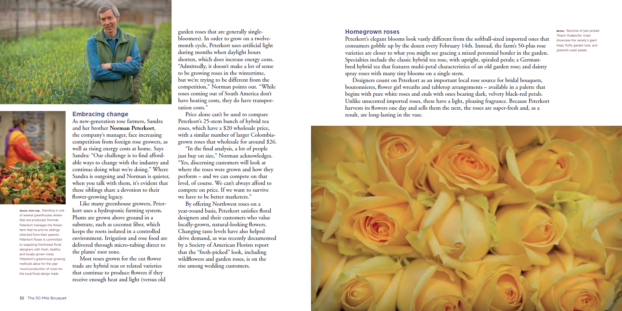
 Her pieces have been carried in dozens of stores and galleries, among them Barneys New York, Takashimaya, and the Neue Galerie. They have recently been exhibited at Object & Thing and her photographs at Wave Hill Garden in the Bronx. Frances has made special limited collections for Moda Operandi, Aerin Lauder, and MARCH in San Francisco.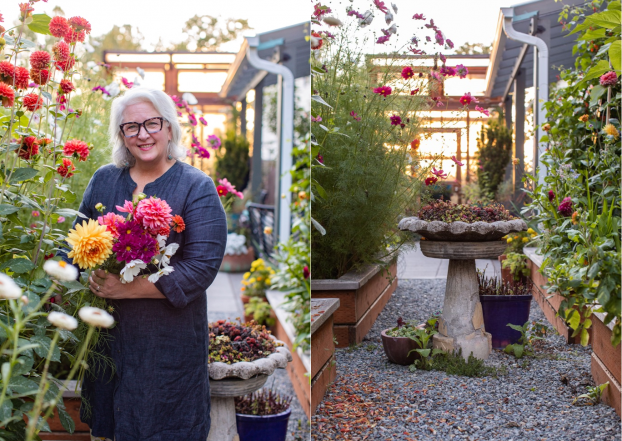
 Rizaniño Reyes is a horticulturalist, speaker, and educator. Growing up in the Philippines, Riz spent his childhood on a fruit plantation managed by his father before moving to the Pacific Northwest at age seven. Upon arrival in the United States, he learned the names of the new and strange flowers and continued to nurture his love of horticulture—“the art and science of plants”—at the University of Washington. Of his work, he says he hopes to inspire more young people, “especially people of color, to be involved with interacting with nature and learning about the environment . . . If everyone did this, can you imagine what a beautiful world this could be?”